A Sri Lankan minister has said the ongoing shutdown of the Norochcholai power plant is costing the government Rs. 600 million a day, as controversy continued in the Ceylon Electricity Board (CEB).
Science, Technology and Atomic Energy Minister Patali Champika Ranawaka stated that with the trouble-ridden power plant being run by the CEB, the daily losses were mounting. The minister went on to blame the CEB officials, labelling the “thieves” and part of the “power mafia”, according to the Island.
Ranawaka's comments come as Ceylon Electricity Board (CEB) General Manager Shavindranth Fernando found himself criticised for announcing an upcoming Memorandum of Understanding (MoU) on the Norochcholai power plant with China, without consultation from the Sri Lankan government.
Responding to a global drop in rubber prices, the Sri Lankan government is looking to control the price of rubber by introducing a certified price, said Plantation Industries Minister Mahinda Samarasinghe.
A joint proposal by the Ministry of Plantation Industries, the Ministry of Finance and Planning, Ministry of Economic Development and the Treasury would see the government enforce a set prices for rubber, said the minister.
See more from ColomboPage here and the Island here.
The announcement comes as the government raided over 400 rice vendors who sold rice at higher than government set prices.
Sri Lanka's ambassador to the United States, Prasad Kariyawasam, criticised an editorial published by the New York Times last month on Sri Lanka's refusal to allow in UN investigators, as "insensitive" and "unjust".
The editorial, 'Sri Lanka's Intransigence' published August 22, argued that the country's intransigence "puts Sri Lanka in the company of North Korea and Syria, two countries that also barred access to United Nations human rights investigators."
In a letter to the editor, published by the NYT on September 2, Kariyawasam said the editorial "makes insensitive assertions about my country."
"To compare Sri Lanka to human rights and humanitarian emergencies elsewhere in the world is unjust," he added, before reiterating Sri Lanka's refusal to engage with the UN inquiry.
Six first-year undergraduates of the Sabaragamuwa University were detained and interrogated by the Terrorism Investigation Department (TID) on Tuesday, becoming the third set of students arrested at the southern university.
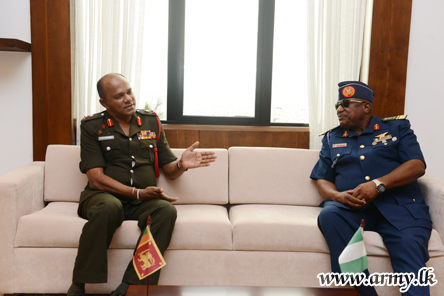
A delegation from the Nigerian Armed Forces Resettlement Centre (NAFRC) arrived in Sri Lanka on Tuesday to explore the country’s welfare system for its military.
The 11-member delegation, headed by Air Vice Marshal M.R Morgan of the Nigerian Air Force met with the Sri Lankan army chief Lt Gen Daya Ratnayake and discussed how the army’s welfare model is employed for the soldiers’ benefit, reported the army website.
The ‘cantonment system’ introduced by the Sri Lankan Army in the Tamil-speaking Northeast of the island has prompted fears amongst the Tamil population about Sinhala settlements, the leader of the Eelam Peoples’ Revolutionary Liberation Front said on Tuesday, The Hindu reported.
A former Sri Lankan soldier, who attempted to self-immolate, outside the US Embassy in Colombo, in protest against the High Commissioner for Human Rights, Navi Pillay, died of his injuries on Wednesday.
The former soldier had said that he was Navi Pillay’s actions against Sri Lanka, reports Colombo Gazette.
A Sri Lankan court has lifted the ban on the deportation of asylum seekers from Pakistan, after Sri Lanka's Deputy Solicitor General warned the refugees were a threat to national security and were at risk of bringing malaria into the island.
Sri Lanka had temporarily halted the deportations, after a petitioner told the court they had fled persecution from Pakistani authorities, who were abusing Christians and Shia Muslims in the Ahamandi region.
However, Sri Lanka's Deputy Solicitor General Janaka de Silva successfully argued in the Colombo-based court, that the asylum seekers were not only committing crimes on their arrival to the island, but were also at risk of spreading malaria to the population.
Sri Lanka hopes that the new UN High Commissioner for human rights, Prince Zeid of Jordan, would be "more balanced" than Navi Pillay, the government spokesperson, Keheliya Rambukwella, said.
Detention facilities in Thailand for refugees are "no place for children", said the New York based rights organisation, Human Rights Watch, in a report - 'Two Years with No Moon' - published Monday.
Condemning Thailand's arbitrary detention of thousands of children in overcrowded and dangerous conditions as "brutal", HRW called on Thailand to "immediately cease detention of children for reasons of their immigration status".
The facilities, which predominantly house Rohingya asylum seekers, also include over 2000 refugees who have fled non-neighbouring countries, including Sri Lanka.
"Thailand’s use of immigration detention violates children’s rights, immediately risks their health and wellbeing, and imperils their development. Wretched conditions place children in filthy, overcrowded cells without adequate nutrition, education, or exercise space. Prolonged detention deprives children of the capacity to mentally and physically grow and thrive," HRW said.