The BJP leader, Ananth Kumar, said that Tamils in Sri Lanka should be given 'special protection' and have their 'safety assured', reports PTI.
Calling on the Sri Lankan government to produce a model where 'Tamils will have a major say in the socio-political and economic development of the island-nation', Kumar said,
Sri Lankan army soldiers embarked on their latest venture into the civilian life of Tamils in the North-East, with a milk programme.
The 51st Division of Kopay, have gave Tamil children in four Jaffna schools a cup of free milk on July 16th.
The four schools were: St James Maha Vidhyalaya, St. Roches Roman Catholic Vidyalaya, Seevari primary school and Thordarmalee school.
The Sri Lankan army's 'Civil Military Coordination' in Jaffna, proudly states, "The company sponsored the project not as a promotion to its product but as compliance to the request of the Army."
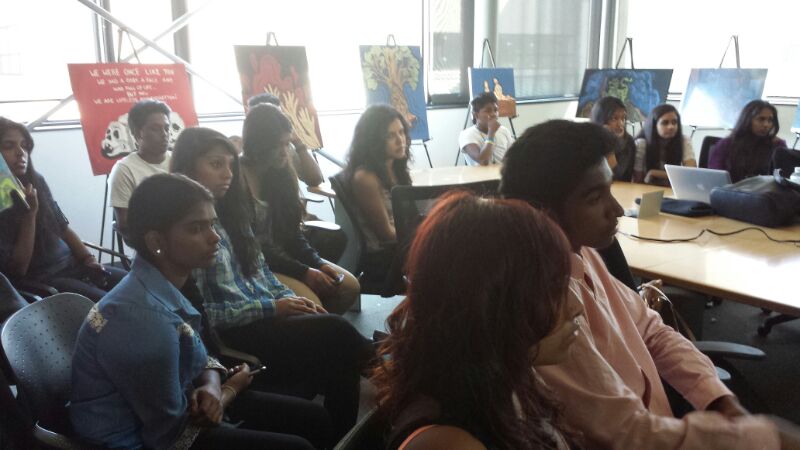
Tamil youths have led commemorations of the Black July pogroms against Tamils in 1983, with events held in Toronto and London to mark the 30th anniversary.
Marking the 30 year anniversary of the Black July anti-Tamil pogrom, the Tamil National People's Front (TNPF), said that it "was not an 'anti-Tamil riot' but the most naked act of Genocide committed by the Sri Lankan state against the Tamil nation", intended "not merely to cause death to the Tamils, it was also designed to ethnically cleanse Tamils from the Sinhala homeland and at the same time structurally undermine the sel
In a statement in Sri Lanka's parliament, highlighting the 30th year anniversary of Black July, the TNA MP M.A. Sumanthiran, spoke of his own experiences during Black July when he was shipped to the North for his safety by the state, asserting that it was the actions of successive governments that had confirmed the North and the East as the homeland of the Tamils.
"We ourselves took shelter in a Muslim house nearby, who gave us shelter, and subsequently, Sinhalese friends, kept us in their house for four days and we were put in a ship and transported to Jaffna.
That was the second such incident in my life. The first being, in the year '77, when there was violence unleashed against Tamils in Colombo. Then too, I was transported that time by air, from Ratmalana airport to Palali, by the government of Sri Lanka.
So twice in my student days I was taken away from the capital city, once by air and once by ship, totally at the cost of the government of Sri Lanka, to the North. The government being unable to protect me, in its own capital, thought that I'd be safe in my home, and sent me to my homeland.
The Sri Lankan government granted interest free housing loans, worth Rs. 300,000 each, to members of its armed forces.
In a special ceremony to take place on Saturday, the Chairperson of the Ministry of Defence Seva Vanitha Unit, Ioma Rajapaksa, granted loans to 47 members of the army, navy, air force and police force.
'Arappor', a documentary on the mass protests that swept across Tamil Nadu earlier this year, is set to be released in Chennai on Sunday the 28th of July.
Tamil Guardian will be tweeting live from the event. You can follow all the action live from our Twitter account here.
This week marks the 30th anniversary of the anti-Tamil pogrom on the island of Sri Lanka, remembered as 'Black July'. The attacks saw Sinhala mobs roaming streets across the country, killing, burning, looting and raping their way through Tamil neighbourhoods. Tamils were singled out for attack purely on their ethnic identity - their facial appearance, their fledgling Sinhalese, their cultural symbols, and their names on electoral rolls. The pogrom was brutal - an inevitable outcome of decades of rising Sinhala nationalism and anti-Tamil sentiment. Black July was not a reactionary act of rioting. It was the persecution of one ethnicity by another, with the full endorsement of the state - an act of genocide.
The Sri Lankan president, Mahinda Rajapaksa, has asked his secretary, Lalith Weeratunga, to appoint a commission to look into disappearances that have taken place over the 30 years of armed conflict, announced the President's media unit.
According to the President's spokesperson, Mohan Samaranayake, the terms of reference and members of the commission are yet to be appointed.
The High Commissioner of Pakistan in Sri Lanka, Qasim Qureshi, visited different provinces to explore opportunities to develop economic, cultural and people to people links, whilst understanding the ground situation,reported
On the 25th July 1983 Sellarasa “Kuttimani” Yogachandiran, leader of the Tamil Eelam Liberation Organisation (TELO) and Ganeshanathan Jeganathan, a political writer, had their eyes gouged out in mockery before being killed by Sinhalese inmates at the high security Welikada prison in Colombo. A total of 37 Tamil prisoners were murdered the same day, and 18 more were killed two days later.
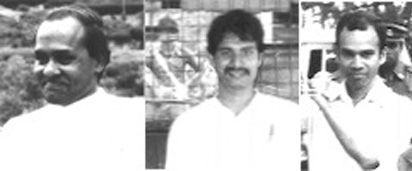
Tamil political prisoners: Dr S Rajasunderam, Selvarajah Yogandram and Nadarajah Thangathurai
5th August 1983 – The Guardian, UK
'It is the massacres in the Welikade gaol which are attracting the most attention. There is a particular interest in circumstances in which two alleged guerrilla leaders were killed. The two men, Sellarasa “Kuttimani” Yogachandiran, leader of the Tamil Eelam Liberation Organization (TELO) and a political writer, and Ganeshanathan Jeganathan had been sentenced to death last year for the murder of a policeman. In speeches from the dock, the two men had announced that they would donate their eyes in the hope that they would be grafted on to Tamils who would see the birth of Eelam, the independent state they were fighting for. Second hand reports from Batticaloa gaol, where the survivors of the Welikada massacre are now being kept, say that the two men were forced to kneel and their eyes gouged out with iron bars before they were killed.
The Australian Greens party released a statement earlier this week to mark Black July, expressing soldarity with the Tamil people, and stating they wll continue to work towards an independent investigation in Sri Lanka.
"Today marks 30 years since the start of Sri Lanka's "Black July", when anti-Tamil riots broke out in Colombo and soon spread to other parts of the country. Many Tamils lost their lives, their loved ones and their homes. It is estimated that up to 3,000 Tamils lost their lives in those riots - and nearly 700,000 people were forced to flee the country."
"Black July was a tragic turning point in the history of Sri Lanka and marked the beginning of a long period of intense civil war. The events of that time and those of the war shattered lives, tore families apart and sent hundreds of thousands of people into exile."
"I have spoken to Australian Tamils who remember Black July and have expressed to me the unimaginable fear of not feeling safe in one's own home and the agony of not knowing the fate of family and loved ones."
"Many countries around the world have welcomed Sri Lankan Tamils who sought a new and safer life overseas."
"The Greens thank you for your contribution to Australian life and culture. We know that today must be a time of sad reflection for many whose lives were forever changed by the events of 30 years ago. The Greens will continue to be a strong voice for a humane refugee policy in Australia and an independent war crimes investigation into the final stages of the war in Sri Lanka."