.jpg)
A parachute used to drop cluster container and the remains of the exploded case which carried bomblets in Vanni, 2008.
Cluster munitions have returned to international headlines. Since the United States and Israel launched strikes on Iran on 28 February 2026, Iran has responded with waves of ballistic missiles directed at Israel, a proportion of which have been equipped with cluster bomb warheads that burst open at high altitude and scatter dozens of smaller bomblets across a wide area.
Amnesty International condemned Iran's use of these munitions last year targeting residential areas as "a flagrant violation of international humanitarian law," with the organisation's Erika Guevara Rosas stating that these are "inherently indiscriminate weapons that must never be used." Israel has itself been accused of using similar cluster munitions in Lebanon in 2025.
Cluster munitions have been used in conflicts around the world for decades, including against the Tamil nation. The Sri Lankan military deployed them against Tamil civilians in the final months of the armed conflict in 2009. The evidence is extensive and documented. No one has ever been prosecuted.
What are cluster munitions?
A cluster munition is a weapon designed to release a large number of smaller submunitions — commonly called bomblets — over a wide area. A cluster munition releases many smaller submunitions that can damage multiple targets across a wider area than a unitary warhead.
The Iranian missiles reportedly spread between 20 and 80 submunitions.
The warheads burst open at high altitudes, scattering dozens of smaller bomblets across a wide area. The smaller bombs, which at night can resemble orange fireballs, are difficult to intercept and have proved lethal. Their dispersal pattern makes them fundamentally indiscriminate. What they can do, reliably, is saturate a large area with explosives.
One of their most dangerous characteristics is their failure rate. A significant proportion of bomblets do not detonate on impact and instead remain on the ground as unexploded ordnance, sometimes for years. The use of cluster munitions creates major challenges for rescue forces because large numbers of unexploded bomblets can remain on the ground. These duds can remain in place for months or even years and might explode if they are touched. The high dud rate is one of the main reasons for the international convention banning the use of cluster munitions.
The Convention on Cluster Munitions was adopted in Dublin on 30 May 2008 and entered into force in August 2010. The Convention prohibits all use, production, transfer and stockpiling of cluster munitions. To date, 112 states have ratified it. The list of countries that refuse to sign the convention and who produce cluster munitions includes the United States, Brazil, China, Egypt, Greece, India, Iran, Israel and North Korea. Neither Iran nor Israel are parties to the convention, which is why neither faces formal legal sanction for their use of cluster munitions in the current conflict.
Sri Lanka's use of cluster munitions against Tamil civilians
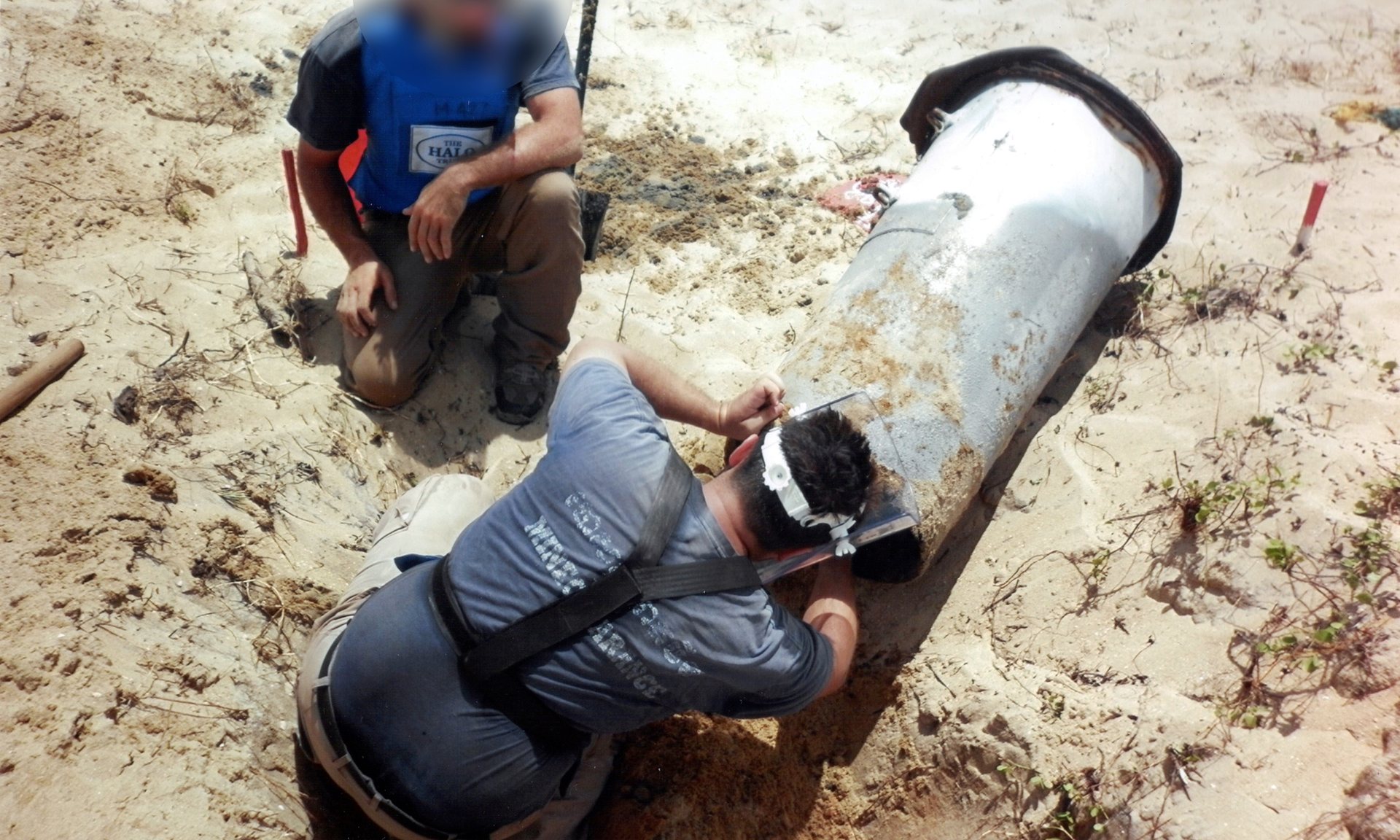 Deminers unearth a RBK-500 AO-2.5RT cluster bomb near Chalai. Photograph: The Guardian/Together Against Genocide
The Sri Lankan military used these weapons against Tamil civilians in the No Fire Zones during the final months of the armed conflict in 2009. The evidence is substantial.
Leaked photographs identified by a senior weapons researcher at Human Rights Watch show "Russian-made cluster bombs and unexploded cluster submunitions" discovered in densely civilian-populated areas within one of the No Fire Zones near Puthukudiyiruppu.
Photographs obtained by the Guardian show demining teams excavating a RBK-500 AO-2.5RT cluster bomb near Chalai. The former official told the Guardian that cluster bombs had been found in a "densely civilian-populated area" in one of the No Fire Zones near Puthukudiyiruppu.
Witnesses who testified before the OHCHR Investigation on Sri Lanka also reported the use of cluster bombs, referred to by some as "Koththu Kundu," on civilian populations, including hospitals.
The UN's OISL report recorded witness accounts describing objects exploding in mid-air and releasing many smaller objects before impacting the ground. The report acknowledged that "given the persistent nature of the allegations of cluster munitions, further investigation needs to be carried out to determine whether or not they were used."
A photograph from a United States State Department report shows a characteristic cluster bomb smoke cloud from a shelling on May 7 in Mullivaikkal.
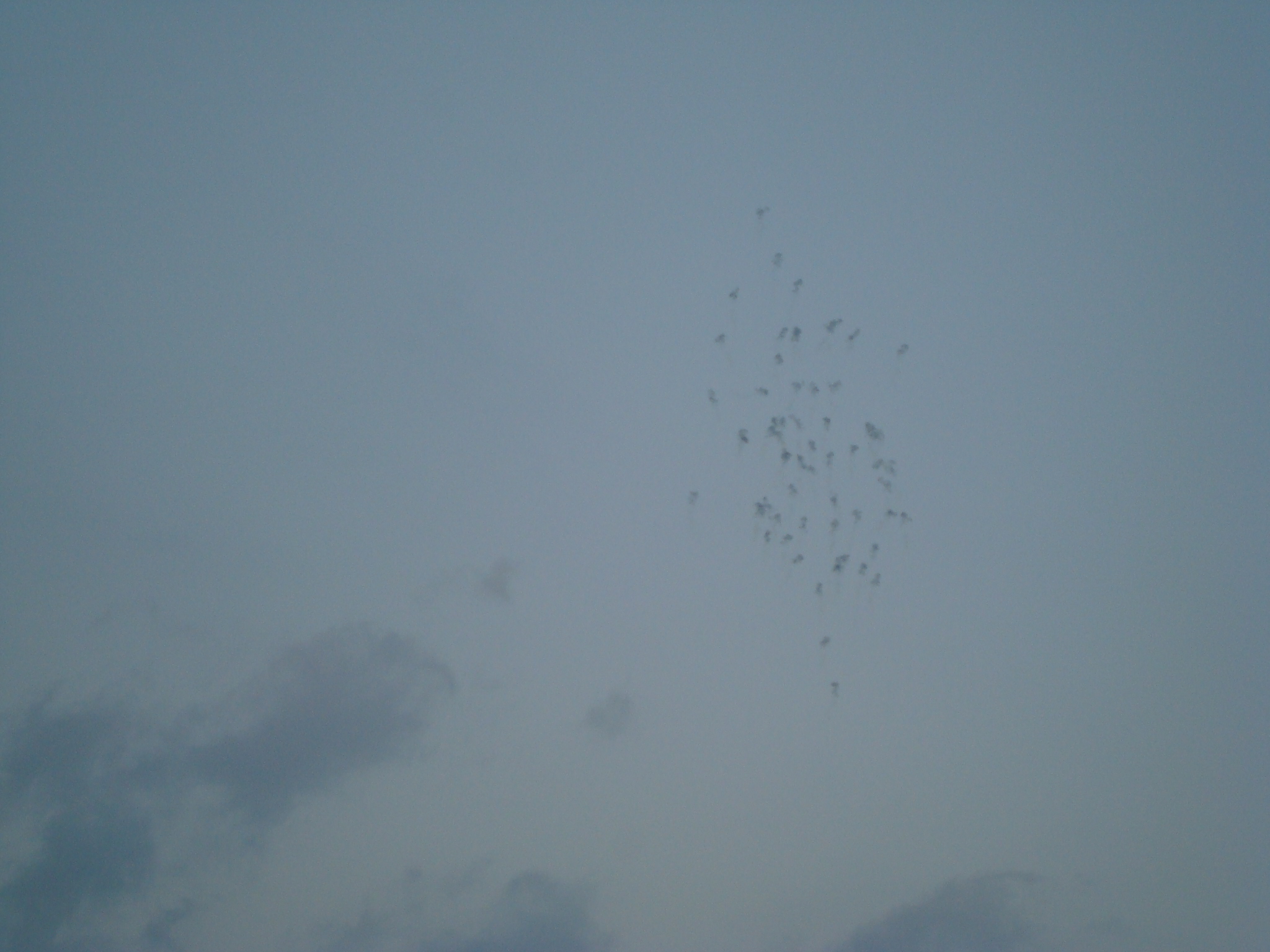
Photograph from US State Department report of “characteristic cluster bomb smoke cloud from a shelling on May 7 in Mullivaikkal".
During the height of the bombardment, the then UN spokesperson Gordon Weiss stated that cluster munitions had been used to attack one of the last functioning hospitals in the war zone, killing dozens of patients.
Witness testimony adds human weight to the photographic and forensic evidence. One witness described the experience in the No Fire Zones: "The main bomb explodes in the air and splits into many pieces. One kind of cluster bomb, used in Iranaipalai, produced colourful ribbons. Children were attracted and picked pieces up; as they handled the pieces they exploded." Another witness told the Guardian that "the cluster bomb would explode high up and small explosions would hit trees and people."
"There would be a smell that would turn your stomach."
.jpg)
Unexploded, unopened cluster bomb container, photographed in Vanni, 2009.
.jpg)
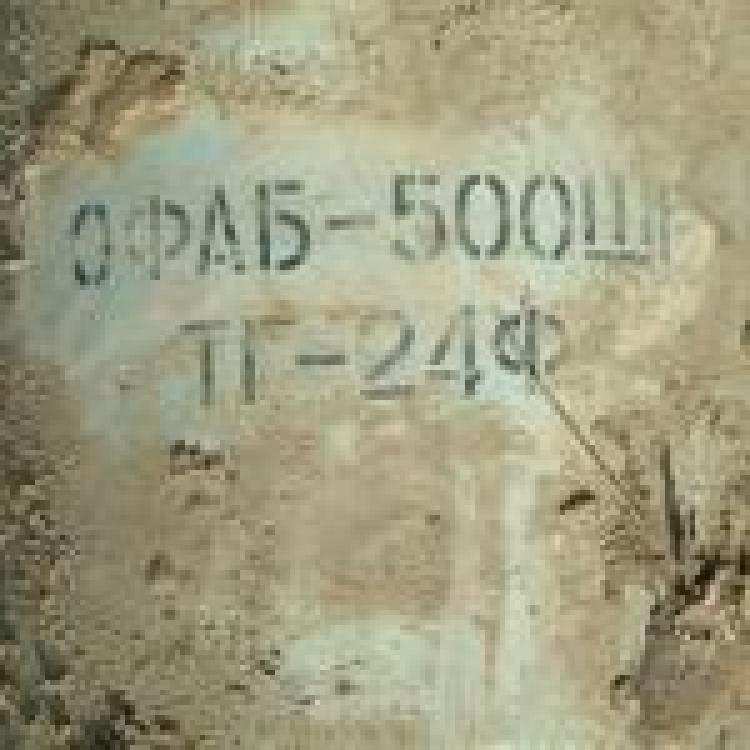
Russian markings masked by paint.
Amnesty International called the use of cluster bombs on civilian areas in Sri Lanka a potential war crime at the time: "These bombs are inherently indiscriminate because of the wide area covered by the numerous bomblets released and the danger posed to all those, including civilians, who come into contact with them."
The Sri Lankan government denied all of it. A statement from Sri Lanka's Ministry of Defence during the conflict declared: "The Government wishes to clarify that the Sri Lanka army do not use these cluster bombs nor do they have facilities to use them." The leaked photographs, the witness testimony, the forensic evidence, and the UN investigators' findings all point in a different direction.
Sri Lanka joins the Convention — after the massacres
There is a bitter postscript to Sri Lanka's use of cluster munitions. In March 2018, the Permanent Mission of Sri Lanka deposited the instrument of accession to the Convention on Cluster Munitions at the United Nations Headquarters in New York. President Maithripala Sirisena, as Minister of Defence, obtained the relevant approvals. Sri Lanka joined the treaty that prohibits a weapon it had deployed against its own Tamil civilian population nine years earlier.
The accession earned Sri Lanka diplomatic credit. It did not produce any accountability for those who gave the orders or carried out the attacks.
To this day, no one has been held accountable.