
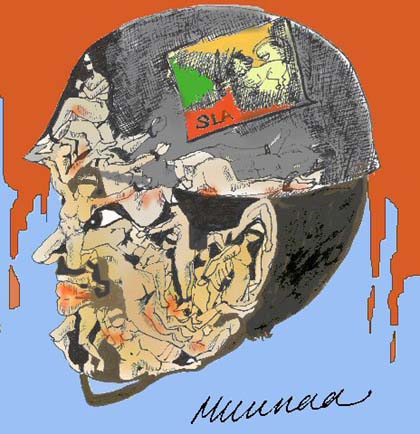
Sri Lanka’s Deputy Minister of Defence made an audacious claim last week, stating that over 700 acres of land in the North and East have been “returned to the public”. His announcement, delivered with little substance, came after two rare reports of military structures seemingly closing in the Tamil homeland. To the untrained eye, such news might lend credence to the minister’s claims that progress is finally being made. But, it only takes a cursory glance to see the reality is painfully clear in the North-East. The occupation continues, suffocating every aspect of daily life.
Aruna Jayasekara, another retired commander turned politician whose own record is marked by serious allegations of abuse, made his remarks when challenged in parliament by a Tamil lawmaker. He provided no details of the supposed “land releases”, referring instead to figures from January 2025, just months into the new National People’s Power (NPP) administration. When pressed on ongoing examples of occupation, including the Sri Lankan army’s base constructed on top of a cemetery for Tamil war heroes in Vavuniya, Jayasekara obfuscated. The minister’s lack of clarity, and the government’s unwillingness to provide any verifiable information, is telling.
Instead, government supporters have pointed to the vacating of a military camp in Karaitheevu and the closure of a police station in Jaffna as evidence of change. Yet neither example reflects meaningful demilitarisation. The camp in Amparai had long been earmarked for dismantling, having served no military purpose for decades. Its removal came after nearly four decades of occupation in an area that had not seen active conflict in years. In Jaffna, the police station was only closed following a six-year court battle, driven by the persistence of local Tamils who refused to back down even when police ignored legal rulings.
In both cases, there was no decommissioning of security personnel, but redeployment. The troops were simply shifted elsewhere in the North-East. This bureaucratic reshuffling is not the demilitarisation that Tamils have long demanded.
As Tamil Guardian’s Occupation Watch series has continued to document, more than a year into the NPP government’s tenure, the military’s presence in the Tamil homeland appears as entrenched as ever. Soldiers are a routine sight in schools, places of worship, and community events, with military-run businesses continuing to compete with local livelihoods. Across the North-East, bases are not being dismantled; they are being reinforced, with new structures fortifying their presence.
The North-East remains one of the most militarised regions in the world and the army continues to impact on every aspect of civil life, from monitoring protests, and harassing journalists, to the ongoing detention, torture, and human rights abuses. These are not the actions of a force preparing to withdraw.
At the same time, the Sinhalisation of the Tamil homeland continues apace. The dispute surrounding the illegal Tissa Vihara in Jaffna, and the proliferation of Buddhist shrines across the North-East, often built with military assistance, illustrate the ongoing attempt to impose a Sinhala-Buddhist identity upon historically Tamil lands. Archaeological departments, backed by the military, have seized sacred sites, displacing local Tamil families in the process. And Sinhala settlers continue to attack farmers and kill their cattle, strangling livelihoods.
For all the government’s rhetoric, the structural reality of occupation remains unchanged. The Sri Lankan state continues to treat the Tamil homeland as conquered territory.
Demilitarisation is not beyond the government’s reach. As Commander-in-Chief of the armed forces, the president holds full authority to begin withdrawing troops from the North-East and restore the normalisation of civilian life. It is also in Colombo’s own interest: the military continues to consume a staggering portion of the national budget, even as the island’s economy teeters on collapse. Reducing the military footprint would free up billions for public services and economic recovery.
Instead, Sri Lanka continues to peddle empty statistics and token gestures to the international community. The claim of “land release” is nothing more than an exercise in deception. Sixteen years after the end of the armed conflict, the Tamil nation remains under occupation.
The people of the Tamil homeland know what genuine change looks like. It is not the closure of a single military post or the shifting of a few troops to another region. It is the complete withdrawal of the Sri Lankan military from their lands, the end of Sinhala-Buddhist colonisation, and the restoration of the Tamil nation’s right to live freely in its own homeland. Until that happens, no amount of government spin can disguise the reality. The occupation of Tamil Eelam endures.