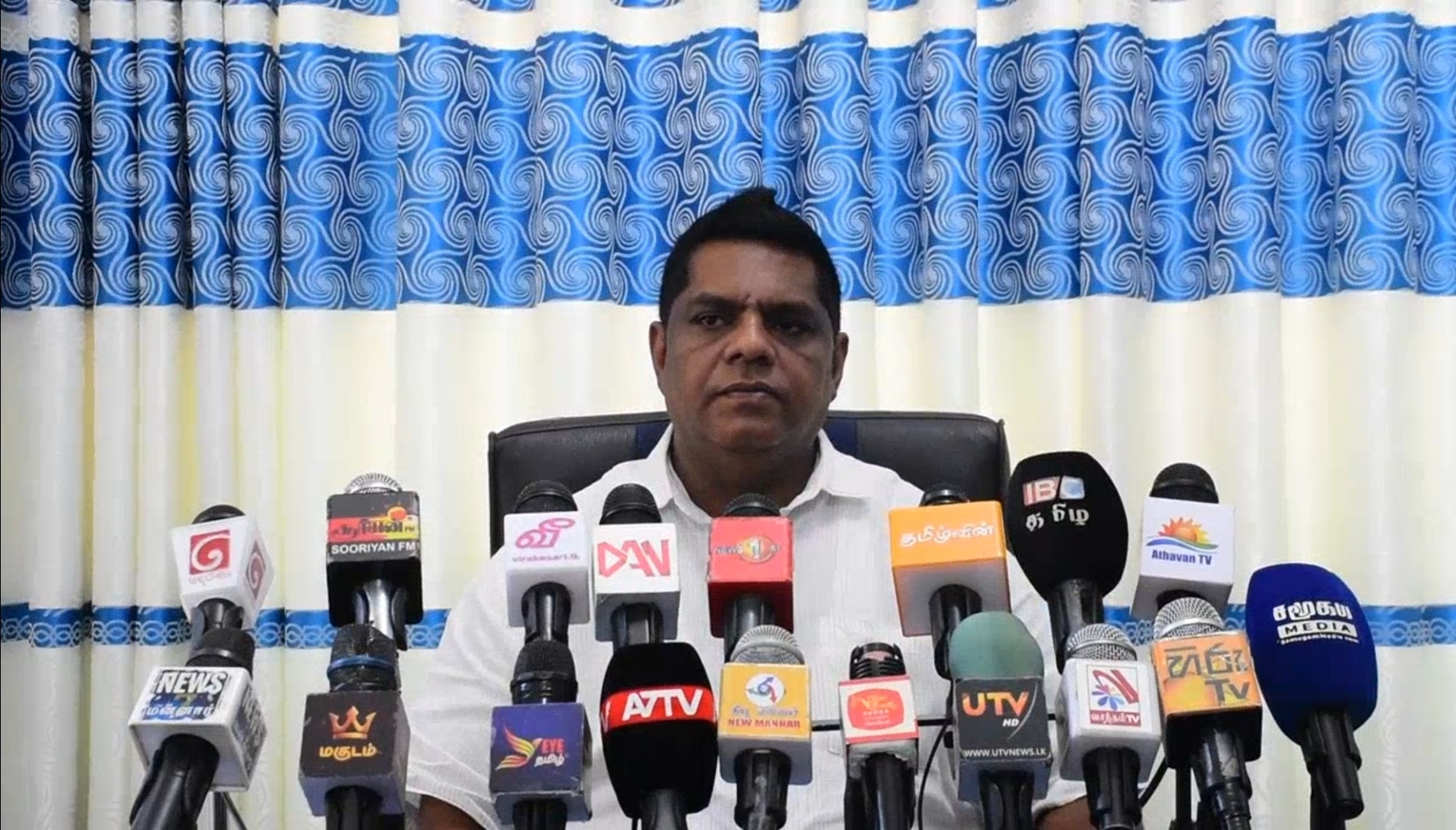
Mannar Urban Council Chairman Daniel Vasanthan has strongly condemned the arrest of Tamil rapper Sangeethsan Ganeskumar under Sri Lanka's Prevention of Terrorism Act (PTA), stating that the detention reflects a situation where "Tamils do not even have the freedom to sing".
Speaking at a media briefing held at the Mannar Urban Council on Friday, Vasanthan criticised the decision to arrest the…
A Colombo magistrate has reportedly ordered the investigation of over 2500 disappearances in the Northeast.
While UN Human Rights Commissioner Navi Pillay begins her visit to Sri Lanka, the Terrorism Investigation Department (TID) was ordered to launch a 'broad' investigation into the disappearances of 2550 people in the Northeast, a list of which has been confidentially submitted to the court.
The shooting of unarmed protesters by a state’s military, as took place in Weliweriya this week, is horrific. The profound perversity of a state turning its military apparatus on the people it purports to protect is universally felt. The Tiananmen Square massacre, Bloody Sunday and even Egypt today, are cases in point. The insurmountable inequity of force and the ensuing bloodshed of the unarmed protesters form a chilling reminder of a state’s simmering potential to abuse its monopoly on violence. The outrage and shock that has reverberated through Sri Lanka’s south following the Weliweriya incident is thus well placed. Yet as with the killings of other dissenting individuals, this tragedy highlights the intractable fallacy of an equal or inclusive ‘Sri Lankan identity’. In Sri Lanka, even death is no equaliser. The killing of a dissenter is defined by ethno-political identity, both that of the individual and their demands.
The failed Mattale Rajapakse International Airport will become a Maintenance and Repair Centre, reported The Sunday Leader.
Chairman of Airport and Aviation Services (Sri Lanka) Limited, Prasanna J. Wickramasuriya, claimed that the centre was needed in order to make Sri Lanka a regional aviation hub.
Reporters Without Borders has condemned the Sri Lankan military's attack against journalists covering the incident at Weliweriya. In a statement published on Monday, the press freedom group, said:
“We are very disturbed by the repeated use of violence against journalists in Sri Lanka,”
“At best, the police take no action when journalists report that they have been the targets of violence. At worst, the army itself, equipped with lethal weapons, organizes and executes these attacks, as it did in Weliweriya.”
“These unacceptable incidents show that, although the civil war is now over in Sri Lanka, violence by the armed forces is still far from being brought to an end and that freedom of information is still in great danger.”
The Teacher-Principal Trade Unions Joint Committee condemned the Weriweliya incident, and said that the government should take responsibility for it.
The committee's swift public condemnation, in line with legal bodies, criticised the military's attack on 'unarmed civilians who were protesting for a basic human need'.
Condemnation from the Sinhala polity, professional bodies and public has been swift. See more:
A mass movement in Sri Lanka, the People’s Movement for Democracy (PMD), has organised a demonstration to show discontent over the killings of civilians at Weliweriya.
The leader of the movement, parliamentarian Vijitha Herath said,
In a statement released on Sunday, Days after the Tamil National Alliance (TNA) registered its nominations for the Northern Provincial Council election, the British Tamils Forum (BTF) has called on the TNA to be "explicit about the dangers posed by the forthcoming Northern Provincial Council election", highlighting that the "TNA participation in the Council poses significant risks" and there was "a real danger of unwittingly playing stooge in the Sri Lankan state's campaign to regain legitimacy on the world stage".
See here for full statement. Extract reproduced below:
"The TNA's decision to contest the Northern Provincial Council election cannot even be described as a low-risk, speculative venture – harmlessly undertaken on the off-chance that it succeeds. Rather, TNA participation in the Council poses significant risks. Complicity in propping up a Provincial Council system that provides token benefits – perhaps a bicycle here and a rice sack there – while perpetuating the Sri Lankan state's structural genocide of Tamils, could strike a devastating blow to the decades-long struggle by the Tamil people for their rights and freedom. There is a real danger of unwittingly playing stooge in the Sri Lankan state's campaign to regain legitimacy on the world stage: if Tamil participation in the Provincial Council is used to provide a distraction that undermines global campaigns for an international independent inquiry into the crimes committed by the Sri Lankan state and recognition of the Tamil people’s right to self-determination.