Tamil Affairs

Tamil News

Latest news from and about the homeland

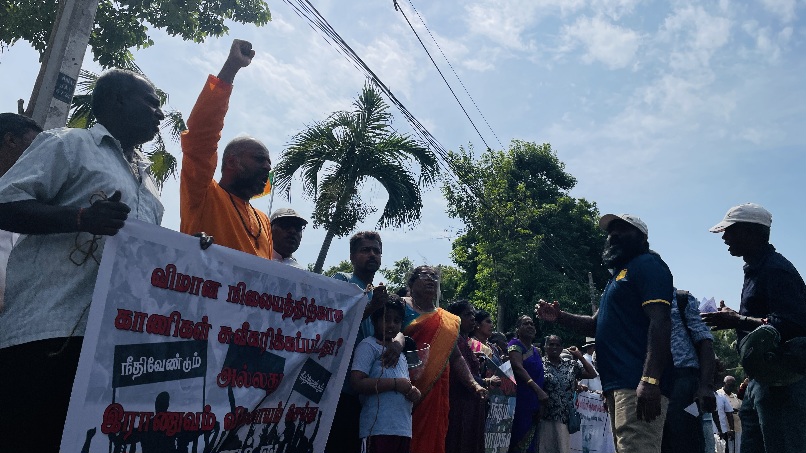
Displaced residents of the Valikamam North region of Jaffna held protests on Monday, in front of the Jaffna District Secretariat and near Palaly Junction, marking 36 years since their forced displacement and demanding the right to return and resettle in their lands. The people of Valikamam North were displaced from their homeland on 15 June 1990 by the Sri Lankan military. Thirty-six years on…

Rice price fix

Sri Lanka’s Ministry of Co-operative and Internal Trade has announced it will set the price of rice from midnight today, reported Ceylon Today.

The rice harvest is expected to be hit hard by the current drought and farmers have been asked to refrain from growing the water-intensive crop, said LBO.

"The drought is worrying us to some extent," Central Bank Governor Nivard Cabraal said.

"In the agricultural side we have to make sure that there is no unnecessary spike in prices. At the same time we can have an impact where generation of electricity generation is concerned."
Sri Lanka mistreats women suspected of LTTE links – Women's Action Network

The Sri Lankan government is arresting and mistreating innocent female relatives of men who it suspects are attempting to revive the LTTE, according to a rights group based on the island.

The Women’s Action Network has detailed the cases of six women who were arrested from the Northeast in a statement, adding that the Criminal Investigations Department is keeping the women in inhumane conditions denying them medical care, reported the Associated Press.

The rights group said five of the women were arrested for links to “Gopi”, who the government claims to be the “new leader” of the LTTE.

NPC Chief Minister declines meeting with Sri Lankan government

The Chief Minister of the Northern Provincial Council (NPC), CV Wigneswaran, yesterday declined a meeting invitation with the Economic Affairs Minister Basil Rajapaksa, after expressing disappointment at the lack of progress made during earlier meetings with the President Mahinda Rajapaksa.

The meeting was intended to discuss cooperation between the Northern Provincial Council and the Government, reports Colombo Gazette.

Sri Lanka’s ban on diaspora groups ‘puts all Tamil activists at risk’ – Human Rights Watch

Sri Lanka’s decision to ban major Tamil diaspora organisations as financiers of terrorism appears aimed at restricting peaceful activism by Tamils, Human Rights Watch (HRW) said Monday.

The Sri Lankan government is using vague counterterrorism regulations to tie the major diaspora Tamil groups to the ruthless but defunct LTTE,” said Brad Adams, HRW’s Asia director.

This broad-brush sanction could then be used to punish local Tamil activists and politicians with international ties.”

The government is putting all Tamil activists at risk by delegitimizing the major Tamil organizations abroad,” Adams said.

Putting organizations engaged in peaceful political activity on a terrorist list is a modern version of McCarthyism.”

Canada questions motive behind diaspora bans, says will not help reconciliation

Canada on Monday expressed concern over Sri Lanka’s motive in proscribing fifteen Tamil diaspora groups and over 400 individuals, saying the move would not help post-war reconciliation in which diaspora Tamils had an important role.

A spokesperson from Canada's Department of Foreign Affairs, Trade, and Development (DFATD) told Tamil Guardian:

“We are concerned about the motives of the Government of Sri Lanka in taking this action and regret that this will not help advance genuine post-conflict reconciliation, a process in which diaspora communities have an important role to play."

"We are particularly concerned about the effect of this order on freedom of speech and association in Sri Lanka," he added.

Noting that some of the individuals and entities listed resided in Canada, the spokesperson made assurances regarding the exercise of freedom of speech by the Tamil community within Canada.

“The Sri Lankan government’s actions do not constrain the freedom of these groups and individuals to express their views in Canada,” he said.

"This ban is the government protecting Sinhala nationalist credentials." - TNPF

The Tamil National People’s Front (TNPF) has questioned Sri Lanka’s motives for its recent proscription of Tamil diaspora organisations and individuals based on information which the government claims to have procured from LTTE officials five years ago.

Speaking at a press conference on Monday, President, Mr Gajendrakumar Ponnambalam stated that the TNPF condemned the extensive ban and believed that there was no evidence or justification to support it.

Explaining what the TNPF believed to be the main motives for the ban, Mr Ponnambalam said:

“After a resolution critical of Sri Lanka was passed in Geneva, the government now needs to save face in the south. This ban is the government’s way of protecting its Sinhala nationalist credentials.”

“Since the Rajapaksa government rests on the laurels of having defeated the LTTE, it needs to reiterate this to its voter base, to counter the increasing humiliation Sri Lanka has faced internationally.”

Tamil Nadu fishers ‘relieved’ at India cricket loss against Sri Lanka

Tamil Nadu’s fishing community expressed relief at India’s loss to Sri Lanka in the ICC T20 cricket world cup final, as a previous win was followed by attacks at sea believed to revenge by Sri Lankan navy personal, the Times of India reports.

UN rights probe an ‘international trap’ set by India – NFF

The National Freedom Front (NFF), a partner of President Mahinda Rajapaksa's ruling coalition, warned the Sri Lankan government against being caught in an ‘international trap’ set by ‘enemy forces’ in the guise of an international investigation into wartime atrocities, reported ColomboPage.

A spokesman for the NFF, Mohammad Muzammil, told reporters that India’s motives in abstaining on the UN resolution against Sri Lanka were doubtful. He accused India of secretly backing an international investigation, and claimed Delhi was instrumental in getting two previous resolutions on Sri Lanka through the UN Human Rights Council.

Transcending Terror

The Sri Lankan government's proscription last week of 15 Tamil diaspora organisations and over 400 individuals was a brazen attempt to instil fear into the Tamil people. Over and beyond those specifically named or officially affiliated to the organisations, given the organisations' mass membership, the proscription criminalises a quarter of the Eelam Tamil population, and all Tamils living on the island who engage with them. It is the mass banning of Tamil civil society. Sri Lanka's broad definition of 'terrorism', including those demanding Tamil political rights and those that criticise human rights abuses by the state, effectively encompasses any threat to Sinhala Buddhist hegemony. Any remaining faint hopes of reconciliation, are made even more unlikely. Ultimately and entirely in keeping with the Sri Lankan state's overarching and long-standing project of consolidating its hegemony, the proscription - ironically only made significant by virtue of the nation's very inextricable connectedness - is an attempt to dismantle the Tamil nation and thereby seek to extinguish the nation's political aspirations.


Testifying tantamount to treason - SL Minister

The Sri Lankan government may take legal action against people testifying before any UN implemented commission, reports Ceylon Today.

Minister of Mass Media Keheliya Rambukwella said:

"We will take legal action against anyone who testifies before this commission, if the evidence submitted by them is in violation of the country's Constitution."