
• Conference in Danish parliament calls for independent, international investigation
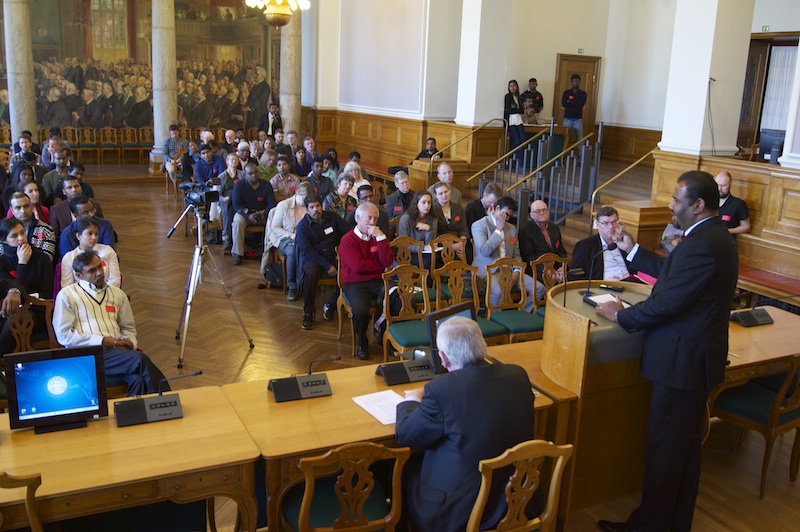
    TNPF Gajendrakumar Ponnambalam addresses conference

    Danish and Eelam Tamil politicians, as well as activists called for an independent, international investigation into the allegations of war crimes, crimes against humanity and genocide at a conference in Denmark - "A forgotten conflict: Conference on Human Rights in Sri Lanka".

    The conference, which took place on Wednesday inside Denmark's parliamentary building, included a speakers from all four main parties of Danish politics, as well as TNPF (Tamil National People’s Front) President, Gajendrakumar Ponnambalam from the North-East. The welcome address was given by the Social Democratic MP Troels Ravn - a member of the ruling coalition.

  • US State Dept 2012 report details on-going abuses against Tamils

    The 2012 US State Department Human Rights report, released on Friday, detailed the abuses that took continued to place through out last year, as well as pointing out that "a disproportionate number of victims of human rights violations were Tamils."

    See here for full report. Extracts have been reproduced below.  


    Executive Summary:

    "The major human rights problems were attacks on and harassment of civil society activists, persons viewed as Liberation Tigers of Tamil Eelam (LTTE) sympathizers, and journalists by persons allegedly tied to the government, creating an environment of fear and self-censorship; involuntary disappearances as well as a lack of accountability for thousands who disappeared in previous years; and widespread impunity for a broad range of human rights abuses, particularly involving police torture, and attacks on media institutions and the judiciary.

    Other serious human rights problems included unlawful killings by security forces and government-allied paramilitary groups, often in predominantly Tamil areas; torture and abuse of detainees by police and security forces; poor prison conditions; and arbitrary arrest and detention by authorities."

    "There were restrictions on freedom of speech, press, assembly, association, and movement. While citizens generally were able to travel almost anywhere in the island, there continued to be police and military checkpoints in the north, and de facto high-security zones and other areas remained off limits to citizens. Authorities harassed journalists critical of the government and self-censorship was widespread."

  • Liberals call for action against Sri Lanka at CMAG

    The Liberal Party in Canada has condemned the ongoing violence in Sri Lanka and called for the Conservative government to take action at the upcoming Commonwealth Ministerial Action Group (CMAG) meeting on Friday.

    Liberal MP Bob Rae said in a statement:

  • Criminal remarks
    A parliamentarian of a major Tamil Party in the north, the Tamil National Alliance (TNA), was interrogated by  Sri Lanka's Criminal Investigation Department (CID), over comments he made regarding the Sri Lankan Army.
    The TNA parliamentarian, Suresh Premachandran told media that the investigations were concerning comme
  • Statues and emblems not enough for BBS

    In an interview to Sri Lanka’s Daily Financial Times, the Chief Executive Officer of Bodu Bala Sena has stated that his group’s aim is to ensure “true Buddhism” is practised in the country, adding that the presence of Buddha statues across the island and Buddhist symbols in government logos was not enough.

    The group, a Sinhala translation of ‘Buddhist Power Force’, is a “civil society movement led by monks”, claimed Dilantha Withange, stating in his interview,

    “According to our Constitution, Buddhism should be given foremost priority. But we believe this is not practiced in Sri Lanka at present. Buddhism is not given due recognition in this country. We may have the dharma chakra in our national emblem; there may be Buddhist statues in every corner in the country; but the question is whether Buddhism is properly practiced in this country.”

    Since the end of the war Sri Lanka has rapidly escalated its construction of Buddha statues and other Buddhist sites across the Tamil homeland in the North-East of the island. Withange also commented,

    “Our country was under imperialists for a long period of time. They ruined the roots of Buddhism in this country. Although they left, our leaders continued their agendas. Various leaders come into power labelling themselves as Buddhists and patriots, but they all follow what the British and others did. Then the war worsened things. Our prime objective is to put an end to this and establish a Buddhist society in our country once again.”

    “Meanwhile, although the Constitution says foremost priority should be given to Buddhism, it doesn’t say anywhere that Buddhism is our State religion. Countries like Bangladesh clearly say that Islam is their State religion. We need to put things in the right place. That is what we want. This is a country that doesn’t even practice the five basic principles of Buddhism. We need to change this.”

  • Further increases in price of bakery product

    Bread prices in Sri Lanka are set to increase, after the government hiked electricity tariffs, despite widespread opposition.

    The All Ceylon Bakery Owners' Association said the increase in electricity tariffs is affecting the industry and consequently prices of bakery goods would be increased.

  • The philosophy behind SL 'reconciliation'

    Permanent Representative to the UN, Palitha Kohona, told the UN General Assembly that Sri Lanka was not particularly interested in finding 'culprits'.

  • Ministry of Finance prohibits sale of land to 'foreigners'

    Sri Lanka's Ministry of Finance sent a circular, dated 27th March 2013, explicitly stating that the transfer of land, included that which is privately owned, was prohibited to any foreign national or foreign company.

  • Rajapaksa - will not allow creation of 'religious or communal disharmony'

    Addressing delegation from 15 Islamic countries on Thursday, Sri Lanka's president, Mahinda Rajapaksa said that the Sri Lankan government 'will not tolerate anyone perpetrating acts to create communal or religious disharmony'.

  • Deportations breach Australia's international obligations
    The Australian immigration department was accused of denying 38 failed asylum seekers access to legal advice before sending them back to Sri Lanka.
    Australian Human Rights Commission president, Gillian Triggs, expressed concern regarding the 'enhanced screening process' that had been implemented on Sri Lankan boat ar
  • Idea of Tamil nation is not dead in SL'

    Writing in Tehelka, Revati Laul, detailed her recent trip to the North-East, concluding, "but even in the aftermath of the terror and genocide, the Tamil idea of nationhood has not disappeared. If India does not want another cycle of violence at its doorstep, it cannot afford to be indifferent to the voices of the Lankan Tamils."

    See here for original article, extracts reproduced below:

      "With the war over, things have gone back to usual. Contrary to Rajapaksa’s famed 13th amendment, promising autonomy to the provincial councils in the north for the Tamils, this means a return to State policies from the 1950s that systematically and deliberately excluded them from cultivable farmland and prime fishing waters. The exclusion that sparked the Tamil resistance and war in the first place is back with a bang."

      "TRINCOMALEE IN the east, a long and beautiful stretch of coastline once held by the LTTE, is now back on the tourist map after it was recaptured by the army in 2006. But Trincomalee is overrun with soldiers at every street corner. Every passenger on every incoming bus to the north and east is checked by the military. Every time you board a bus, you have to write your contact numbers, purpose of visit and passport details."

      "In another camp in the east — local guides did not wish it to be identified — a frail 53-year-old woman stepped out of her mud hut to greet us. She dashed her daughter off to get us a sweet red drink from a store nearby as her eyes slowly shifted to a faraway place. She now lives entirely in the past. Every waking moment is spent thinking of the home they fled in 2006; the two cows she had to sell, named Neerum or water and Neeruppu or fire. “Even if I don’t get back my farmland, I will live with that. All I want, even if it’s just a small hut, is to get back to my homeland,” she said wistfully.

    At yet another camp in the north, a fisherman’s eyes brimmed over. Living in a camp for more than 22 years is no life, he said. In the 1990s, he left the camp to live in the Vanni, the LTTE heartland, where he felt protected and thought the Tamils would have a future. Now, at the age of 60, with that dream getting more and more blurred, he confessed, “I think I should just end it all now and walk into the sea.”

    The refusal to be named or identified is commonplace among the Tamils. Their fear is palpable."

  • Indian Navy ships on training visit in SL

    Three Indian Navy ships arrived in Colombo on Thursday, on a 4 day training visit aimed at increasing mutual cooperation between the two navies.

    The ships, "INS Sujata", "INS Tarangini" and Coast Guard Ship "ICGS Varuna" were welcomed at the port by the Sri Lankan Navy.

  • Australian Air Force plane sends asylum seekers home

    The Australian government has sent back 38 asylum seekers who arrived by boat in Australia’s busy Geraldton port last week, as refugee advocacy groups claim they were denied access to lawyers.

    A further 28 asylum seekers who were on the boat are having their claims “processed” on Christmas Island, according to reports, after the group pulled into the port following a 44-day voyage from Sri Lanka. An Australian Air Force jet will be sending the asylum seekers to Colombo. Immigration Minister Brendan O’Connor stated,

    ''Returning this group to Sri Lanka sends the powerful message that people who pay smugglers are throwing their money away and risking their lives in the process... There is no fast track to Australia - irrespective of whether someone arrives at an excised offshore place. If they do not engage Australia's protection obligations, they will be returned home.''

    Meanwhile, as another group of asylum ended a 10-day hunger strike in a Melbourne detention centre, American political critic Noam Chomsky stated,

    “The true measure of the moral level of a society is how it treats the most vulnerable people... Few are as vulnerable as those who have fled to Australia in terror and are locked away without charge, their terrible fate veiled in secrecy. We may not be able to do much beyond lamenting about North Korean prisons. But we can do a great deal about severe human rights violations right within reach”.

    He was joined by critically acclaimed Australian author Thomas Keneally, who said,

    “If any Australian citizens were treated as these people are, with detention, humiliation and denial of rights, we too would make protests to assert the justice of our cause – just as these present refugees have done”.

Subscribe to Tamil Affairs