
• Sri Lanka ready to ‘share lessons’ with international community says prime minister

    Sri Lankan Prime Minister Ranil Wickremesinghe said his government had “consolidated democracy and revived the economy” in an essay published as the World Economic Forum’s Annual Meeting in Davos kicked off on Wednesday.

    “A new era has dawned in Sri Lanka,” said Mr Wickremsinghe, adding that “peace has been consolidated” on the island.

    Mr Wickremesinghe said his government was ready to “play its full role as a responsible member of the global community of nations,” and was “well placed to play a constructive role in addressing the pressing international issues of the day, such as terrorism, climate change, migration and strengthening democratic values”.

    In his essay, Mr Wickremesinghe went on to add his government was bolstering Sri Lanka’s democracy by “reasserting the independence of the judiciary, combating bribery with the UN Convention Against Corruption and allowing a free and vibrant press to flourish”.

    Yet, Sri Lankan continues to rank 6th in the Committee to Protect Journalists (CPJ) 2015 Global Impunity Index published in October 2015, with both the Jaffna Press Club and Northern Provincial Council calling for justice for murdered journalists.
  • Sri Lankan president ‘more committed to national security than ever before’
    Sri Lankan President Maithripala Sirisena stated he was “more committed in upholding the national security better than ever before” as he called for “moves to crush active LTTE ideology”.

    Speaking at a ceremony for disabled Sri Lankan soldiers on Tuesday, the official Ministry of Defence website quotes Mr Sirisena as stating “the present government is progressively more committed in upholding the national security better than ever before”.

    Mr Sirisena went on to add that “the dream of Ealam subsists in overseas” and “moves to crush active LTTE ideology is the greater responsibility that has befallen us which also needs the global support”.

    “We have determined to thwart such actions of carrying LTTE ideology wherever and have the compliance of the international community for same,” added the president, stating that “ties with the foreign countries were further strengthened while reopening avenues for military training during the last year.”
  • EU trade delegation meets with TNA


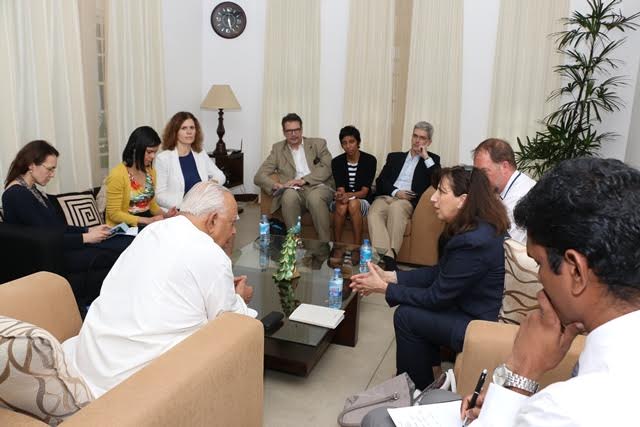
    The European Union trade delegation, currently visiting Sri Lanka for discussion regarding the regaining of GSP+, met with the Tamil National Alliance on Wednesday.

  • Exiled Tamil journalist detained on return to Sri Lanka
    Reports emerged on Wednesday night that an exiled Tamil journalist from the North-East had been arrested on arrival at Sri Lanka earlier during the day.

    The journalist, who reportedly returned after being invited by the new government, was arrested at Katunayake airport.

    It is not clear what the alleged offence is. He is expected to be produced before Negombo Magistrate Court on Thursday morning.
  • Sri Lankan president says all IDPs in North resettled within 6 months
    The Sri Lankan president said on Wednesday that all internally displaced persons (IDPs) in the Northern province would be resettled within six months.

    His remarks came during a discussion at the presidential secretariat on the continued displacement of Tamils.

    The president has instructed officials to identify land and develop the necessary infrastructure in the North, the Colombo Page reported.

  • India and Sri Lanka commence bi-lateral army talks in Delhi
    India and Sri Lanka commenced 3-day talks between Army officials in New Delhi on Wednesday, reports Colombo Page.

    A Sri Lankan military delegation led by the Military Secretary at Army Headquarters engaged in the fifth consecutive bi-lateral talks between the two armies in New Delhi.
  • Sri Lanka’s constitutional framework must ‘promote power-sharing and right to self determination’ - Wigneswaran

    A Sri Lankan constitutional framework must “promote power-sharing and protect(s) the identity, language, culture and right to self determination” of all communities in Sri Lanka, said Northern Provincial Council Chief Minister C. V. Wigneswaran.

    Speaking at a seminar on “Constitutional models of power sharing, challenges and perspectives in multi ethnic societies” organised with support of the government of Switzerland, Justice Wigneswaran noted that the “classical distinction between federal and unitary state is giving way to more complex forms of the nation states”.

    “Thus we cannot limit us to look at the problem of devolution from a binary reasoning standpoint of unitary or federal only,” said the chief minister. “It is essential to keep in mind the fact that a strictly unitary state places power in the hands of the majority and the consequent authoritarianism, majoritarianism and domination of the majority-centre would affect the minority-periphery.”

    Recalling the Tamil National Alliance election manifesto of 2013, which also noted that the Tamil people are a distinct People that have inhabited the island from time immemorial with the right to self determination, Justice Wigneswaran said the seminar would examine how “the individuality of People different from the majority could be preserved and maintained.”

     “We Tamil Speaking people of the Northern and Eastern Provinces feel that the people of the North and East of Sri Lanka are fully qualified to be categorized as People entitled for self determination in terms of the characteristics and qualifications delineated in the UN Covenants,” he added. “How to recognize our right of self determination within this Country which is multi lingual, multi ethnic and multi religious is the larger problem facing the Country.”

  • Sri Lankan president meets with BBS to discuss ‘threats from Tamil separatists’

    Sri Lankan President Maithripala Sirisena met with Buddhist organisation Bodu Bala Sena in a wide ranging meeting to discuss threats to Sinhalese villagers “from Tamil separatists”.

    “About 4,500 families in five remote villages in the Bogas Weva region in Vavuniya, who had been resettled by the previous government, have now started to get back to their previous places,” said BBS General Secretary Galagoda Aththe Gnanasara.

    “The attention given to them by the Government and the influence from several Muslim Ministers and threats from Tamil separatists resulted in the villagers returning to their former places,” he added.

    He went on to state,

    “Those villages have been set up by the help of tri forces. I am pleased to inform that the President had informed the Army Commander to take immediate action regarding the issue. We hope the President will take fruitful decisions in the future.”

  • Mullaitivu villagers protest against Sinhala colonisation

    Villagers in Mullativu held a protest on Monday, demanding the return of their lands which have been occupied by the Sri Lankan authorities under the controversial Mahaweli Development project.

    Villagers from Kokkulai, Kokkuthoduvai and Karunattukerni gathered in front of the Mullaitivu district secretariat demanding an end to the project, which has seen Sinhala settlers move to the Tamil North-East, in large scale colonisation projects.

  • Ranil prohibits fishing in Palali in order to expand air base
    Sri Lankan Prime Minister Ranil Wickremesinghe declared any fishing activities by Palali airport were strictly banned, due to the planned expansion of a military base in Jaffna.
  • Sri Lankan govt thanks China for support during armed conflict

    The Sri Lankan government expressed its thanks on Tuesday to China for its support during the armed conflict.

  • Sri Lanka targets $5 billion in FDI over next 3 years

    Sri Lanka’s investment promotion agency is aiming to attract $5 billion of Foreign Direct Investments (FDI’s) over the next three years said the International Trade and Development Minister.

  • EU trade delegation visits Sri Lanka
    An European Union trade delegation will visit Sri Lanka for three days this week till Friday.

    The delegation which includes officials from the European Commission and the European External Action Service, will discuss a number of issues with the Sri Lankan government, including how to regain the Generalized System of Preferences plus (GSP+).
  • Britain says no to defence pact with Sri Lanka
    The British foreign office minister for South Asia, Hugo Swire, on Saturday ruled out a defence pact with the Sri Lankan government, stating it was too "premature".

    Britain would be engaging in providing training to Sri Lankan troops on how to operate in a democratic country, Mr Swire was quoted by the Island as saying.

    "In terms of defence, we are re-engaging with our non resident Defence Attache based in New Delhi, establishing contacts with the Sri Lankan military right across the board. It is all part of what we are doing in other countries such as Burma, where our military experiences are being imparted."

  • Tamil diaspora organisations commemorate 40th anniversary of Vaddukoddai resolution

    Tamil diaspora organisations, in a statement marking the 40th anniversary of the passing of the ‘Vaddukkoddai Resolution,’ pledged to host events around the world to reaffirm and 'take it forward in all dimensions.'

    The statement read,

    “The essence of the Resolution declared on 14 May 1976 under the leadership of the late S.J.V Chelvanayagam was the enunciation by Tamils that, in view of their long maligned experiences, they could no longer live under the hegemonic rule of a Sinhala Buddhist State. In the subsequent General Elections of 1977, the Tamil people gave a clear mandate for the Resolution by electing all candidates who stood behind it. That mandate by the people lives in their spirit forty years on.”

Subscribe to Tamil Affairs