
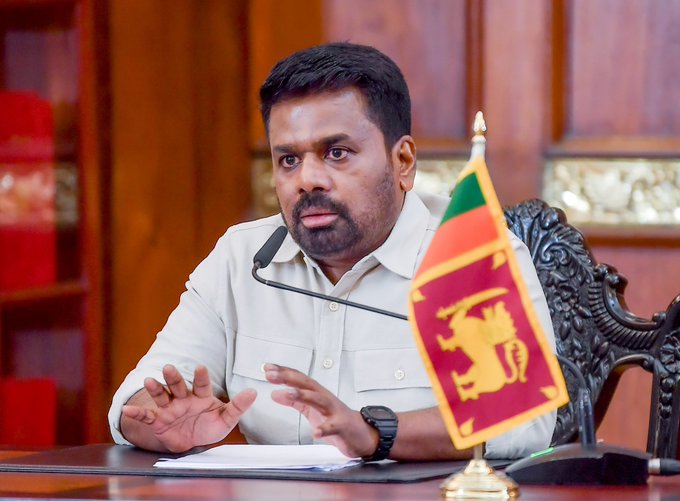
Sri Lankan President Anura Kumara Dissanayake has confirmed that Iran had requested permission for its naval vessels to visit Sri Lanka days before one of its warships was struck near the island’s southern coast.
In a statement released on Thursday, Dissanayake said Iran had formally approached Sri Lanka on 26 February seeking permission for three naval vessels to make a goodwill visit to the island between 9 and 13 March.
According to the president, the request had been deferred as there were “extensive formal procedures” to be considered. “We were studying those procedures” whilst the vessel waited, he confirmed.
On 27 February, Sri Lankan authorities were informed that a sailor aboard the Iranian vessel IRIS Bushehr had suffered an injury while the ship was near Sri Lanka’s maritime zone. The Sri Lanka Navy and Air Force intervened and transported the injured sailor and an accompanying officer ashore for medical treatment.
Days later, in the early hours of 4 March, Sri Lankan authorities were alerted that a vessel had come under attack near Sri Lanka’s maritime boundary.
According to the president, the incident occurred outside but close to Sri Lanka’s maritime zone, approximately 19 nautical miles from the port of Galle. Distress signals were subsequently transmitted from the area.
Sri Lanka’s navy and air force launched a search and rescue operation shortly afterwards.
“In that operation, it must be said that we acted with both neutrality and humanitarian concern,” the president said.
Sri Lankan forces rescued 32 individuals from the sea and recovered the bodies of 84 deceased persons, bringing them ashore. The injured were taken to the Karapitiya Teaching Hospital in Galle for treatment.
Following the attack, the Iranian vessel IRIS Bushehr requested permission to enter a Sri Lankan port, Dissanayake added.
Sri Lankan authorities subsequently held discussions with Iranian officials and diplomatic representatives to determine the appropriate response in accordance with international law.
Dissanayake said the government had decided that the vessel would not enter the Port of Colombo, citing concerns about the potential impact on the country’s main commercial harbour.
Instead, Sri Lanka opted to escort the vessel to Trincomalee Port. The president said the government had acted in accordance with international conventions while maintaining a neutral position.
“We have followed a very clear and consistent stance, we act neither in favour of any state nor in subordination to any state. We followed international conventions, including the 1982 UN Convention on the Law of the Sea.We act as a free and sovereign nation. We act on principle not pressure. Our intervention is decisive and humanitarian and in the interest of our nation and our people.”
Dissanayake also reiterated Sri Lanka’s position that humanitarian considerations had guided the government’s actions during the incident.
“No civilian should die in wars. Our approach is that every life is as precious as our own. We jealously guard our non-aligned policy while ensuring that humanitarian values and the saving of lives remain our top priority.”