
A fundamental rights petition will be filed before Sri Lanka's Supreme Court seeking the release of Tamil artist Sangeethsan Ganeskumar, better known as HipHop Sangee, after his arrest and detention under the Prevention of Terrorism Act (PTA), President's Counsel M. A. Sumanthiran announced on Thursday.
The move comes amid growing criticism of the rapper's detention and mounting calls from politicians, civil society organisations and artists for his release.
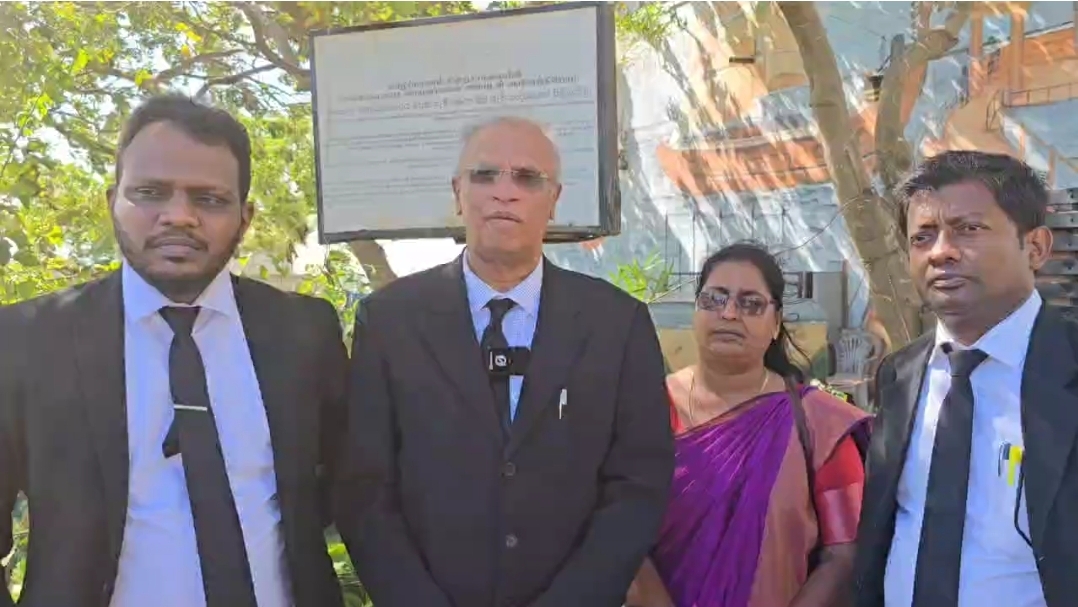
Sumanthiran made the announcement after visiting Sangeethsan at Jaffna Prison, where the 24-year-old remains on remand. The legal team, comprising Sumanthiran and attorney Sajanthan, met the artist together with his mother to discuss the next steps in his legal defence.
Sangeethsan was arrested on 2 June after Sri Lankan authorities alleged that he had edited videos of songs performed during a musical event in Navatkuli, Chavakachcheri, on 31 May and uploaded them to social media with additional voice recordings that allegedly promoted the Liberation Tigers of Tamil Eelam (LTTE).
Police subsequently filed charges under the PTA and produced him before the Chavakachcheri Magistrate's Court on 3 June.
The court ordered that he be remanded until 17 June whilst investigations continue.
Speaking to reporters following the prison visit, Sumanthiran said attorney Sajanthan had appeared on behalf of the artist before the Magistrate's Court and challenged the basis of the case.
According to Sumanthiran, the defence argued that the allegations outlined by police did not constitute an offence under the PTA.
However, the court ordered that Sangeethsan remain in custody whilst investigations continue.
Sumanthiran stated that the legal team had met the artist on the instructions of his mother and had now received his consent to proceed with a fundamental rights application before the Supreme Court.
He said the petition would be filed on 5 June and that all available legal avenues would be pursued to secure the artist's release as quickly as possible.
Referring to the allegations, Sumanthiran said the entirety of the material in question had already been placed before court and maintained that the alleged conduct did not fall within the scope of the PTA.
According to the legal team, the authorities are relying on Section 2(1)(h) of the Act, under which it is alleged that the material could create or possess the possibility of inciting hostility between communities.
The provision states that any person who, "by words either spoken or intended to be read or by signs or by visible representations or otherwise causes or intends to cause commission of acts of violence or religious, racial or communal disharmony or feelings of ill-will or hostility between different communities or racial or religious groups" commits an offence under the legislation.
Sumanthiran rejected that interpretation and argued that the song could not reasonably be construed as creating hostility between communities.
He further alleged that certain parties were deliberately attempting to portray the material in that manner.
The legal team intends to argue before the courts that the allegations, even if accepted in full, do not amount to an offence under the PTA. Whilst those arguments were already advanced before the Magistrate's Court, Sumanthiran noted that no immediate relief was likely whilst police investigations remained ongoing.
As a result, the defence has decided to seek urgent intervention from the Supreme Court through a fundamental rights application.
The case has attracted significant attention across the Tamil homeland and diaspora since Sangeethsan's arrest earlier this week.
His detention comes amid growing concern over what many artists, activists and civil society organisations describe as an escalating crackdown on Tamil cultural expression. In recent weeks, occupying Sri Lankan police have questioned musicians, interrupted performances and launched investigations into homeland-themed songs performed at temple festivals and cultural events across the North-East.
Last week, Gokulan, the son of the late Tamil musician S. G. Santhan, was among those summoned and questioned by police following a performance in Urumpirai.
Critics argue that the arrest of HipHop Sangee represents a further expansion of efforts to criminalise artistic works connected to Tamil identity, memory and political history.
The case has also reignited debate over Sri Lanka's continued use of the Prevention of Terrorism Act, a law long criticised by international human rights organisations for granting sweeping powers of arrest and detention and for its disproportionate use against Tamils.