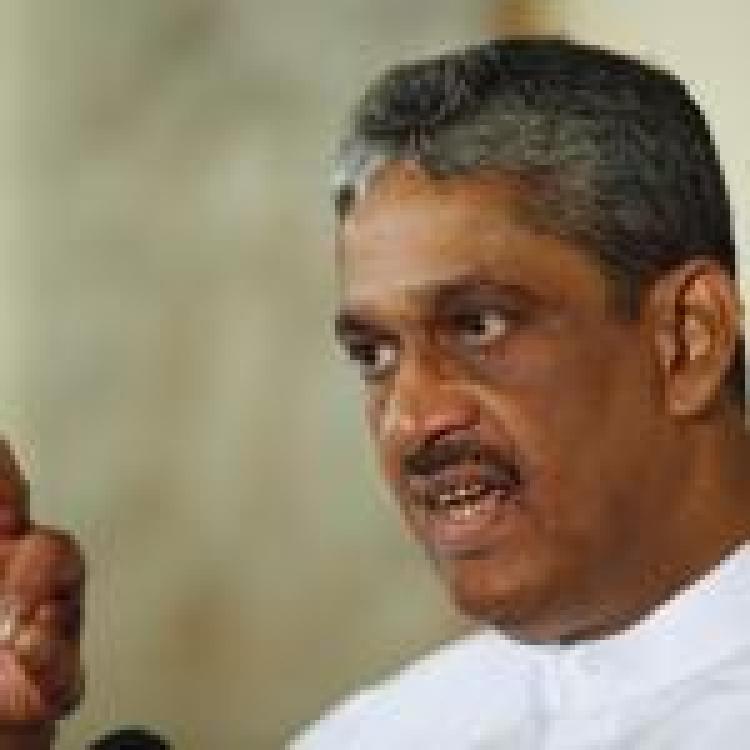
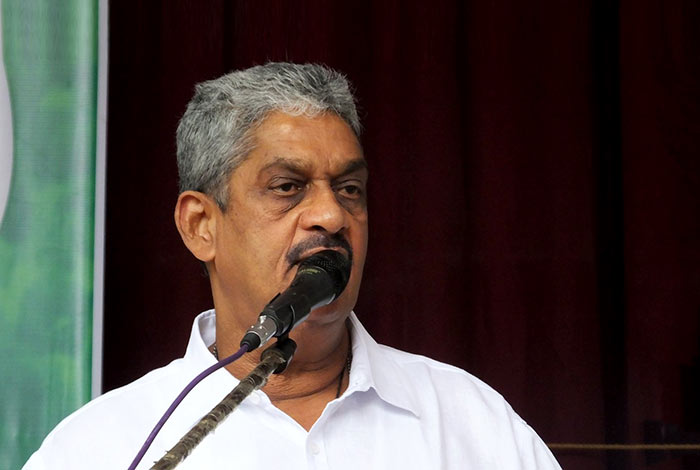
Former Army Commander Sarath Fonseka lashed out Sri Lankan president Anura Kumara Dissanayake, rejecting his framing of the armed conflict as a struggle pursued “by all parties for peace” and for allowing Tamil genocide commemorations to take place in the North-East.
Speaking in a televised interview, Fonseka took aim at the Dissanayake’s portrayal of the Liberation Tigers of Tamil Eelam (LTTE), asking pointedly, “Did LTTE leader Prabhakaran wage war for peace?” He dismissed the idea that the armed conflict, which resulted in the deaths of tens of thousands of Tamil civilians, could be viewed as a mutual quest for peace.
Fonseka, who was the commanding officer of the Sri Lankan military during the final stages of the armed conflict in 2009, also expressed alarm at what he perceived as weakening national security. Referring to recent calls to reduce military expenditure, including Dissanayake’s claims that funds saved from demilitarisation would be redirected towards rebuilding the country, Fonseka stated such notions were “unrealistic.” He argued that even when he led an army of 200,000 troops, the budget only supported half that number, insisting that security cannot be compromised under the guise of fiscal prudence.
He went on to claim that the International Monetary Fund (IMF) has no authority to interfere in such matters and an expressed his strong opposition to the removal of Sri Lankan army camps.
"People talk about cutting military expenses, but when I was in charge, I managed 200,000 troops on a budget meant for 100,000,” said Fonseka. “You can't approach national security with a cost-cutting mindset—militaries must evolve with technology and training."
Crucially, Fonseka also dismissed the claims of genocide made by Tamil survivors, victims’ families, and the global Tamil diaspora. He alleged that, “certain segments of the Tamil diaspora are continuing to assert that genocide took place in Sri Lanka, using these claims to extend their stay and privileges in foreign countries.” This comment follows long-standing efforts by Tamil organisations to secure international recognition of the genocide committed during the final phases of the war, particularly in Mullivaikkal in May 2009.
Fonseka was also vocally opposed to Tamil commemorations of the genocide, both in the North and across the diaspora. Referring to recent remembrance events held in the Tamil-majority North-East and in Wellawatte, Colombo, Fonseka stated that such activities could facilitate the resurgence of militancy. “If the authorities are not vigilant,” he warned, “there is a high chance of terrorism reoccurring in the nation.”
Despite surveillance and harassment, Tamils across the North-East lit candles and held vigils at memorials like Mullivaikkal and Jaffna University, while diaspora communities held large-scale commemorations in places such as Toronto, London, and Chennai.
In response to the commemorations, Sri Lanka’s foreign minister Vijitha Herath warned that those that use the term “genocide” on the island, may face legal action.