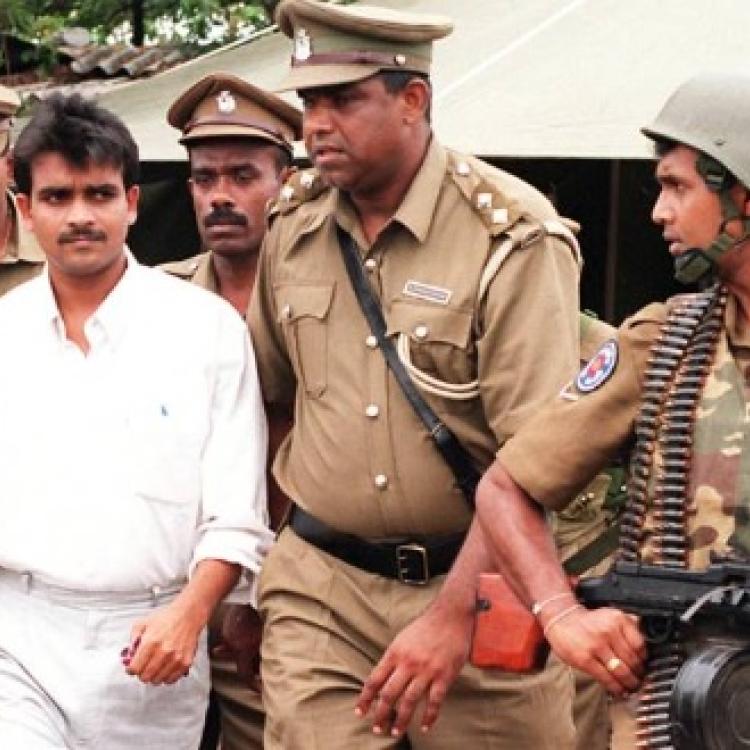

Rajapaksa, under heavy security, guides officials to a mass grave site in Chemmani, 1999.
Somaratne Rajapakse, the Sri Lankan soldier convicted in the 1996 rape and murder of Tamil schoolgirl Krishanthi Kumaraswamy, has revealed further details of mass graves in Jaffna, implicating senior politicians and the army in a systematic cover-up.
Rajapakse, who in 1998 revealed the existence of the Chemmani mass graves during his court case, now claims that dozens of Tamil civilians arrested at military checkpoints were tortured, executed, and buried at another site in Jaffna known as Maniam Thottam.
He said those detained from Chemmani to the Thundi camp in the late 1990s were taken to torture facilities, including the notorious Balasena headquarters, before being killed. The 7th Infantry of the Sri Lankan Army, based at Ariyalai, was responsible for the arrests, Rajapakse alleged.
The 7th Infantry of C3 camp buried people who were killed at torture camps at Maniam Thottam, which was just outside the area in the control of the army, Rajapakse said, according to a report in the Virakesari, noting that while he could not pinpoint the exact burial spots, he knew the area well.
Political cover-up and prison assault
Rajapakse also alleged that in 1998, after he was sentenced for the rape and murder of Krishanthi, he received a letter from the late government minister Jeyaraj Fernandopulle via a prison officer. The letter, he said, urged him to retract his claims about other mass graves, insisting he had spoken “in anger.”
When Rajapakse attempted to send the letter to the Human Rights Commission, prison officers demanded it back. Upon refusing, he was brutally assaulted by officers, including Namal Bandara. “I was saved due to the intervention of other prisoners,” he recalled. A formal complaint was filed, but he never heard the outcome.
Kumar Ponnambalam’s promise and assassination
In 1999, while imprisoned at Bogambara, Rajapakse met Tamil lawyer Kumar Ponnambalam, to whom he relayed details of the cover-up and his testimony. Ponnambalam promised to secure his role as a state witness and press for his release.
But Ponnambalam was assassinated shortly afterwards in Colombo. Without his protection, Rajapakse said he was coerced into only partially identifying graves at Chemmani, after being promised a presidential pardon. “That is why I only identified a few spots,” he admitted.
State complicity at the highest levels
Rajapakse further alleged that the existence of torture camps in Jaffna in the mid-1990s, including the Balasena HQ, was known to then-President Chandrika Bandaranaike Kumaratunga and the Defence Secretary.
His testimony adds to a growing body of evidence that Sri Lanka’s political and military leadership oversaw a network of torture camps, disappearances, and mass killings in the Tamil homeland.
The revelations from the very soldier convicted in one of the country’s most notorious war crimes deepen pressure to account for the thousands of Tamils who remain disappeared at the hands of the Sri Lankan state.