


 |
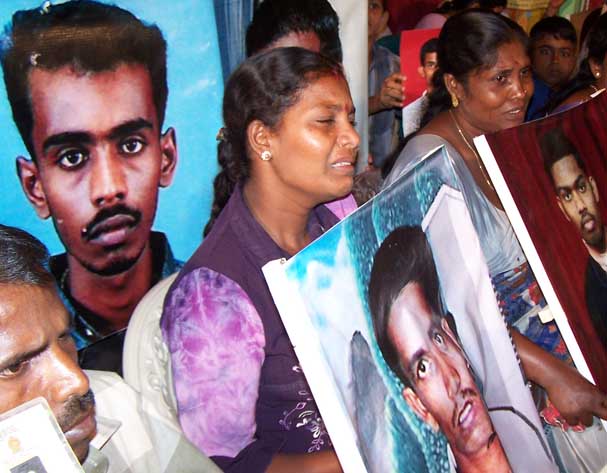
When people are abducted and never seen again – ‘disappeared’ – or their bodies are later found dumped, and when they are gunned down in public or in front of their families, these acts are often described as ‘senseless’. Senseless because nothing these people might have done - or are suspected to have done - is seen to justify such horrific ends.
But there is a purpose to disappearances and extra-judicial killings: terror. These acts are not just about the individual, but the rest of society. They constitute a specific form of violence aiming to define the relationship between the state and the community concerned, between fear and submission.
How genocide?
Disappearances are not mere ‘senseless’ manifestations of ‘lawlessness’, but a deliberate and planned effort by a state to achieve its objectives. As Amnesty International said this week, "entire communities can fracture under pressure as people fear being associated with those targeted."
Historically, disappearances and extra-judicial killings fit within a strategy to destroy the political will of a target population or a way to destroy in whole or in part a target population.
If the target group shares a political belief (for example some Latin American states’ assaults on leftist movements during the Cold War), then it is politicide. If this target population is chosen on the basis of ethnicity – as with the Armenians, Kurds or the Tamils – then disappearances and extra judicial killings become part of a strategy of genocide.
As Raphael Lemkin, the academic who coined the term put it,
“Genocide is intended rather to signify a coordinated plan of different actions aiming at the destruction of essential foundations of the life of national groups, with the aim of annihilating the groups themselves.”
“The objectives of such a plan would include the disintegration of the political and social institutions, of culture, language, national feelings, religion, and the economic existence of national groups, and the destruction of the personal security, liberty, health, dignity, and even the lives of the individuals belonging to such groups”
Sri Lanka's case
In Sri Lanka, disappearances and extra-judicial killings have long been part of the state’s assault on the Tamils. Indeed, given the scale of such targeted violence, it is integral to the degradation of Tamil political and physical life, to genocide.
According to a 1999 UN Study Sri Lanka then already had the world's second highest rate of disappearances - the overwhelming majority of victims since 1990 being Tamils. In the decade since thousands more, again mainly Tamils, have vanished since being taken into government custody.
By 2003 Amnesty International had received 20 000 complaints of disappearances since the armed conflict began in 1983 - of which 9000 were still open. Last year Amnesty said:
"Enforced disappearances continued to be part of a pattern of abuse apparently linked to the government’s counter-insurgency strategy. ... Many enforced disappearances took place inside high-security zones and during curfew hours."
Even after the end of the armed conflict, thousands of Tamil men, women and youth are being held by the state accused of working for the LTTE. None have been charged. The ICRC and international human rights groups have been denied access to them, amid persistent reports of torture, summary executions and rape.
Sri Lanka said last year 11,000 people were being held. Amid international protests, a tiny handful have been released in a few much publicised ceremonies. The state also now claims only 5,000 are held.
Continuous
Disappearances and killings even continued, after a short lull, during the internationally-brokered ceasefire and peace process period (2002 to 2006).
Amongst the high-profile cases, Sri Lanka’s best known defense analyst, Sivaram Dharmaratnam was taken off a Colombo street in May 2005. His body was found the next day, he had beaten and shot in the head. Tamil MPs Joseph Pararajasingham (Dec 2005) and Nadarajah Raviraj (Nov. 2006) were gunned down in public – just two amongst several Tamil parliamentarians. All were advocates of Tamil self-determination.
Some Sinhala critics of the government have also been killed or disappeared. Lasantha Wickrematunge editor of the Sunday Leader newspaper was murdered in January 2008 - a case that gets much more attention internationally than fellow newsman Sivaram’s.
However, notably, the vast majority of media workers killed or disappeared are Tamil: of 35 cases between 2004 and 2009, 29 were Tamil, 3 Sinhala and 2 Muslim. The office of Tamil newspapers in government-controlled Jaffna, including Uthayan, were repeatedly stormed and threatened by gunmen.
Purposeful
Why are reporters and media targeted? It is not only a question of their criticisms or exposes of government policy. It is also about spreading terror across the media and imposing collective self-censorship, about ensuring non-coverage of the broader assault on, and destruction, of their community. As Rodney Pinder, head of International News Safety Institute says, “Murder is cheap censorship …Terror increases self censorship.”
Another group of Tamils who have been targeted are humanitarians. Several aid workers with the Tamil Rehabilitation Organisation (TRO) were abducted and disappeared in January 2006.
In August that year seventeen staff – all but one Tamil - of the French aid agency Action Contre la Faim (ACF) were lined up and shot dead by Sri Lankan troops (the second worst attack worldwide on aid workers, after the bombing of the UN in Baghdad).
Why are aid workers targeted? It is about spreading terror among humanitarians and curtailing the capacity for extending assistance to a population suffering deprivations amid military offensives.
As a recent study points out, terrorising aid workers into leaving amid a humanitarian crisis is effectively a "death sentence" for refugees and internally displaced.
As the ICRC protested in 2006, even before the ACF killings, the attacks were "severely hampering the efforts of humanitarian actors in Sri Lanka to provide assistance to the most vulnerable segments of the population."
Seeking submission
Amongst the other Tamils who either disappeared in government custody or murdered by the armed forces and their paramilitary allies, are civil society leaders, student leaders, academics, parliamentarians, business owners, relatives of LTTE cadres.
The logic of such state violence was best put by Sivaram himeself. These brutal acts, he said, are about “forcing the target population to lose its collective will.”
“Arrest, detention and torture, all indiscriminate, and interrogation destroy the basis of civil society. All this denies one’s sense of rights; you want people to lose track of the idea that they have rights of any kind. You reduce them to the point where staying alive becomes their top priority.”
Based on a presentation to the 6th International Conference Against Disappearances (Dec 2010), hosted by ICAD (International Committee Against Disappearances).
We need your support
Sri Lanka is one of the most dangerous places in the world to be a journalist. Tamil journalists are particularly at threat, with at least 41 media workers known to have been killed by the Sri Lankan state or its paramilitaries during and after the armed conflict.
Despite the risks, our team on the ground remain committed to providing detailed and accurate reporting of developments in the Tamil homeland, across the island and around the world, as well as providing expert analysis and insight from the Tamil point of view
We need your support in keeping our journalism going. Support our work today.
For more ways to donate visit https://donate.tamilguardian.com.
