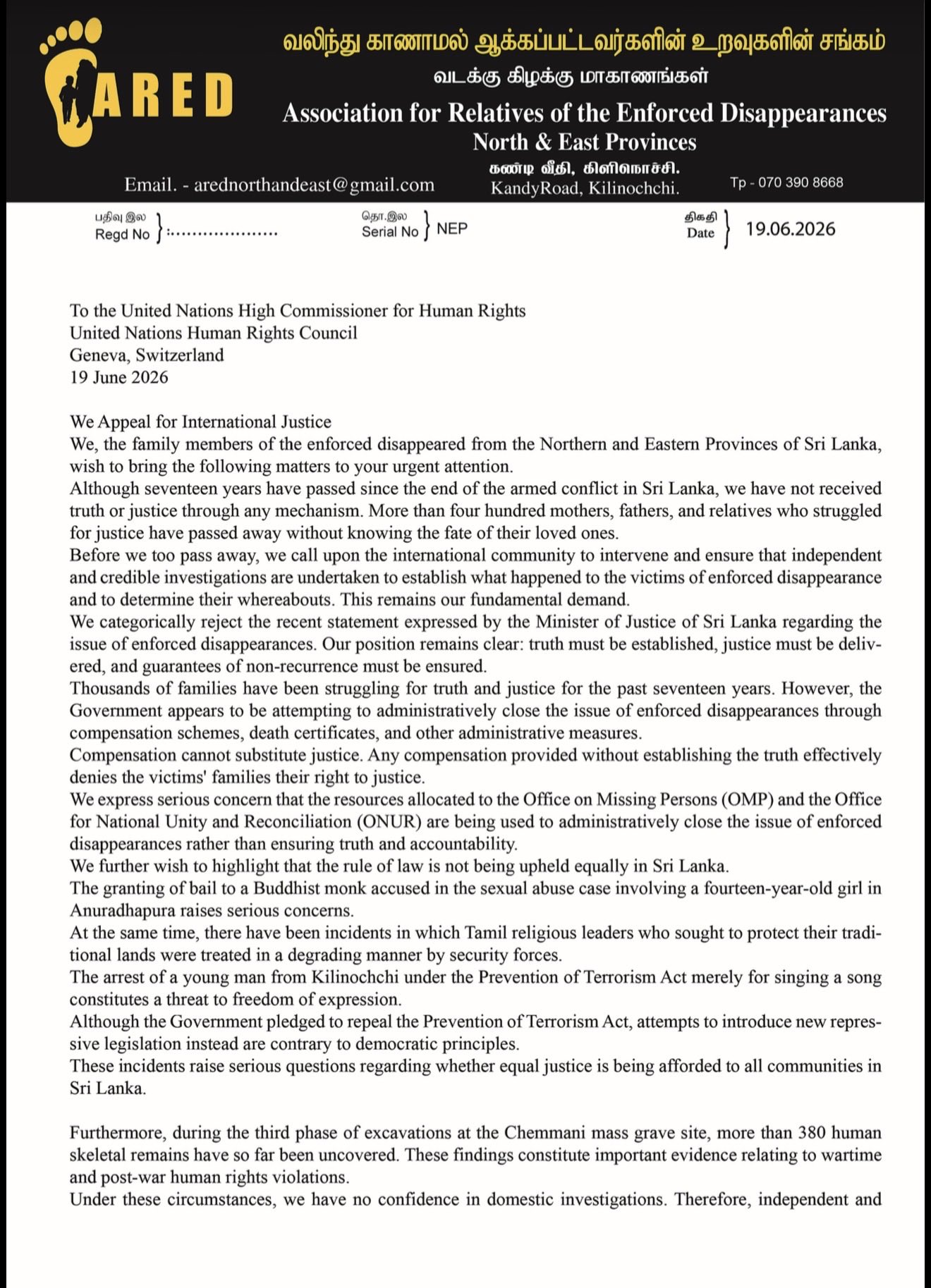
The Association for Relatives of the Enforced Disappeared in the North-East (ARED) has appealed to the United Nations to ensure an international investigation into enforced disappearances and mass graves across the Tamil homeland, including the ongoing excavations at Chemmani, where more than 380 human skeletal remains have been uncovered.
In a letter dated 19 June 2026, the association called on the United Nations High Commissioner for Human Rights and the United Nations Human Rights Council to intervene, stating that seventeen years after the end of the armed conflict, families have still not received truth or justice through any domestic mechanism in Sri Lanka.
The association said more than 400 parents and relatives who had campaigned for justice have died without learning the fate of their disappeared loved ones. It warned that more families risk passing away before the truth is established, unless the international community acts.
"Before we too pass away, we call upon the international community to intervene and ensure that independent and credible investigations are undertaken to establish what happened to the victims of enforced disappearance and to determine their whereabouts. This remains our fundamental demand."
The appeal comes as fresh excavations at Chemmani continue to expose the scale of mass graves in Jaffna, raising renewed questions over Sri Lanka’s long history of enforced disappearances, military violence and impunity in the Tamil homeland.
ARED said the discovery of hundreds of skeletal remains at Chemmani amounted to significant evidence relating to wartime and post-war human rights violations. The association said it had no confidence in Sri Lanka’s domestic investigations and called for independent and credible forensic examinations with international oversight.
Tamil families have for years rejected Sri Lanka’s domestic accountability mechanisms, accusing successive governments of using commissions, compensation schemes and bureaucratic processes to delay, deflect and ultimately close cases without truth or justice.
In its letter, ARED said thousands of families have continued to search for answers for the past seventeen years, but accused the Sri Lankan government of attempting to administratively close enforced disappearance cases through compensation schemes, death certificates and other measures.
"Compensation cannot substitute justice," the association stated, adding that any compensation offered without establishing the truth denies victims’ families their right to justice.
The association also rejected recent remarks made by Sri Lanka’s Justice Minister on enforced disappearances, stressing that truth, justice and guarantees of non-recurrence remain essential.
It expressed "serious concern" over the work of the Office on Missing Persons (OMP) and the Office for National Unity and Reconciliation (ONUR), alleging that resources allocated to the institutions were being used to administratively close cases of enforced disappearance rather than deliver truth and accountability.
The OMP has been consistently rejected by Tamil families of the disappeared, who have said the body is incapable of holding the Sri Lankan state to account. Families have repeatedly demanded an international process, arguing that domestic mechanisms remain structurally tied to the same state accused of carrying out and concealing the disappearances.
ARED’s letter also raised wider concerns over the rule of law and equal justice in Sri Lanka.
It cited the granting of bail to a Buddhist monk accused in a sexual abuse case involving a fourteen-year-old girl in Anuradhapura, incidents where Tamil religious leaders seeking to protect traditional lands were treated in a "disregarding manner" by Sri Lankan security forces, and the arrest of a young singer from Kilinochchi under the Prevention of Terrorism Act (PTA) for merely singing a song.
The association said that although the Sri Lankan government had pledged to repeal the PTA, attempts to introduce a new "repressive legislation" ran contrary to democratic principles. It said these developments raised serious questions over whether equal justice was being afforded across the island.
The PTA has long been used by the Sri Lankan state to target Tamils, including former political prisoners, activists, journalists, students and artists. Despite repeated pledges to repeal the law, successive governments have continued to rely on it while attempting to replace it with similarly repressive legislation.
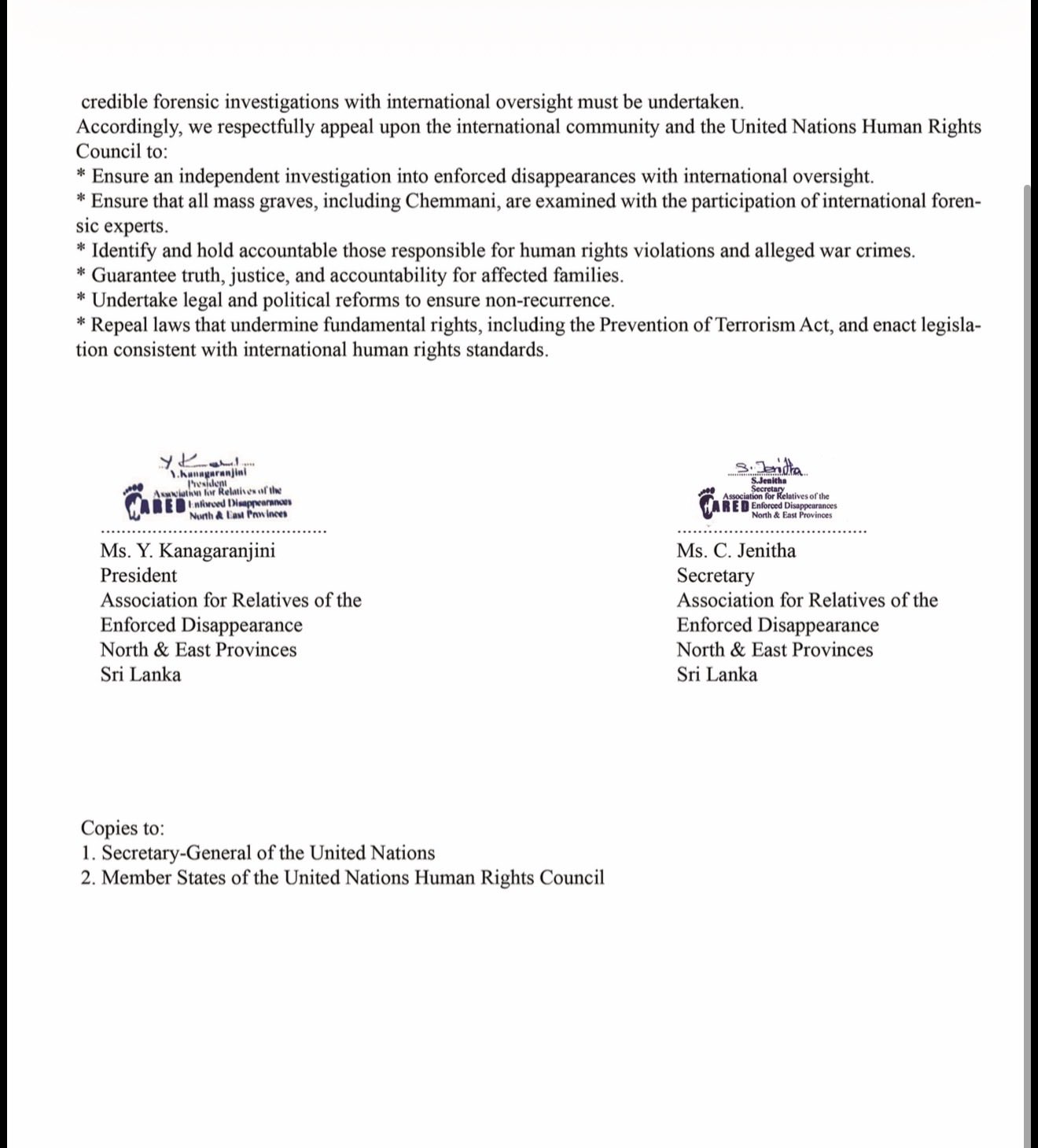
In its demands, ARED urged the international community and the UNHRC to ensure an independent international investigation into enforced disappearances, facilitate the examination of all mass graves with the participation of international forensic experts, identify and hold accountable those responsible for human rights violations and alleged war crimes, and guarantee truth, justice and accountability for affected families.
The association also called for legal and political reforms to prevent recurrence, the repeal of laws that undermine fundamental rights, including the PTA, and the enactment of legislation consistent with international human rights standards.
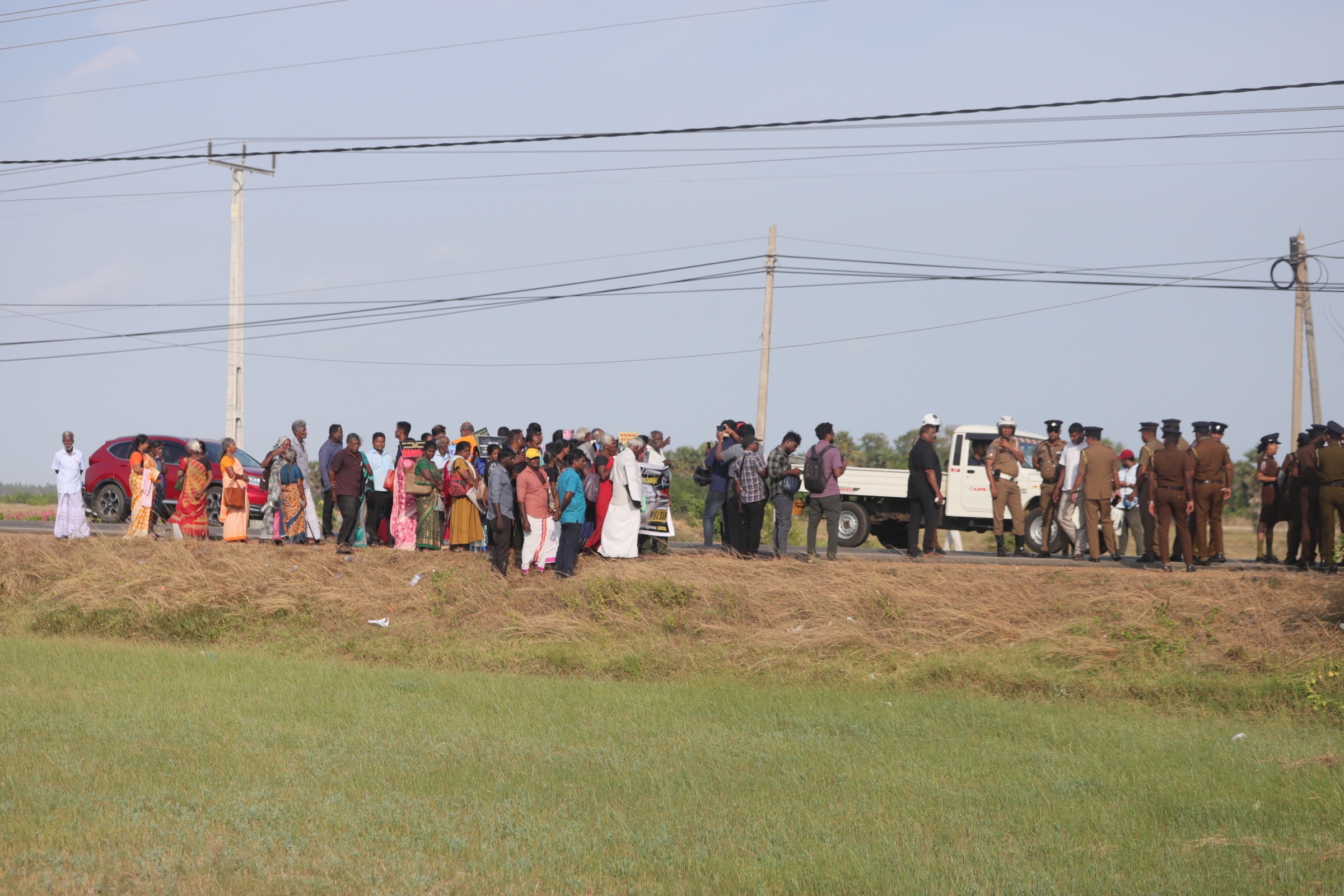
The appeal follows a demonstration by ARED during a visit by Sri Lanka’s Justice Minister and representatives of the OMP to the Chemmani mass grave site. Protesters called for international oversight of investigations into enforced disappearances and mass graves, though neither the minister nor OMP representatives engaged with the demonstrators during the visit.
For Tamil families, Chemmani is not an isolated case. It stands as part of a wider pattern of mass graves, disappearances and state denial that has marked the Tamil homeland for decades.
As excavations continue, families say Sri Lanka cannot be trusted to investigate itself.
Their demand remains unchanged: international oversight, accountability for perpetrators, and the truth about what happened to the disappeared.