Sri Lanka’s Committee on Public Finance sharply questioned senior Central Bank officials, including Governor Nandalal Weerasinghe, over regulatory and supervisory failures that allegedly allowed a Rs. 13.2 billion internal fraud at National Development Bank PLC to remain undetected for years.
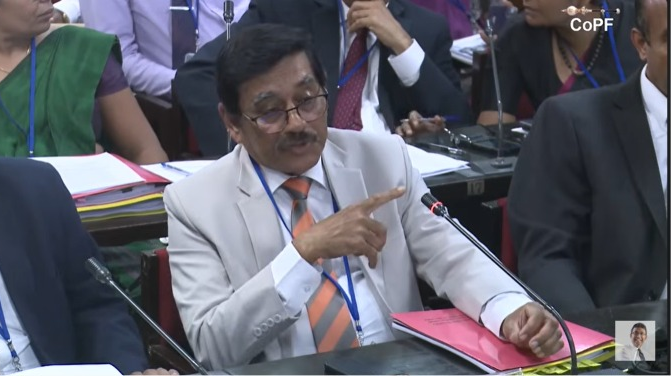
The parliamentary hearing, chaired by opposition MP Harsha de Silva, examined how one of the island's most serious alleged insider banking frauds could have continued for nearly a decade without being detected by internal controls, external auditors or the Central Bank’s supervisory mechanisms.
Lawmakers raised concerns over whether existing banking oversight systems had failed to identify major warning signs despite significant irregularities appearing in the bank’s financial records.
Committee members questioned how the Central Bank’s supervision process did not detect the alleged manipulation, which reportedly involved a bank employee exploiting reconciliation processes and altering internal records over an extended period.
The hearing also focused on the independence of the forensic investigation after Central Bank officials disclosed that NDB had contributed to preparing the initial scope of the inquiry.
Harsha de Silva challenged the arrangement during the session. “Is the accused asked to draft the scope of the investigation?” he asked.
Governor Weerasinghe defended the process, stating that although NDB had prepared an initial draft, the Central Bank retained final authority over the mandate and scope of the investigation.
Central Bank officials informed the committee that Deloitte India had been appointed to conduct the forensic investigation. An interim report is expected within two weeks, while the final report is due by 18 July.
Officials said enforcement decisions would be taken after the forensic investigation is completed.
Committee members also raised concerns over possible conflicts of interest in the external review process and sought assurances that the investigation would remain fully independent.
The hearing examined how an accumulated Rs. 13.2 billion balance remained recorded under “Other Financial Assets/Receivables” without triggering stronger regulatory scrutiny.
Lawmakers argued that large fluctuations in the account over previous reporting periods should have prompted earlier intervention through off-site supervision mechanisms.
Central Bank officials responded that the complexity and duration of the alleged fraud meant investigators would need to review records spanning almost ten years to establish how the transactions were carried out and concealed.
The Committee on Public Finance instructed the Central Bank to submit all approval and endorsement documents issued to NDB for parliamentary review, signalling continued scrutiny of whether supervisory processes and regulatory checks were sufficiently robust.
The case comes at a sensitive moment for Sri Lanka’s financial sector, as the country continues to seek economic stability after sovereign default, debt restructuring and years of public anger over institutional failure, corruption and weak oversight.
For a banking system that depends heavily on public confidence, the allegations surrounding NDB raise broader questions about the effectiveness of Sri Lanka’s regulatory architecture and the Central Bank’s ability to detect systemic risks inside major financial institutions.
The CoPF hearing also places renewed pressure on the Central Bank to explain not only how the alleged fraud occurred, but why existing safeguards failed to identify it earlier. If the forensic investigation confirms the scale and duration of the alleged misconduct, the case is likely to intensify scrutiny of bank governance, internal audit practices, external review processes and the independence of financial supervision in Sri Lanka.