
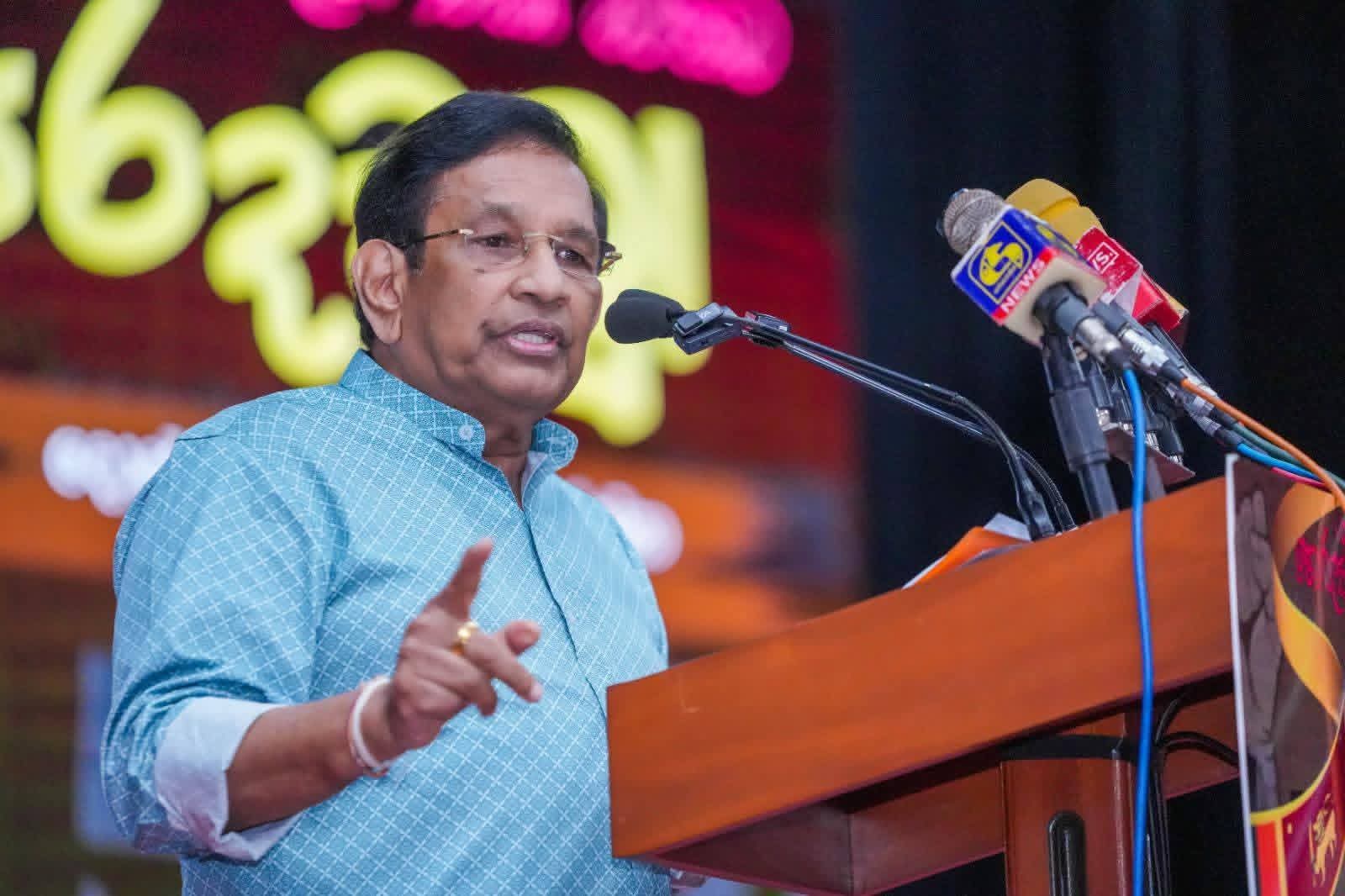
Former Sri Lankan minister Rajitha Senaratne has accused the Janatha Vimukthi Peramuna (JVP) of spearheading a violent campaign against the Provincial Council system in the late 1980s, claiming the movement was responsible for widespread attacks on state property and the first armed assault on the Temple of the Tooth in Kandy.
Senaratne, a former parliamentarian now affiliated with the New Democratic Front, an alliance led by the United National Party under former Sri Lankan president Ranil Wickremesinghe, made the remarks while discussing the history of the Provincial Council system and the political violence that surrounded its introduction, according to a report in the New Suthanthiran.
The Temple of the Tooth, or Dalada Maligawa, is one of the most significant Sinhala Buddhist sites on the island and houses a tooth relic believed by Buddhists to be that of Lord Buddha.
Speaking on the origins of the Provincial Council system, Senaratne said many who had struggled for provincial rights had suffered as a result. He argued that younger generations were largely unaware of the history behind the system and the political opposition that emerged when it was first introduced.
Senaratne said the Indo-Lanka Accord of 1987, signed after years of anti-Tamil violence and armed conflict, introduced a framework for provincial-level power sharing through the creation of Provincial Councils.
According to him, even the Liberation Tigers of Tamil Eelam (LTTE) had at one point agreed to a power-sharing arrangement, while the Sri Lankan government was taking steps towards implementation.
He accused the JVP of becoming one of the principal opponents of the Provincial Council system and launching an extremist propaganda campaign against it.
Senaratne claimed the JVP spread fears that people would eventually require visas to travel between provinces and carried out arson attacks across the island in opposition to the reforms.
He alleged that the JVP targeted state property on a large scale, causing major economic losses. Damage caused to government-owned buses alone amounted to more than Rs. 288 million during that period, he claimed. He added that the movement had also targeted government trains and private transport vehicles.
Senaratne further claimed that the LTTE was not the first organisation to attack the Temple of the Tooth in Kandy, alleging instead that the JVP carried out the first armed attack on the religious site in 1989.
“The same JVP that set fire to the country and damaged the economy now takes to public platforms and describes the political administrations of the past 75 years as a curse on the nation,” Senaratne said.
He argued that younger generations should study Sri Lanka’s political history closely in order to understand “who truly acted as a curse on the country”.
The former minister also criticised the JVP’s current position on Provincial Councils, stating that while the party once took up arms against the system, it is now in government and has failed to hold Provincial Council elections.
“We changed parties during our political journey, but the JVP has completely changed its fundamental principles in pursuit of power,” Senaratne said.
Provincial Council elections have not been held for years, leaving the institutions without elected administrations. The issue remains particularly significant in the Tamil homeland, where the Thirteenth Amendment and Provincial Councils have long been presented by successive Sri Lankan governments and India as a limited form of devolution, despite falling far short of Tamil demands for meaningful self-government and self-determination.
Senaratne’s comments come after JVP General Secretary Tilvin Silva recently said Provincial Council elections were unlikely to be held this year, citing the financial impact of Cyclone Ditwah and unresolved legal issues over the electoral system.
In a separate press conference in Colombo, Senaratne broadened his criticism of the JVP and also referred to the armed struggle of the LTTE, stating that if there was any “curse” on the country, it would be the insurrections led by the JVP and the armed struggle of the LTTE.
He argued that these movements caused severe damage to Sri Lanka’s development trajectory and had significantly disrupted the island’s economic progress.
Senaratne referred to a book by former Indian Foreign Secretary Shivshankar Menon, claiming it estimated Sri Lanka had suffered economic losses of around US$200 billion due to these conflicts. According to him, had those losses not occurred, Sri Lanka would not be facing its current economic crisis.
He also criticised members of the current Sri Lankan government over their handling of the economy, saying international financial institutions reviewing Sri Lanka’s budget and economic conditions had warned that the economy remained highly vulnerable.
Senaratne accused government figures of claiming there was no economic crisis and of acting as though they were economic experts without understanding the seriousness of the situation. He alleged that the current administration lacked awareness of the reality facing the country, contrasting it with previous governments which he said had at least anticipated crises and taken steps to address them.
Warning of further deterioration, Senaratne said Sri Lanka could face severe inflation and a deeper economic collapse by the end of the current administration’s term. He pointed to rising prices of essential goods and increasing shortages in the market, warning that such conditions could trigger renewed public unrest. He said that if people were unable to access food, protests would be inevitable, as seen during previous mass uprisings that were not necessarily led by political leaders.
Senaratne also questioned the government’s management of the economy, including the depreciation of the Sri Lankan rupee and fluctuations in the value of the US dollar, while criticising government statements that deny the existence of an economic crisis.
The former minister argued that simply having Wickremesinghe in parliament would not resolve the country’s problems. He claimed that a full transfer of national leadership responsibilities to Wickremesinghe was necessary to stabilise the country and said political activities were being organised towards that objective.
He insisted those efforts were not for the benefit of one individual, but for the country.
Senaratne said Wickremesinghe, whom he described as internationally recognised and experienced in economic management, would soon take part in public meetings and rallies.
According to him, only a political alliance built around capable leadership could guide Sri Lanka forward, and voters would ultimately decide who should lead through public opinion and democratic choice.
He warned that if the island was again entrusted to those he described as making false promises, it would return to a path of decline. He added that while legal proceedings were underway against the current government, true change would not come through courts alone but through the will of the people.