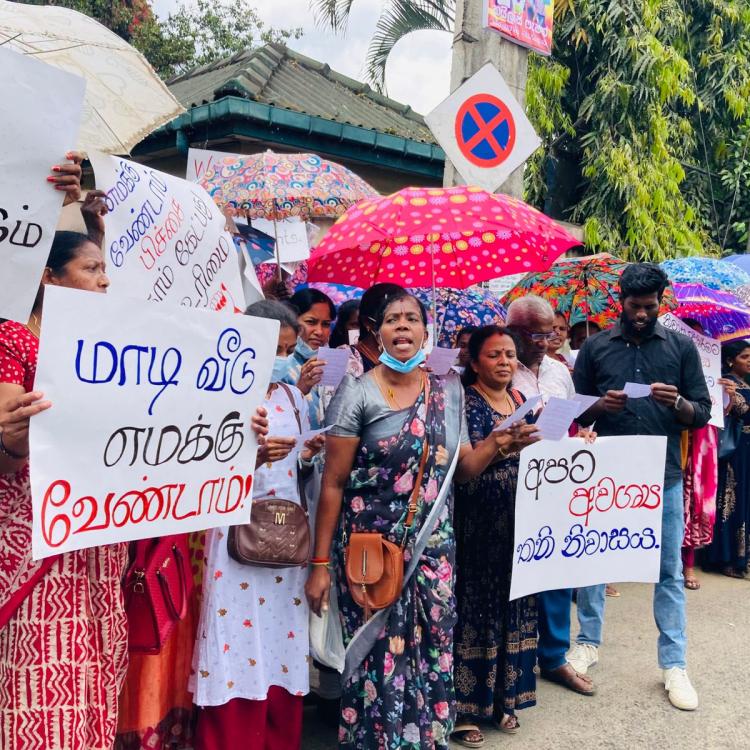

A new report by Amnesty International has found that Malayaga Tamil workers employed on private tea estates and smallholdings in Sri Lanka’s Southern Province are subjected to widespread labour abuses that may amount to forced labour under international law.
The report, titled “Abandoned by the State, Trapped in Private Estates: Rights Abuses Against Sri Lanka’s Malaiyaha Tamil Tea Workers”, documents severe exploitation faced by workers on privately owned tea estates and smallholdings in the districts of Galle and Matara. Amnesty’s investigation uncovered patterns of intimidation and threats, physical violence and harassment, debt bondage, restrictions on movement and unsafe living and working conditions.
Smriti Singh, Amnesty International’s Regional Director for South Asia, said the findings exposed systemic failures in both labour protections and state accountability.
“Private tea estates in Sri Lanka are systematically violating labour laws in their treatment of Malaiyaha Tamil workers with no accountability. Across the sites we visited, workers reported a consistent pattern of discrimination and abuse, including violence, debt bondage, withheld wages, and poor living and working conditions, raising serious concerns about forced labour. The persistence of these abuses despite existing legal safeguards reflects a serious failure of the state to enforce labour protections and safeguard workers’ rights,”.
Amnesty’s research was conducted between January 2024 and January 2026. Researchers visited 45 estates across Sri Lanka’s Southern Province and carried out 159 interviews with workers, former workers, estate managers, supervisors and other stakeholders.
The report argues that the longstanding discrimination faced by the Malayaga Tamil community has left workers particularly vulnerable to exploitation and abuse.
Researchers highlighted how landlessness and economic dependency further entrench workers’ vulnerability. Amnesty found that many labourers relied on estate management not only for employment but also for housing, making it difficult to challenge abuses or leave exploitative conditions. Workers on all 45 estates visited said they depended on employers for accommodation and lived in fear of eviction.
Amnesty also found that workers on many estates faced punishing production targets that pushed them deeper into debt. Of the 45 estates surveyed, 27 reportedly required workers to pick more than 25 kilograms of tea leaves per day. Labourers who failed to meet these quotas said their wages, already as low as LKR 1,000 (approximately US$3.10) per day, were reduced or withheld entirely.
One worker, identified as Subramaniam, described how management penalised those unable to complete assigned work. “If we do not finish the assigned work, they count three days of work as one day’s work. If we finish the work, they pay LKR 1,000 (US$3.10),” he said.
Amnesty warned that such practices trap workers in cycles of indebtedness to estate owners, amounting in some cases to debt bondage, recognised internationally as a form of forced labour.
The organisation also documented restrictions on workers’ freedom of movement. Labourers on at least 22 estates reported being subjected to curfews or requiring permission to leave the estate. Researchers further found that housing conditions frequently failed to meet basic standards for adequate housing, citing insecurity of tenure, overcrowding and inadequate sanitation facilities.
According to Amnesty, labour protections guaranteed under Sri Lankan law routinely fail to reach Malayaga Tamil tea estate workers in practice. The report states that employers on private estates and smallholdings “exploitatively misclassify” labourers as “casual workers” in order to deny them legal entitlements and statutory protections.
Many workers reportedly lacked access to benefits such as maternity leave, sick leave and pension entitlements. Amnesty also highlighted major barriers preventing workers from seeking redress for labour abuses, including language barriers when dealing with state institutions, discriminatory treatment by officials and the absence of formal employment documentation.
The report further found that trade union representation was either absent or actively suppressed across the estates surveyed. Amnesty said none of the estates visited had functioning trade unions and raised concerns over weak labour inspections and enforcement mechanisms in the tea-growing regions of Galle and Matara.
“The exploitation of Malaiyaha Tamil workers is being enabled by entrenched discrimination, extreme marginalization, and systematic mischaracterization of their status that deprives them of the protection of the law,” said Smriti Singh. “We urge the authorities to fully enforce the law, dismantle the barriers preventing the Malaiyaha Tamil community from accessing their rights, and strengthen labour protections and accountability across private tea estates.”