
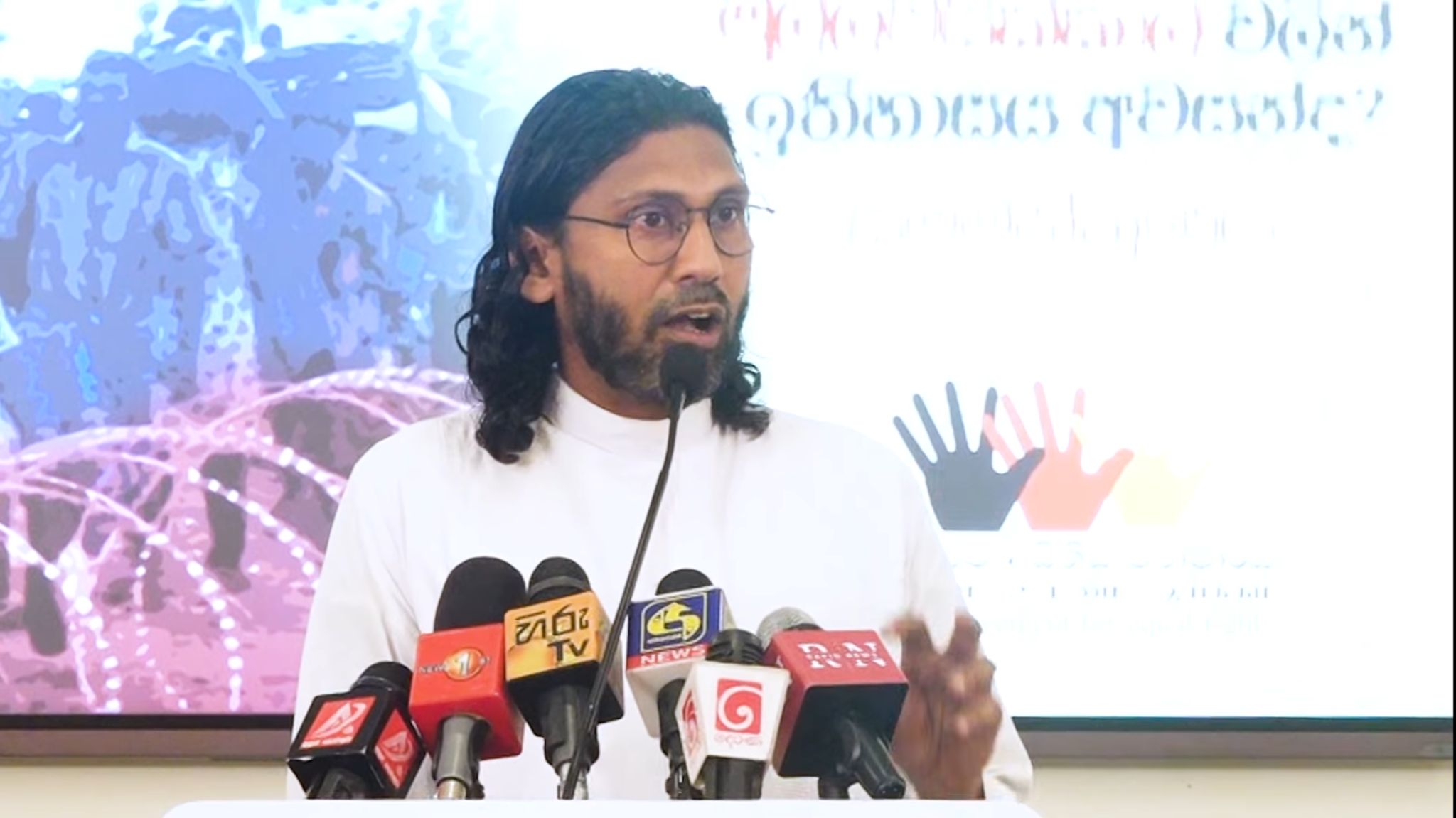
The full text of a speech delivered by Father Jeewantha Peiris on May 16, 2026, at the SEDEC Caritas Hall, at an event organised by the Movement for Equal Rights.
_____
I think it is very important that in this evening’s discussion we ask the question of whether Mullivaikkal marks the end of history, because what we are still reading is history written by someone. Most of the time, we are compelled to read the history shaped by elite Sinhala nationalist narratives. But I believe it is necessary to question what the real history is, as read through a subaltern, non-elite, genuine political analysis - especially at a moment like today, in an evening like this, and as citizens living in the year 2026.
We know we are talking about a genocide. When we read reports about this genocide, we encounter the figure of Father Francis Joseph, the former principal of St. Patrick’s College. From January to May 2009, Father Francis Joseph stayed with the people in the Mullivaikkal area - displaced civilians - within the final stretch of Nandikadal lagoon and the Mullivaikkal coastline, a strip of land about 12 kilometres long. This entire area was caged in by the state. Father Joseph, along with about seven other religious leaders, remained with the people inside that cage.
At St. Patrick’s School, the former principal, Father Francis Joseph, was 76 years old at the time. He was told by the people there, “Father, leave,” because they believed they were destined for death - for a collective death. But Father Joseph refused to abandon them. He chose to walk with the people until the very last moment.
On May 10, 2009, he wrote a letter addressed to the Pope in the Vatican. The reason was that he realized the Sri Lankan government, the United Nations, and all other organizations had failed to intervene in the crisis faced by the Tamil people.
At that time, when severe restrictions had been imposed on essential goods and people were dying of starvation, Father Joseph remained with the people in the Mullivaikkal area. In his letter, he wrote very clearly:
“Let it be known that under the guise of eradicating terrorism the Sri Lankan government is waging the war to annihilate the Tamil nation. It is a genocidal war.”
He emphasized that everyone must understand that under the pretext of eliminating terrorism, the Sri Lankan government was conducting a war aimed at destroying the Tamil nation - a genocidal war.
When sending this letter to Rome, to the Vatican, he also made an appeal: he said that the present Sri Lankan government, as well as all previous governments, had always taken the side of Sinhala nationalism, not the side of the Tamil or Muslim people.
Likewise, he writes in that article that the Catholic Church — even the central Catholic Church in Colombo — has by now abandoned the Tamil brothers in Jaffna, Mannar, Batticaloa, and Trincomalee, and instead has entered into an impure alliance with this nationalist state. He states that this is against Christian principles.
He also writes about the events of May 10, 2009, the night before. He notes that on the previous night, 3,318 killings were reported among the people. He describes how multi-barrel rocket launchers, mortars, artillery shells, and cluster bombs were unleashed, defining this violence as a crime against humanity. It is in this context that from January to April 2009, more than 15,000 killings were reported from the Mullivaikkal area.
At that time, about 190,000 people who had left their original villages were living in refugee conditions in the Mullivaikkal area. Then, making calculations, he - who had come there - was a retired school principal, highly knowledgeable in English, and an intellectual. He said that around 365,000 people were by then living in refugee conditions in the Mullivaikkal area.
In this so-called “No Fire Zone,” which was supposed to be a war-free area, the people were being subjected to artillery, multi-barrel rocket fire, and complete aerial bombing from above, suffering destruction and devastation.
Finally, on May 18, 2009, he himself disappeared. All international reports state that on May 18, 2009, he was taken onto a military truck. The reason was that he had spoken on behalf of saving the elderly Tamil civilians, and on the promise that he and the group would be handed back safely to the army. But that group, including him, remains missing to this day.
Altogether, 146,000 people went missing during that genocidal war in Mullivaikkal alone. From January 2009 to May 18, 2009, about 146,000 people disappeared. Among them, one individual was Father Francis Joseph.
When this topic is discussed in the South, many people say: “Yes, there was a mass killing. Yes, Tamil people were killed.” But many hesitate to accept it as genocide. So, what is the difference between mass killing and genocide?
A mass killing is often what we call mass murder. Thousands of people are killed, murdered, subjected to violence — that is what we call a mass killing. But genocide is what political science defines as genocide. Genocide is not just mass killing; it is a distinct category.
So, what is genocide? Under international law, there are two fundamental elements required for genocide. It is considered the ultimate crime. To qualify as genocide, two key factors must be present: the physical element and the mental element. Any crime is judged based on these — the physical act and the mental intent. For example, whether a human life was deliberately destroyed.
But for genocide, international law requires not only the physical act (the killing of people) but also two mental elements. First, the deliberate intent to kill a person as a human being. Second, the killings must be carried out with the specific aim of destroying the group to which that person belongs. That is how genocide is defined.
So, let’s take Sivaram’s assassination as an example. Sivaram was known as a Tamil journalist, a political analyst, and a poet. We know that Dharmaratnam Sivaram, also called “Taraki,” was abducted on April 28, 2005, in Bambalapitiya by men in a white van near the police station. After being abducted, within hours he was shot in the head, his body mutilated with sharp weapons, and found near Parliament. At that time, the area was considered a high-security zone.
Now, can we look at Sivaram’s assassination as just a murder? Or is it part of a larger act of genocide? The question we must ask is: if Sivaram had not been Tamil, would he have been killed? We know that Sivaram was continuously writing in favor of a political solution. That is why Dharmaratnam Sivaram was deliberately killed. Therefore, Sivaram’s assassination is part of the genocide.
So, what existed in Sri Lanka was not merely mass killings, but genocide. There was a desire to completely eradicate the Tamil community. This destruction was carried out continuously by the Sri Lankan government, with the involvement of geopolitical powers such as the United States and the United Kingdom.
So the question I’m asking is this: we usually say that in the Philippines Marcos had a dictatorial regime. We say in Germany there was Hitler. We still talk about how Auschwitz was entirely a concentration camp, or rather, a place of mass crimes. Cambodia had Pol Pot, Uganda had Idi Amin, Iraq had Saddam Hussein. Now, when we look at all of these, we understand something. We call that a “state of exception.” There have been military regimes, dictatorial regimes, and very brutal governments. But is Sri Lanka like that? From 1948 to 2026, what did all the Sinhala nationalist governments do? Instead of deliberately recognizing the Tamil people as a distinct group, they subjected them entirely to oppression and destruction.
So the situation in Sri Lanka is a state of exception by default. That means it’s not just one Pol Pot, not just one Idi Amin—it’s all the governments. From 1948 onward we know what happened, under every government:
• The Citizenship Act of 1948 was introduced.
• The Language Act of 1954 was introduced.
• The riots of 1956.
• The riots of 1958.
• Then in 1964, the Sirima–Shastri Pact.
• And in 1983, Black July.
Now, someone might look at this and ask, “Why talk so much about these things? Aren’t these just normal situations?” Or, when we discuss this in many places—as I have done over the past years—the common question raised is: “Why don’t you talk about the murder of Bikkus of Arantalawa?” “Why don’t you talk about the bomb under the Bo tree in Colombo fort?” “Why don’t you talk about the LTTE bombing of Kadirgamar?” “Why don’t you talk about the bomb attack on the train in Colombo Fort?”
We are not saying we don’t talk about them; we know about them. They are history. But they are not genocide. They are terrorists. Then the question is: who created terrorism? Terrorism was created by the Sinhala nationalist state. So we cannot simply blame all Sinhala people. But we know very well who the state serves today. The state serves imperialism and colonialism. Therefore, it is only through imperialism and colonialism that we can understand the state terrorism of this Sinhala nationalist state.
Here we are talking about ethno-nationalism. There is a Sinhala nationalist ideology. And right now, the NPP government is serving that ideology. All previous governments carefully ensured that the 1957 Bandaranaike–Chelvanayakam Pact and the 1965 Dudley–Chelvanayakam Pact were never implemented.
“So then, where does it end? Lenin once said, ‘When one nation completely oppresses another, it is like forging its own chains.’ Lenin was quoting Marx. So, when one nation fully oppresses another, it is indeed forging its own chains. Why is that? Because by doing so, it creates shackles for itself against its own enemy, against the capitalist. Even today in Sri Lanka we still suffer—on the 18th, thousands of mothers were beaten and killed on that sandy ground at Mullivaikkal.
So even though we reached 2022, symbolically, as our sister said, we must commemorate or at least remember; otherwise, we call it memorialization. That is a right. When we tried to remember at Galle Face, and later in Borella, Wellawatte, and everywhere else, what happened? These nationalist governments sent their thugs, their henchmen, to attack those gatherings.
Last year in Negombo, a similar program was organized. Because of that, Father Sherard and other organizers were summoned by the intelligence services and questioned: ‘Why are you organizing such events during peace? Why are you breaking peace?’ So, we ask: is this so-called reconciliation genuine reconciliation? Justice must truly be delivered to the people who suffered genocide.
So, the first question we cannot avoid is: did a genocide take place or not? If it did, we must accept that. There is evidence. History has proven it. When we go to Vietnam, when we go to Germany, those concentration camps are there. They are written into history. But even now, in Mullivaikkal, in Mullaitivu, in Jaffna, where entire communities were buried, where brothers were buried, all of that has been bulldozed. That is the clear question we face.
So, a genocide has taken place. And then, do we accept the Tamil people’s nationhood within national identity?
Often we say to the Tamil people, “Brother, let’s talk about a Sri Lankan nation.” But here’s the simple question. Imagine an elder brother and younger brother living in the same house under the father’s and mother’s authority. In the end, differences arise. The father always sides with the elder brother. The younger brother keeps saying, keeps asking, but every time the father beats him. Beating, beating, beating—finally the younger brother cannot bear it, leaves the house, and throws a stone at the house. He becomes hostile to the father. He says, “I will not come back to that house.” Then he plants a small sapling at the edge of the garden, because he kept asking not only to take the elder brother’s side but also his side. The father never listened, always beat him. So, the younger brother leaves and builds a small hut. Now the father says, “You are a terrorist.” Can we say that? The younger brother’s problem was never understood. Later, after everything, the father says, “Now come back home, all problems are over, after 2009 everything is finished, let’s live like brothers.” But the younger brother says, “I don’t feel safe in that house. I don’t feel safe when the national anthem is sung. I don’t feel safe under that national flag. That’s why I won’t come back.” Then what do we say? “No, no, no, this is a unitary state. This Sinhala state created by conquerors, this is it.”
We know that before independence there was a unitary state. So, this unitary state is essentially a colonial construct. That means, as a people, we have lost both the intellect and the heart to question it.
Therefore, it is very important to politically interpret the nationhood of both the Sinhala people and the Tamil people. Even those who call themselves socialists must revisit this understanding. The reason is that only within this framework can we seek a political solution to the problem.