
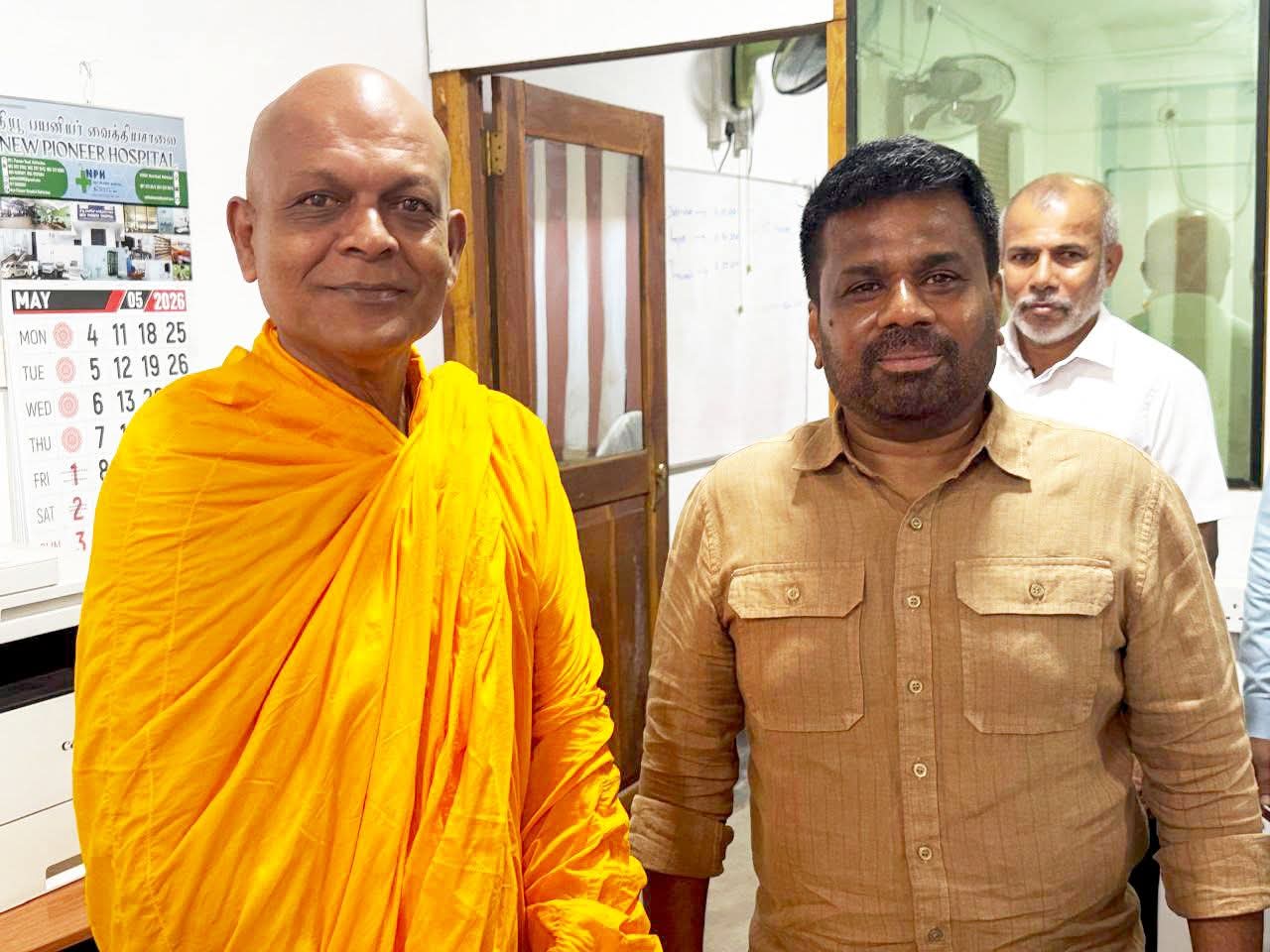
Notorious racist Sinhala Buddhist monk Ampitiye Sumanarathana has pledged his support to Sri Lankan President Anura Kumara Dissanayake following a meeting in Batticaloa earlier this month, announcing that he would distance himself from what he termed the "Rajapaksa Nikaya".
In a video statement released after the meeting, Sumanarathana said he had previously indicated that he would take further action if efforts to engage with Dissanayake proved unsuccessful.
He stated that he had sought an opportunity to meet the Sri Lankan President during the visit and initially did not expect such a meeting to take place.
According to Sumanarathana, senior police officers and officials attached to the Presidential Security Division facilitated discussions between the two sides.
During the meeting, the monk said he raised several concerns relating to the Eastern Province and claimed that Dissanayake assured him that steps would be taken to address the issues raised.
Expressing appreciation for the engagement, Sumanarathana thanked Dissanayake for granting him an opportunity to present his concerns and for listening to his views. He also stated that he was prepared to offer his "maximum support" to Dissanayake for the duration of his tenure and declared that he would move away from the Rajapaksa political camp, with which he has long been associated.
The monk also voiced support for what he described as the Dissanayake's efforts to steer the country in a positive direction.
A history of racism
Sumanarathana thero has long been one of the most extremist Sinhala Buddhist monks in Sri Lanka with a record of anti-Tamil rhetoric, intimidation and confrontations with public officials.
In 2023, he became the subject of an ICCPR case after making remarks in Batticaloa that prosecutors argued amounted to incitement of racial hatred.
In footage that circulated widely on social media, Sumanarathana threatened violence against Tamils, declaring that “every single Tamil person will be cut into pieces” and claiming that Tamils living in the south would be “butchered” and “massacred”.
The remarks led to legal proceedings and an arrest warrant after he failed to appear before court, before eventually being granted bail by the Batticaloa High Court in December 2025.
🚨Sinhala Buddhist monk threatens to slaughter Tamils in the Southhttps://t.co/OHwcn13du1 pic.twitter.com/3FJBdUxQEA
— Tamil Guardian (@TamilGuardian) October 26, 2023
The monk has also been accused of threatening state officials. In 2020, he was filmed berating Department of Archaeology officials in Chenkalady and threatened to kill a government officer during a dispute over an archaeological site. He warned the officer that he would use a pole to attack the official if his superiors did not appear.
“Tell your superior to come or I will take this pole and kill you,”
A year later, Sumanarathana disrupted activities at a Divisional Secretariat office in Batticaloa while demanding land for the construction of a Buddhist shrine.
Earlier incidents include a 2016 confrontation in which he threatened a Tamil government official, referring to him using ethnic slurs including “Tamil dog” and “bloody tiger”. He was also arrested after leading a group of hardline Buddhist monks named Bodhu Sala Sena (BBS) into Batticaloa and delivering anti-Tamil and anti-Muslim speeches.
Sumanarathana the has additionally faced criticism over anti-Muslim activism and was leading the anti-Muslim unrest in 2018, further cementing his reputation as a prominent figure within Sri Lanka's hardline Sinhala-Buddhist nationalist movement.
For many Tamils and Muslims, Sumanarathana thero has come to symbolise the Sinhala-Buddhist supremacist politics that has repeatedly been linked to violence, intimidation and hostility. Successive governments and law enforcement authorities have failed to hold him accountable for inflammatory conduct, allowing him to continue operating with a degree of impunity often associated with politically connected members of the Buddhist clergy.