
Today, across the homeland and around the world, Tamils are once again gathering to remember the dead. The Eelam Tamil calendar is scarred with memorials of massacres and killings, each date carrying its own weight. May 18 is different. It marks not one atrocity among many but the culmination of decades of state violence against the Tamil nation encapsulated into a single day of almost unimaginable horror. It is the date when Sinhala chauvinism was at its most brutal, when the indifference of the world was at its most brazen, and when it became devastatingly clear that the future of the Tamil nation lay solely in our own hands.
Seventeen years on, the Tamil people have not forgotten. In every corner of the North-East, red and yellow bunting has been hung and kanji served. At Mullivaikkal itself, some 10,000 people have gathered today in the very ‘No Fire Zones’ where thousands were slaughtered in the final days of May 2009.
These are not government-backed initiatives. They are acts of defiance carried out in the face of continued intimidation by security forces, and under the shadow of draconian anti-terror laws that successive governments, including this one, have retained precisely because they remain useful instruments of suppression. The grip may have loosened fractionally. The threat has not gone away.
The deliberate choice to keep such legislation is another example of how almost two years into a yet another regime, there has been scant material change for Eelam Tamils. Anura Kumara Dissanayake is the fifth president of Sri Lanka to hold office since the massacres at Mullivaikkal. He was elected on a wave of anti-incumbent enthusiasm and the cautious, qualified hope among some Tamils that something - anything - might shift. Yet, he will not be marking May 18 in mourning with the Tamil people. According to reports, he will instead be attending a “National Victory Day” ceremony tomorrow, celebrating a military triumph that cost tens of thousands of Tamil lives. That choice tells its own story.
It comes alongside his repeated denouncing of international accountability initiatives, the continuation of the military occupation, and the ongoing Sinhala Buddhist colonial schemes in the Tamil homeland that in some regions appear to be gathering pace. Whatever cautious goodwill was extended to him has been squandered, and his regime is growing rapidly unpopular even among those who once gave him the benefit of the doubt.
If anything, the NPP's seemingly rapid abandonment of even the pretence of caring about Tamil aspirations confirms what the Tamil people have long argued: that the problem is not the character of individual regimes. It is the nature of the Sri Lankan state itself.
And yet, even as Colombo refuses to reckon with the genocide, the world is moving. Around the globe, calls for genocide recognition and accountability have grown louder and more organised. Lawmakers across multiple countries have joined formal demands for justice. Commemorations this year are larger and more prominent than those of the year before, and those were larger than the year before that. While the Sri Lankan state’s “victory” monuments in the Tamil homeland continue to blight the North-East, memorials dedicated to the victims are rising in cities across the world. The Tamil cause is not receding. It is internationalising.
May 18 is a day of mourning, but it is also a day that clarifies the resolve the Tamil nation has shown in its relentless and unceasing pursuit of justice. It is a determination that has entered homes, offices and parliaments, and has become embedded in a new generation that was not yet born when the guns fell silent but that has grown up knowing precisely what was done and in whose name.
The dead are not forgotten. They never will be.
_____
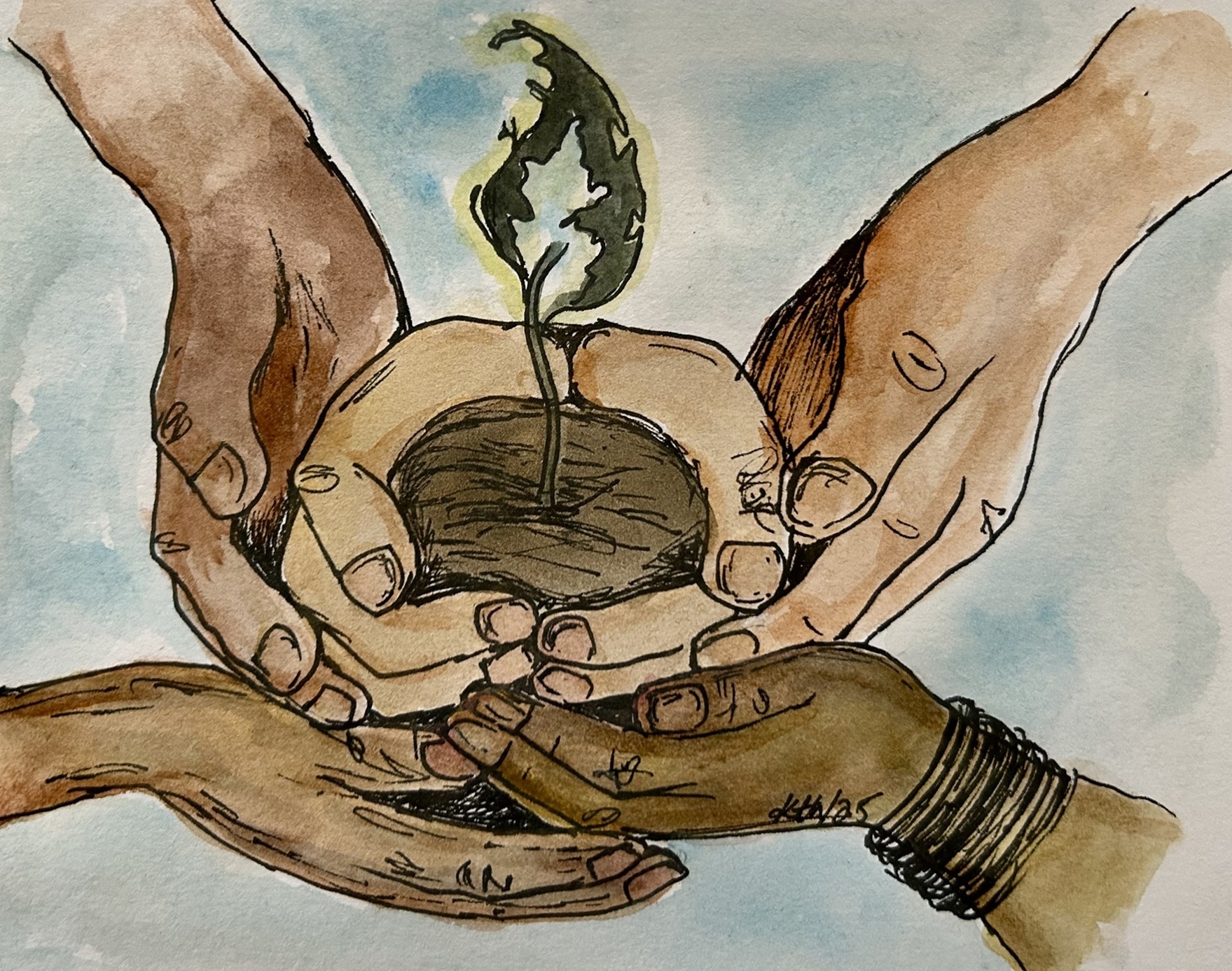
Illustration by Keera Ratnam / wavesofcolour