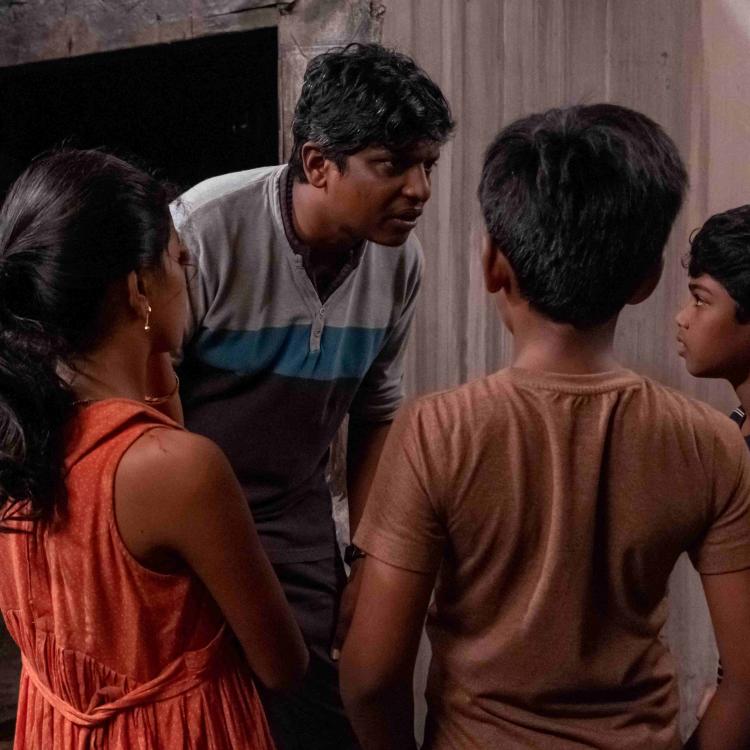

Ahead of the release of his production company Stone Bench’s latest release ‘Neelira’, producer Karthik Subbaraj sat down with Tamil Guardian to discuss the upcoming film as well as diving into a quick retrospective of his career.
What made you decide to produce 'Neelira'?
From my short film time, I always am… very deeply empathized with the Eelam Tamils and the plight of the war and everything – not just because I'm a filmmaker. Even if I was not a filmmaker… I used to work in an IT field… I think when I was working in Bangalore, and that's the time the war was at its peak, and there was a protest that happened in Chennai, like a human chain protest. So at that time I came down to Chennai to participate in that, just to show my empathy towards people dying there.
And then when I got interested in filmmaking, and… I started making short films… The initial stories – all I could think [of] for a short film… what would be the perspective of smaller things, or things that [are] very normal, or things that give happiness to us – how [can it] be perceived by people from the land of the war? That was my first short film… And also, like, if you see my short films [on] my YouTube channel – everything had that connect[ion].
I always wanted to make and direct films like ‘Life is Beautiful’... like ‘The Pianist’... During [my] school days, in history books I have read about World War Two, about Hitler… it's all very… theoretical – I memorized it to write answers. But I have never actually felt or [got] to know what war can do to a person…

Films like Mani [Ratnam] sir’s film ‘Kannathil Muthamittal’ or Bala sir’s ‘Nandha’ [speaking about the refugee camps]. I'm from Madurai, I know that during my college, we came to know that even Madurai has people [at the refugee camps]. They were trying to survive by working here and people usually don't give them [a] job or [a] place to stay. So they stay in the [camp]... they get out of the room in the morning, and then they go back to the camp by the evening. So why has [there] not been very serious films about it?
I started a production house – Stone Bench – producing films. I thought, “Okay, I should be doing films like this.” But then I also got to know Somee[tharan], I think during my ‘Jigarthanda’ time in 2014. When I met him, he had already made a lot of documentaries about war, about the [Jaffna] library event… I know Somee also wants to make a film… So I kept telling him, “Okay, let's discuss some story which we can produce... Maybe we had a very exciting story that could be made [on] a very low budget.” And when Someetharan told the story of ‘Neelira’, I was really moved and really touched… It also had a very mainstream element… It's not just like a docudrama, but it had potential to be like a mainstream theatrical hit film here. I mean people – [who don’t] have any idea of war… they [can] come into [the] theatre and watch the film… This film will keep you engaged, keep you gripped… like watching a thriller... So then we decided, “Okay I should produce it.”
All throughout your filmography you have been drawn to stories either openly or subtly speaking about the genocide. Why do you feel compelled to tell Eelam Tamil stories?
So I don't see this as a topic, or it's like a point of interest… I don't see it as a ‘there's a good scope to make a story from this’. I always believe that the art form – cinema as an art form – is very powerful, and it has [the] capability… to move people, to create an awareness… to make people understand, what is reality, what is history and all that. So it is [a] very strong tool – [a] very strong weapon. That's what I tried to [say] in ‘Jigarthanda DoubleX’ – cinema, can actually lead to… justice, even though it might be delayed. Because in ‘DoubleX’, the entire plot is the entire government, the politics, everyone… they commit a genocide. And when they don't have any other hope, the entire… tribe believes in cinema… and then… cinema gets them justice in the end. So I actually strongly believe that – it's not just for the story’s point of view for ‘DoubleX’ – I actually believe that cinema has the capability to do that sort of thing.
Even in ‘Jigarthanda’, there's one dialog… when Siddharth asks his uncle about the gangsters, he just says, “No, I'm a journalist. I cover only politics and Eelam.” And then Siddharth says, “I think both are [the] same.”
So it was always to create a stronger impact to a film, or at least… put a thought that – it's not something that you could move on from… keep reminding them that this has happened. There have been lives lost. There have been still a lot of people I know who I’ve met who can't go back to their homeland… going away from home, it's an emotion everybody could actually relate but when it comes from the reason… of war… that pain, the actual emotion, I always wanted it to be conveyed through film… I wished it to be touched upon.
And also it has to be mainstream… This is my first step through ‘Neelira’... We are starting so that people here – other producers, other directors – they all come forward [to make their own stories, with the belief] people are going to watch it… it can be mainstream cinema. It's not just for very niche festival[s]... I mean, people are open to watch it, but we don't give it to them, that's what I think…
And even if we ask people in Tamil Nadu, many people… have that emotion towards the war… they see the same Tamil people who lived in a land that is not very far from Tamil Nadu – a few kilometers of sea separate [them].
I strongly still believe that… when it comes [out], they are going to see a film from [Eelam], with all that heart and soul… I think they will also relate, and they will also watch it.

Do you have any regrets with how you handled the topic in any of your films? Do you feel like there’s anything you could have done differently?
I always make sure, because since I was not from there, and I'm… doing… research and trying it out and then putting [it] into the film, I always wanted it to be… said right – politically right or emotionally right... So I've done all the prep work for all of it....
But I mean, once the film is out… I had both points of view; some people were really touched upon seeing this, and some people [have] told ‘it’s not right’... And I've learned from that… some things which I felt, “Okay, there's a point in what they are saying”... I used to take it, and if there is no point in what they are saying, I just ignore that. I do my homework before shooting something in this zone.
I think [the] major criticism – I got it for ‘Jagame Thanndhiram’... I show[ed] the female protagonist has come from there. And then the character played by Joju [George] is… a person who… became a gangster because he wants to be… a protector…
I actually show[ed] the [journey] of the female protagonist, played by Aishwarya Lekshmi… [how] they [came] from Sri Lanka, how they traveled… the route, and then they reached London, and then how they [struggled] to get a life…
There were also some comments [saying], “... we are not gangsters…” But that was not [what was] actually meant. My intention [was] not to show them as gangster[s]... We have seen films like ‘Nayagan’... it's a gangster film… but he just stands for his people, and there is no other option; he needs to take a weapon and then he needs to fight for his people. Some comments, I could see that… it was… a general bashing that was also happening. But I… also got what they were saying.

Toxic masculinity is a theme you have explored in a lot of your films, most predominantly in ‘Iraivi’, ‘Retro’ and the ‘Jigarthanda’ films. Why are you drawn to this deconstruction and exploration of masculinity?
I think even if you take a war… mostly it starts from a conflict between somebody's decision… somebody's ego… I’m not saying all the wars – but somebody’s ego is hurt and he has that power and he has that authority. [The] same thing applies to a small house also – in-between a couple, a husband and wife… whenever you feel that you have that authority to cause a restriction… or you feel that you are bigger than them… you take a step to start the conflict… So, it's always there…
I always like to explore the gray shade in everybody's life. People can be portrayed or seen as very good people… even inside them, there is a little gray shade, and that comes [out] only when the situation pushes them to or exposes them. Until then, they could be in that shell of being a good person. And also, the person whom you see as an extremely bad [person]... that might also be like a shell... So that's [the] kind of stories and character[s] I would like to explore.

Five films that have inspired Karthik Subbaraj.
1. The Shawshank Redemption (dir. Frank Darabont) – One of my most favourite. It changed my perspective of cinema… I would say that it is the first film that is out[side of the] usual consumption of a guy from Madurai who is watching films in theatres.
We watch English films like ‘Jurassic Park’, ‘Rambo’, Jackie Chan films. I watched it when I was working in IT… when my interest started towards filmmaking… I [had] not even thought of getting [into films] seriously – like a full time filmmaker... But I just thought, “Okay, let me make some short films”.
One of my friends told me, “You should also watch other films. It is not… like popular films (action films)”.
So, I think I was working [in the US] at the time and I think in Walmart there used to be a big basket where they sell the original DVDs for like $5.
It sort of gave me [a lot] about writing: what is the screenplay and how to build a character… It actually opened a new perspective towards filmmaking and a new perspective towards film-watching.
2. Thalapathi (dir. Mani Ratnam) – I came from Madurai and my dad… he watches films whenever he's free – whether it's a weekend or a weekday… He worked… for a pharma company, so he used to travel a lot, but whenever he's… at home, he used to go for a film…
But at that time itself, for me, Mani [Ratnam] sir’s film made an impact – I [didn’t] even know the director's name, you just go to the film and watch [it] for the action. But before that, I was fascinated by Thalaivar – I was a Thalaivar fan right from my childhood. So like that, I went for ‘Thalapathi’, but then that had something more than what you see in other Thalaivar films. Even now, when I’m scrolling, and I see [a scene], I end up watching the whole film again.
3. Mullum Mallarum (dir. Mahendran) – As I said, my dad is also a Rajini fan… we used to… keep watching films like ‘Annamalai’, ‘Basha’ and everything…
This was during [the] 90s… There is always a comparison: Thalaivar is for the style and Kamal sir is for the performance. So my dad is also a very ardent fan of Thalaivar so he's like even Thalaivar has done films which is hardcore performance [oriented]... And he gave me a list of films and said “watch this.”
[Mahendran sir] is an extraordinary filmmaker – the way he writes characters, the emotions, the relationships… It's very tough to write.
4. Moondram Pirai (dir. Balu Mahendra) – I don't remember exactly at what age I saw the film, but when I saw it… I couldn't come out of the shock of the climax [even now] – the railway station scene… And the songs, even at that time, had a huge impact [Kanne Kalaimaane]. But the climax… It was very hard for me to come out of the film at that age.
5. Moondru Mudichu (dir. K Balachander) – KB sir is always… way ahead of his time in thinking… and it's not like much… action. I mean, all his main protagonists – or his entire plot point – will be between a family or two people in love. But the relationships – the complications in the relationship he creates – and how he resolves [them] is extraordinary.
It has everything. I think [it has] one of the peak villainisms of Thalaivar.
'Neelira' is scheduled to be released in cinemas worldwide on 3rd April 2026.
Official trailer for film below.