
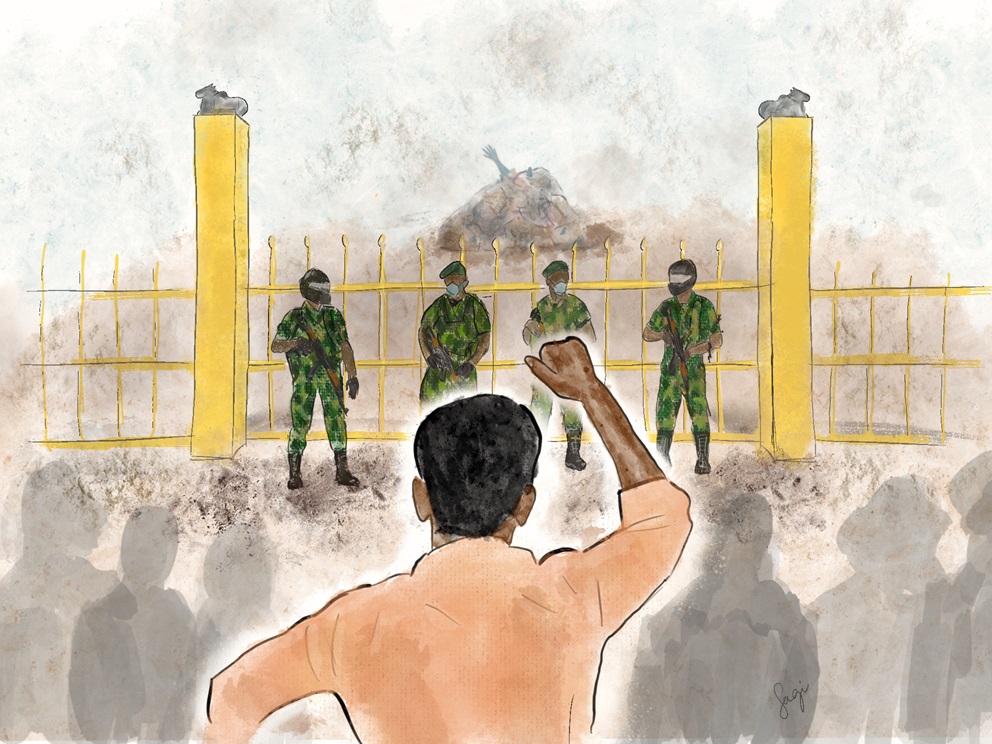
The interrogation of student leaders at the University of Jaffna marks a deeply troubling escalation in the Sri Lankan state’s long-standing efforts to suppress political expression in the Tamil homeland. What was a symbolic act of protest has been met with harassment, intimidation and criminal investigation. It exposes once again the fragility of claims that the island has entered a new era of reform under the National People’s Power (NPP) regime.
On February 4, students at the University of Jaffna lowered the Sri Lankan lion flag – an emblem that has come to symbolise the decades of repression - and raised a black flag in its place. It was a peaceful, political protest that reflected a sentiment widely held across the Tamil homeland. For Eelam Tamils, Sri Lanka’s ‘Independence Day’ does not represent freedom but the continuation of structural subjugation. It was the moment that one colonial power was replaced by another. The student’s demonstration was not new or isolated. Across the North-East, as has been done for decades, black flags were raised, highlighting decades of unresolved grievances, occupation and the denial of Tamil nationhood.
The response from the regime in Colombo has been swift and, sadly, predictable. Police entered the university premises in a vehicle and interrogated the Vice-Chancellor and Registrar for hours. The presence of armed state officials within a university campus, questioning senior academic figures, is itself a violation of institutional autonomy. It signals a deliberate attempt to bring spaces of learning under the shadow of state control.
The subsequent summoning and interrogation of student leaders represents a further escalation. Students were called in for questioning, subjected to hours of interrogation and informed that further action would be taken following consultation with the Attorney General. These are not the actions of a state confident in its democratic credentials. They are the actions of a state that views dissent as a threat.
Students have rightly responded with protest and a boycott of lectures. Their message is clear. The investigations are attempts at intimidation and intended to send a warning to an entire generation of Tamil youth that political expression will be monitored, questioned and, if necessary, punished.
This pattern is not new. Tamil universities have long been sites of surveillance and repression. From the heavy militarisation and intelligence infiltration of campuses, to the monitoring of student unions and the disruption of memorial events, the Sri Lankan state has consistently sought to control and curtail Tamil student activism.
What is different today is the political context in which these actions are taking place. The current government came to power promising reform, accountability and a break from the excesses of the past. Yet, more than a year into its mandate, the same tactics of intimidation are being deployed against Tamil students. The interrogation of student leaders over a peaceful act of protest reveals the limits of these promises. It demonstrates that when it comes to the Tamil nation, the underlying structures of control remain firmly intact.
The students’ explanation for their actions is both simple and profound. Sri Lanka’s ‘Independence Day’ cannot be meaningful to Tamils so long as their political aspirations are denied. This is not a radical position. It is a reflection of lived reality and a sentiment shared across the North-East, shaped by decades of marginalisation, dispossession and violence.
The events at the University of Jaffna are therefore not merely about a single black flag or an individual act of protest. They are about the ongoing struggle of a people to assert their political rights in the face of a state that continues to deny them. The courage shown by students in resisting this intimidation must be recognised and supported. Their protest is part of a broader continuum of Tamil resistance that has endured.
For the Tamil nation, the struggle for justice, dignity and self-determination is far from over.
____
Art by Sagi Thilipkumar