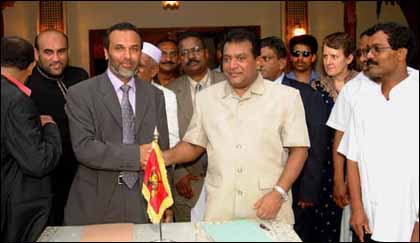
Hakeem with Prabhakaran in 2002.
Sri Lanka Muslim Congress (SLMC) leader Rauff Hakeem has recalled in detail his meeting with Liberation Tigers of Tamil Eelam (LTTE) leader Velupillai Prabhakaran in 2002, describing the reception accorded to Muslim representatives in Kilinochchi as one of extraordinary respect.
Reflecting on the visit, Hakeem said that when arrangements were made by Norwegian peace facilitators for Muslim representatives to meet the LTTE leadership, the delegation was received with exceptional formality.
“When arrangements were made by Norwegian peace facilitators for us to meet the leader of the Liberation Tigers, as representatives of the Muslims, and conduct peace talks, we were given an overwhelming reception in Kilinochchi. This was not an ordinary welcome. It was the kind of reception given to a head of state.”
He described how LTTE cadres lined the streets during their arrival.
“On both sides of the streets, female cadres were positioned, with their salutes (hands held upright against their chest). At every 50-foot distance, a person stood guard and we were accorded great respect.”
Hakeem said the delegation held discussions with Prabhakaran for several hours, during which an unexpected interruption took place.
“We met with the leader of the Liberation Tigers and held discussions for around 4 1/2 hours. Then something happened that no one would have expected. In the middle of the talks, another very important matter occurred.”
According to Hakeem, Prabhakaran halted the meeting to allow Muslim representatives to observe their prayers.
“Around 12:10, The leader of the Liberation Tigers said, ‘We will pause the talks now. It is time for your prayers. We have made the necessary arrangements, you may conduct your prayers and then return.’ We were all surprised.”
He added that following the prayers, the LTTE leader hosted the delegation for a meal, addressing concerns about dietary practices.
“After the prayers were completed, he hosted a grand feast for us. I initially had some hesitation. Even then, the leader of the Liberation Tigers told us ‘Don’t worry, we have prepared the food in line with your practices’.”
Hakeem recalled how Prabhakaran introduced the cook responsible for the meal. “As we still hesitated a little, he called over someone. Then a bearded man with a white shirt came forward. I had my doubts but we greeted each other with ‘As-salamu alaykum’ ‘Wa alaykumu as-salam’. Then he said, ‘I am the one who cooks for the Leader. I have been with him this entire time’ Prabhakaran added, ‘He is the one who cooks for me, now you’ll also be tasting his food’.”
Hakeem said the meeting also included senior Muslim political figures from the North and East.
“At that time, our former Vanni Minister Noordeen Mashoor was with us. Athaullah was also there. Around 5, 6 of us were there in total.”
He further recounted a personal disclosure made by Prabhakaran during the talks.
“Not only that, the Leader also shared that when he was fleeing from the Indian army, wounded and broken, a Muslim family in Silavathurai hid him and kept him safe. He said he would never forget that.”
Hakeem acknowledged that this raised difficult questions regarding LTTE Muslim relations.
“When we heard this, we did question why did the LTTE then conduct themselves in a particular way towards us. But we were not in a position to ask these things.”
During the discussions, Hakeem said Muslim representatives raised two central issues, including the return of displaced Northern Muslims and the taxation of Muslim businesses in LTTE-controlled areas.
“In our talks, one of the key issues we stressed was about enabling Northern Muslims to return and resettle.”
He described the taxation issue as particularly sensitive. “Another very difficult issue we brought up was: In the North and the East, Muslim businesses were being subjected to an external tax system imposed by the Tigers.”
Explaining Prabhakaran’s response, Hakeem said the LTTE leader justified the taxation policy on practical grounds.
“The Leader replied,” We usually have a system of collecting taxes in the North and East. Every 5 shops in the area, there will be around 4 Tamil owned businesses and 1 Muslim owned businesses. So, if we only collect taxes from the Tamil businesses and skip the Muslim ones, it will be a difficult thing to do. Therefore, you must try to understand this.”
Hakeem said he responded cautiously but directly.
“I hesitantly replied, ‘Amongst the Muslims, there is no prevailing sense that your struggle is also being carried out on behalf of Muslims. In this situation, there is a perception that Muslims are being viewed not as contributors but as people subjected to extortion.’”
He said Prabhakaran immediately reversed the policy.
“The moment I said this—The leader immediately declared that from that very day onwards, no taxes would be collected from Muslims anywhere.”
Hakeem noted that while some commanders expressed displeasure, the decision was final.
“Although some Eastern commanders who were present appeared displeased, once the leader had stated it, no one spoke in opposition.”
He added that subsequent issues were addressed through direct communication.
“Since this decision, whenever we experienced any issues, I would frequently be in telephone conversation with Thamilselvan. Things would get sorted.”
Reflecting on broader Tamil–Muslim relations, Hakeem said historical realities must be acknowledged. “The fact that Muslims once lived in what Eelam Tamils continuously celebrate as their capital is a historical reality. The fact that an episode occurred which sought to erase or deny this causes all of us great sorrow. What adds to that sorrow is that those people are still alive today.”
Referring to the LTTE’s expulsion of Muslims from the Northern Province on 30 October 1990, Hakeem recalled how the issue was addressed publicly.
“In a particular year, when the national leader came for peace talks, a question regarding that was famously raised at that very press conference by N.M Ameen. When that question was asked, the leader of the Liberation Tigers looked around and did not speak to his chief ideologue Anton Balasingham either. What he said immediately was that it was a tragic incident, and that they had nothing further to say about it. That statement itself has become another historical record.”
“Jaffna is their (Muslim’s) own land. Unfortunately, difficult circumstances have rendered these Muslim people refugees. We very much regret that this has happened,” LTTE leader Velupillai Prabhakaran told the BBC in an interview in 1994.
Political strategist Anton Balasingam also apologised to the Muslims after the 2002 talks with Hakeem. "I made an apology to the Muslim people that what has happened in the past has to be forgotten, that we are willing to talk to them and resolve their problems," Balasingam said, assuring Muslims that they could return to their homes in the North. He stressed that the Tamil homeland and the Tamil territory in the North-East "belonged to the Muslim people also".
Hakeem stressed that his remarks were not intended to justify past actions. “I am not saying all of this to justify anything. It is a clear fact that even the Tigers themselves realised that the expulsion of Muslims from the Northern Province was one of the greatest mistakes in the history of the LTTE’s struggle. Not only that, honest Tamil leaders have stated the same too.”
Hakeem said these experiences underscored historical bonds between the Tamil and Muslim people.
“I am reminding you all of this because, there is a long-standing bond between Muslims and Tamils. In the past, we had carefully set some ground work and built a relationship to maintain that bond. However, we have now allowed ourselves to be divided in such a manner.”
Hakeem met with Prabhakaran in April 2002, when he led an SLMC delegation to the LTTE-controlled town of Kilinochchi and signed an agreement to cooperate on matters relating to Sri Lanka’s Muslim community. At the time, Hakeem said, “LTTE have given favourable answers to questions and concerns raised by us.”
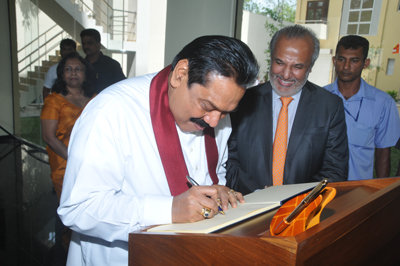
File photo: Hakeem with accused war criminal Mahinda Rajapaksa.
However, Hakeem’s recollections have drawn renewed scrutiny in light of his political role within the Sri Lankan state. He served as Minister of Justice under Mahinda Rajapaksa from 2010 to 2014, shortly after the mass atrocities committed against Tamils at Mullivaikkal.
During this period, Hakeem lobbied against international accountability efforts at the United Nations Human Rights Council and dismissed allegations of war crimes and genocide.
When asked whether Sri Lankan security forces had committed war crimes or human rights abuses, he replied “certainly not”, characterising civilian deaths as “collateral damage”.