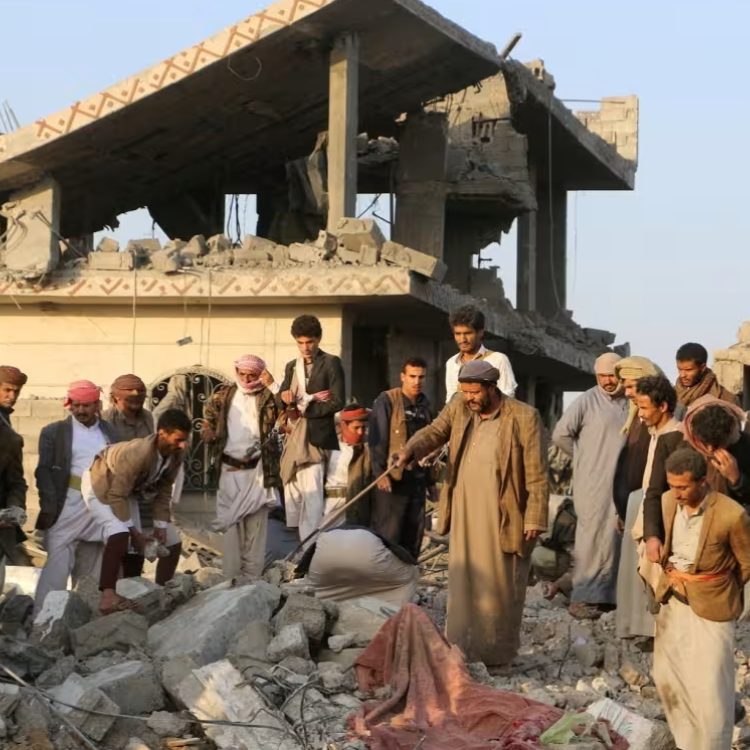

The Southern Transitional Council (STC) seized the Hadramout governorate, gaining control of all eight governorates in what was formerly known as 'South Yemen'.
The STC, considered the largest military faction in Southern Yemen, is backed by the United Arab Emirates (UAE). The group had participated in a power-sharing agreement with the internationally recognised government through the Presidential Leadership Council (PLC).
However, the core demands of the STC remained the same, which were the restoration of an independent state in southern Yemen. An independent state called the People’s Democratic Republic of Yemen existed there from 1967 to 1990, before it merged with the Yemen Arab Republic in the north of the country.
Following the capture of Hadramout, the flags of the People's Democratic Republic of Yemen, also known as South Yemen, were being flown across military institutions aligned with the STC.
The rapid seizure of land has strained the already fragile allegiance between the Saudi-backed government and the STC, which has led to a full withdrawal of Saudi troops from the southern capital of Aden and its airport.
Yemen’s government condemned the STC’s latest military advance and land grab across the south and labelled the group separatists – calling their action a “unilateral and a blatant violation of the transitional phase’s framework”.
The PLC was established in 2022 when former Yemen President Abd-Rabbu Mansour Hadi formally transferred his powers to the new eight-member body. Its mandate is to manage Yemen’s political, security, and military affairs during a transitional period and to steer negotiations towards a permanent ceasefire.
Speaking on the consolidation of territory, STC representative Amr al-Bidh told Reuters news agency.
“We are concentrating on unifying the operational theatre of our armed forces to enhance coordination and readiness to reinforce stability and security in the south, as well as combating the Houthis should there be a willingness to head in this direction.”
Commentators state that STC will further consolidate its power in the region and possibly push for independence, but the regional complexities mean this could further inflame conflict in the region.
The complexities of Hadramout
Hadramout is a crucial and essential governorate in Yemen, occupying more than a third of the country’s area, approximately 200,000 square kilometres (77,000 square miles), with a population of nearly two million.
It is home to the largest share of Yemen’s oil wealth, containing important oil fields and export terminals. Hadramout governorate has always had a unique political and administrative character throughout all eras and political systems, especially during the socialist regime that ruled the South from the early 1970s until 1990, when the two Yemeni parts, North and South, unified.
This unique character continued under the unified state, as Hadramout remained governed by its own people and refused to accept officials from outside its geographical boundaries. Consequently, the people of Hadramout consider the STC’s control over it an unprecedented occupation. Therefore, the stability and continuity of the STC’s authority in the governorate are doubtful because the group lacks local and popular support.
Read more from The Guardian here , Al Jazeera here and The New York Times here