
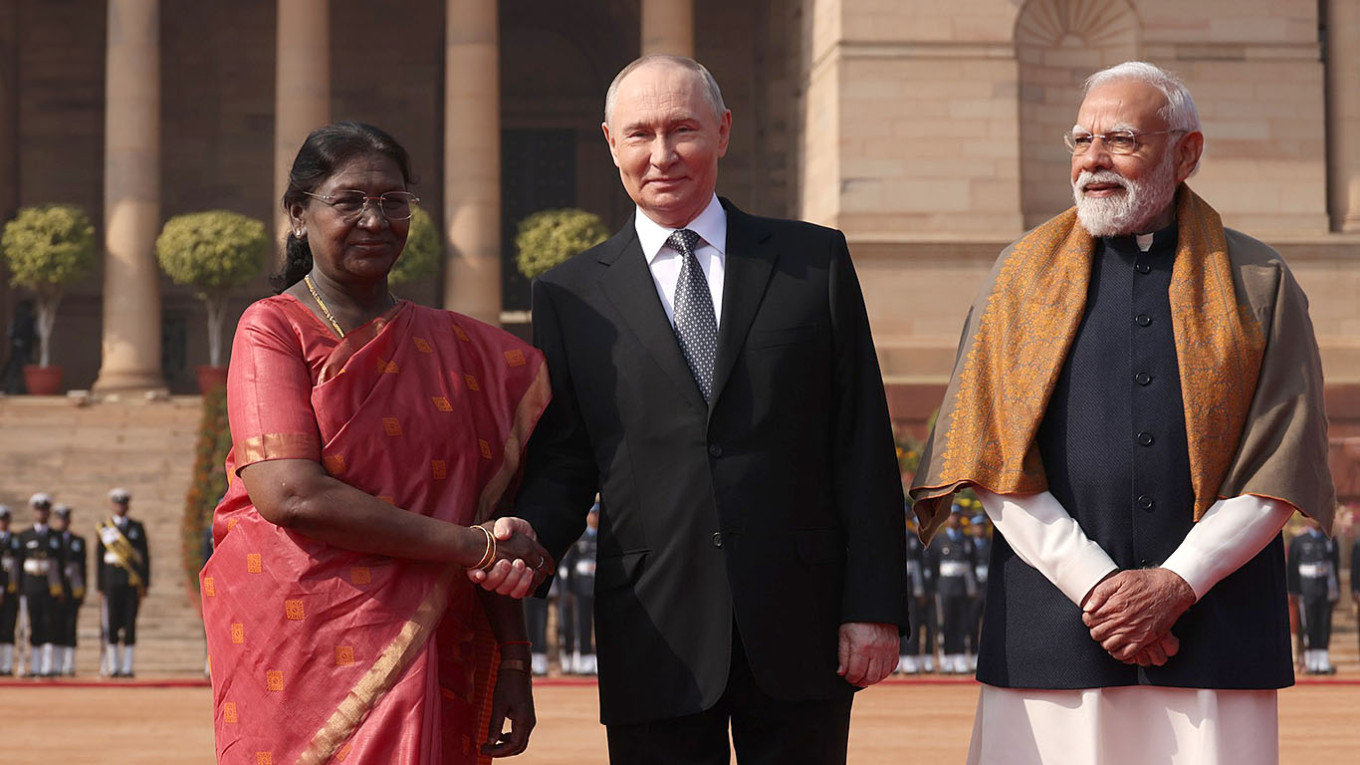
Indian President Draupadi Murmu shakes hand with Russian President Vladimir Putin alongside Indian Prime Minister Narendra Modi.
Russian president Vladimir Putin has pledged to ensure “uninterrupted” oil shipments to India as he met prime minister Narendra Modi in Delhi for the annual India–Russia summit, where he said both countries were working towards a more “multipolar” world.
The pledge follows the decision by US president Donald Trump in August to impose an additional 25 percent tariff on Indian goods, on top of existing duties, over New Delhi’s continued purchase of discounted Russian oil. Washington has argued that India’s imports undermine sanctions and help bankroll Russia’s war in Ukraine.
Putin however said “Russia is a reliable supplier of energy resources and everything necessary for the development of India’s energy sector”.
“We are ready to continue ensuring the uninterrupted supply of fuel for the rapidly growing Indian economy.”
Modi did not directly reference oil in his public remarks, but said that “energy security has been a strong and important pillar of the India-Russia partnership”. In a television interview ahead of the summit, Putin also defended India’s right to continue purchasing Russian fuel, saying, “If the US has the right to buy our [nuclear] fuel, why shouldn’t India have the same privilege?”
Putin’s visit marked his first trip to India since Russia’s invasion of Ukraine. Modi broke with protocol to personally receive Putin at the airport on Thursday night, greeting him with a hug before the two travelled together to the prime minister’s residence for a private dinner. The gesture was widely interpreted as a signal that India intends to preserve what it calls its “strategic autonomy” between Washington and Moscow.
In his official statement, Modi described India’s partnership with Russia as “a guiding star” and said that “based on mutual respect and deep trust, these relations have always stood the test of time”. A joint statement issued after their talks emphasised that “in the current complex, tense, and uncertain geopolitical situation, Russian-Indian ties remain resilient to external pressure”.
The summit produced a renewed Economic Cooperation Programme until 2030, aimed at doubling bilateral trade to $100bn annually. Trade between the two countries stood at $68.7bn in the last fiscal year, though it remains heavily skewed in Russia’s favour. Indian exports account for only around $5bn, leaving New Delhi with a widening trade deficit.
“To achieve this significant goal, a program for the development of Russian-Indian economic cooperation until 2030 has been agreed upon,” Putin said.
Work is also underway on a possible free trade zone agreement between India and the Moscow-led Eurasian Economic Union, which Putin said could further expand trade. India has also committed to introducing free electronic visas for Russian tourists and expanding consular services in Russia.
Despite Russia remaining India’s largest arms supplier, the summit delivered limited new defence announcements. While earlier expectations centred on faster delivery of S-400 missile systems and upgrades to Russian-origin fighter jets, the talks concluded with an agreement to encourage joint manufacturing in India of spare parts and components for Russian-origin defence equipment through technology transfer and joint ventures.
Putin said that defence and technological cooperation would continue to deepen. “The two nations also have relations in the military sphere, in space development, artificial intelligence, and other areas … and we intend to move forward in all these areas.”
Indian officials confirmed that recent US sanctions on Russian oil producers were discussed during the talks, though no details were disclosed. Foreign secretary Vikram Misri said the issue of sanctions had been raised but offered no further clarification.
India’s imports of Russian crude have surged since 2022, making it the second largest buyer after China. However, official data shows that imports fell by 38 percent in value compared with last year, from a record $5.8bn to $3.55bn this October. Russia still accounts for just over 30 percent of India’s total oil imports by value and volume.
Beyond energy and defence, the two sides signed memorandums of understanding across multiple sectors including agriculture, pharmaceuticals and industrial cooperation. Russian officials also expressed interest in importing Indian fishery and meat products, with India exporting $127m worth of fishery goods to Russia last year.
Putin concluded his short 30-hour visit on Friday night after attending a state dinner, a business forum, and announcing the launch of a new India service from Russia Today.
Read more from The Guardian here, Al Jazeera here and The Independent here.