.jpg)
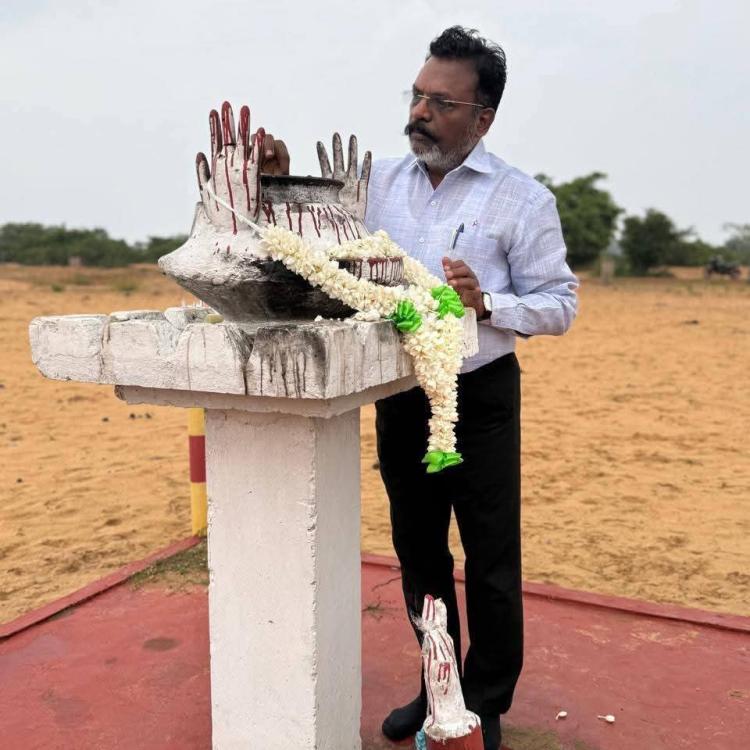
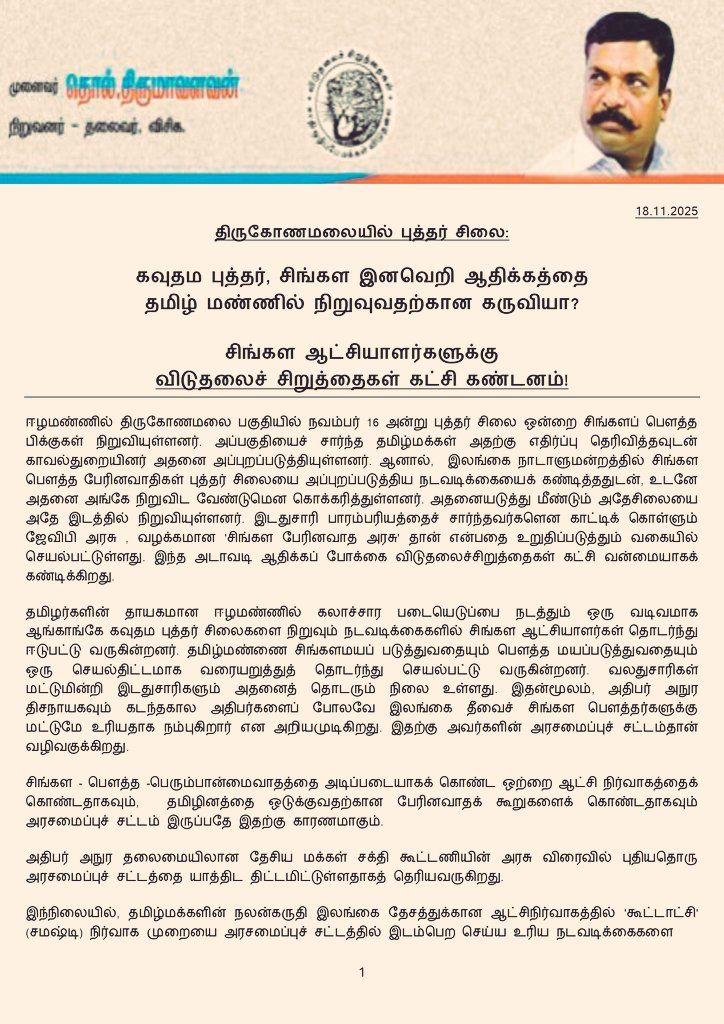
Indian parliamentarian and Viduthalai Chiruthaigal Katchi (VCK) leader Thol. Thirumavalavan has sharply condemned the Sri Lankan government after Sinhala Buddhist monks erected a Buddha statue in Trincomalee this week.
He warned that the episode reveals the National People’s Power (NPP) administration to be “yet another Sinhala supremacist government,” despite its attempt to present itself as a left-leaning alternative.
Thirumavalavan said the sequence of events clearly demonstrated who the new government chooses to protect. According to him, the clash revealed that the JVP-led administration, which came to power promising equality and reform, has instead aligned itself with the long-standing Sinhala Buddhist chauvinist project of previous governments.
He stated that the VCK “strongly condemns such authoritarian and oppressive conduct,” describing the re-installation of the statue as yet another example of how the state actively facilitates Sinhala Buddhist expansionism across the Tamil homeland.
Thirumavalavan said that across the North-East, Sinhala rulers continue to carry out a “systematic cultural invasion,” pointing to the steady placement of Buddha statues in areas with no Sinhala Buddhist population.
He asserted that this programme of Sinhalisation and Buddhisisation is not the work of one political camp alone. Even parties that claim to be progressive, he said, continue the same expansionist agenda.
According to him, the events in Trincomalee prove that Sri Lankan president Anura Dissanayake, like past Sri Lankan leaders, believes that the island belongs exclusively to the Sinhala Buddhist majority. He added that this belief is strengthened by the structure of the Sri Lankan Constitution itself, which he described as being founded on Sinhala-Buddhist majoritarian supremacy under a unitary framework designed to suppress the Tamil nation.
Reports indicate that the NPP government plans to draft a new Constitution in the coming period. Thirumavalavan cautioned that unless India intervenes, the process will not address the structural inequalities faced by Eelam Tamils.
He urged the Government of India to ensure that any new constitutional arrangement includes a genuinely federal model that protects the rights and security of the Tamil people. He emphasised that India must play a meaningful role at a moment when Colombo seeks its political and economic support.
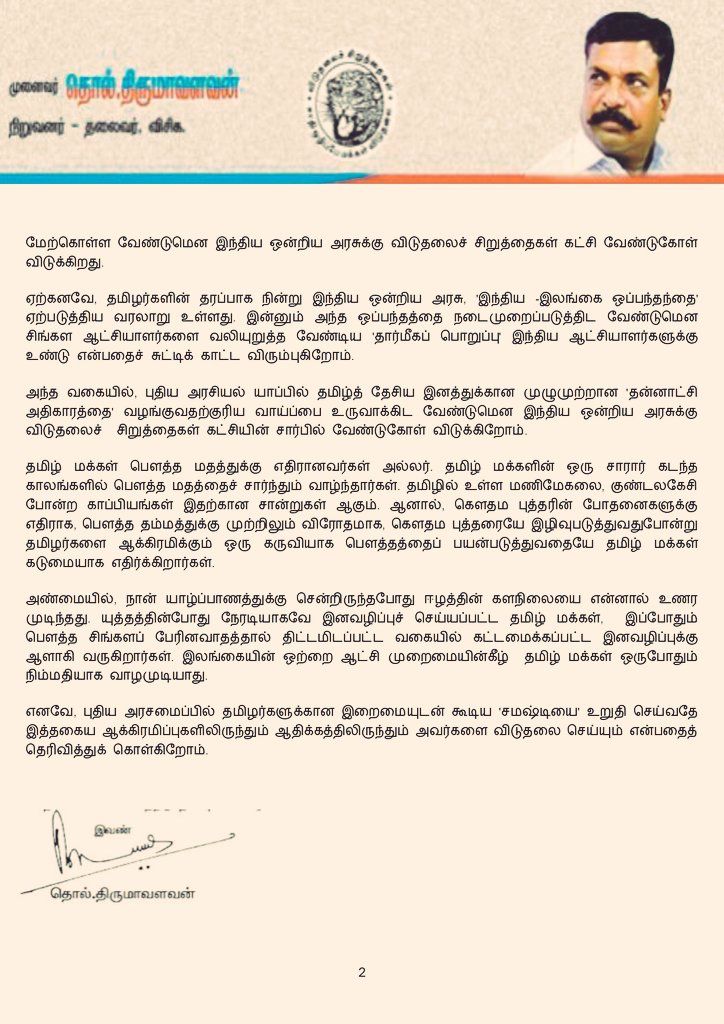
He reminded that the Government of India had previously facilitated the India–Sri Lanka Accord on behalf of the Tamil side. Therefore, he argued, India carries a moral responsibility to insist that the Sinhala rulers fully implement the commitments of that agreement. In the upcoming constitutional process, he appealed to India to create the conditions necessary for granting the Tamil national people full and meaningful autonomous powers.
Thirumavalavan stressed that the Tamil people are not opposed to Buddhism itself. He pointed out that historically, some Tamils were followers of Buddhism, as evidenced by literary works such as Manimekalai and Kundalakesi. What the Tamil people firmly reject, he said, is the misuse of Buddhism as a tool of domination—a distortion that contradicts the teachings of Gautama Buddha and demeans the Buddha by weaponising his image to subjugate Tamils.
Reflecting on his recent visit to Jaffna, he stated that he had witnessed firsthand the conditions faced by the Tamil people. Those who endured direct genocide during the conflict are now, he observed, subjected to a structurally engineered genocide executed through Sinhala-Buddhist supremacist strategies. Under Sri Lanka’s unitary system, he argued, the Tamil people can never live in peace.
Therefore, Thirumavalavan concluded that only a federal arrangement endowed with sovereign authority for the Tamil nation within the new Constitution can free them from such invasions and forms of domination.