

A new Buddhist shrine erected without permission on Trincomalee’s Dutch Bay beachfront has triggered a major political row, as state-enabled Buddhisisation in the Tamil homeland continues, deepening scrutiny of the government’s stance on Sinhala Buddhist nationlism.
What began as an unauthorised construction attempt by a group of monks has, within forty-eight hours, escalated into a clash involving government ministers, opposition leaders, local officials, and Tamil parliamentarians. The incident has also highlighted long-standing Tamil concerns about land appropriation and demographic engineering in one of the most treasured parts of the Tamil homeland.
This explainer outlines what happened, why it matters, and how the reactions so far reveal deeper issues around colonisation of the North-East.
What happened in Trincomalee?
In 2004, there stood a small building on the beachfront, as part of a Sinhala Buddhist vihara. During the devastating Boxing Day Tsunami, the entire building was destroyed.
Subsequently, the Sri Lankan government granted Sinhala Buddhist monks a new allocation of land alongside the Sri Sambuddha Jayanthi Bodhivardhana Vihara.
Given the devastation the tsunami caused, the previous area was opened up for public use and it was advised no buildings should be constructed there due to its proximity to the coastline.
1. Monks begin illegal construction
Late on 15 November, there were reports of construction material being transported into the premises of the Sri Sambuddha Jayanthi Bodhivardhana Vihara site on Dutch Bay beach.
When journalists went to investigate they were obstructed.
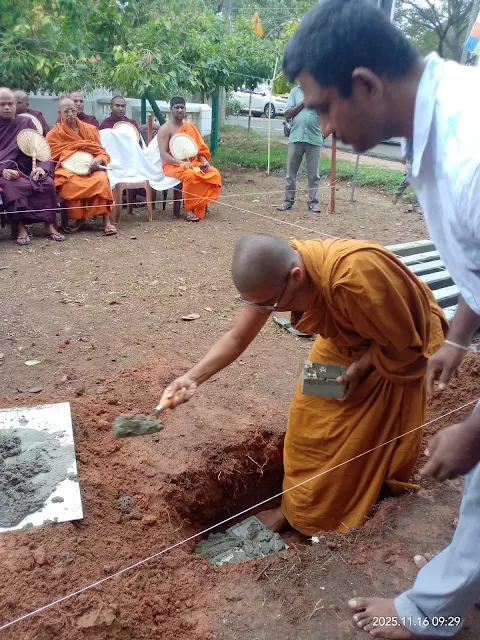
Then the next morning, several Sinhala Buddhist monks began constructing a new structure at the area used by local residents and governed by the Department of Coast Conservation and Coastal Resource Management (DCC).
No permission had been obtained from:
• the DCC
• the Trincomalee Municipal Council
• the Urban Development Authority
2. Coast Conservation officials intervene
After receiving complaints, DCC officers arrived at the site. They were met with verbal threats and were forced to leave by monks who refused any inspection.
This was not the first unauthorised structure. On 4 November, the DCC had already filed legal action over an illegal canteen being built inside the shrine premises.
3. Police attempt to halt construction
Video footage shows police attempting to stop the monks as they transport a Buddha statue to the site. Tension escalated, with one officer slapped by one of the monks.
Officers managed to briefly remove a Buddha statue that had been placed there.
According to the Police, the land is under an existing court order prohibiting any development.
4. Minister of Public Security initially backs enforcement
On the night of 16 November, Public Security Minister Ananda Wijepala instructed the Police to remove the statue. Tamil MP Shanakiyan Rasamanickam praised the rare enforcement of law against unauthorised Buddhist construction.
5. Overnight reversal
By the next morning, on the 17 November, Wijepala told Parliament the statue had been removed only because of a “possible threat of vandalism.”
He confirmed it would be reinstalled and given police protection.
“A special security plan will be implemented from today for the safety of the statue,” Wijepala said.
This reversal stunned local officials. The DCC had filed a police complaint and was preparing legal action.
Political reactions
Shanakiyan Rasamanickam condemned the Minister’s U-turn:
“It’s an embarrassing climbdown… the minister and the government have given in to nationalist pressure.”
“Tamil people have never destroyed religious shrines, not even during a 30-year war.”
ITAK spokesperson M.A. Sumanthiran issued a scathing statement:
“The NPP government stands exposed as a racist, Sinhala Buddhist nationalist force, no different to any other government in the past. All Tamil members of the NPP… must resign forthwith.”
Speaking in Parliament, Tamil National People’s Front (TNPF) leader Gajendrakumar Ponnambalam traced the history of Trincomalee’s demographic shifts from 1827 to today. He argued that the shrine issue must be seen within a broader framework of state-sponsored Sinhalisation.
He pointed out that:
• The site had been declared a high-risk coastal zone after the 2004 tsunami.
• Alternative land for the Vihara was already allocated by the state.
• The current attempt to build new structures is part of a continued pattern of state-backed encroachment.
He accused the NPP-led government of “capitulating” and betraying its anti-racist promises.
Opposition leaders back the monks
Sajith Premadasa condemned the Police for intervening, calling it a violation of the “foremost place for Buddhism” in the Constitution.
He insisted "sending police to disrupt development activities is unacceptable.”
Premadasa declared that disputes should be resolved through the Buddhist Chief Prelates, not through state enforcement of coastal laws.
His intervention reinforced long-standing Tamil concerns that Sinhala parties across the political spectrum close ranks when Buddhist institutions face scrutiny.
A pattern of state-enabled Buddhisisation
The shrine controversy fits into a well-documented pattern since Sri Lanka was granted independence, including:
• Buddhist shrines built inside Tamil and Muslim areas without permission
• Archaeology and forestry departments used to claim “ancient Buddhist heritage”
• Police protection provided for illegal constructions
• Military-backed encroachment in areas of demographic sensitivity
What happens next?
• Police say they will “take legal action”, but the statue has already been reinstated.
• Buddhist monks continue construction activities despite court orders.
• Tamil parties are escalating pressure, with calls for Tamil NPP members to resign.
• Civic groups in Trincomalee are preparing further complaints regarding coastal law violations.
The Trincomalee shrine controversy is not an isolated dispute over a statue, but a revealing episode that exposes the structural power of Sinhala Buddhist nationalism, the fragility of the government’s reformist promises, and the persistent insecurity felt by the Tamil people in their homeland.
For many Tamils, the events of the past forty-eight hours have reaffirmed a long-standing truth: in Sri Lanka, even the rule of law bends when confronted with the demands of Sinhala Buddhist institutions.