
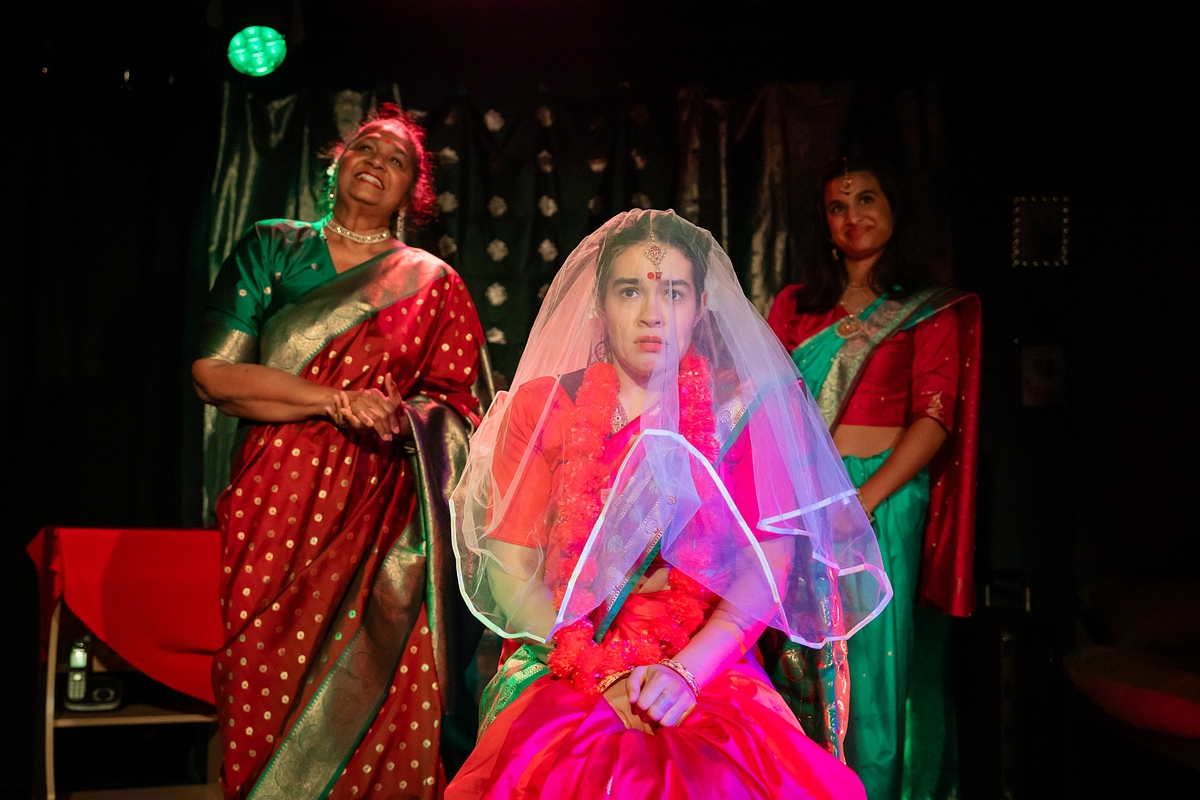
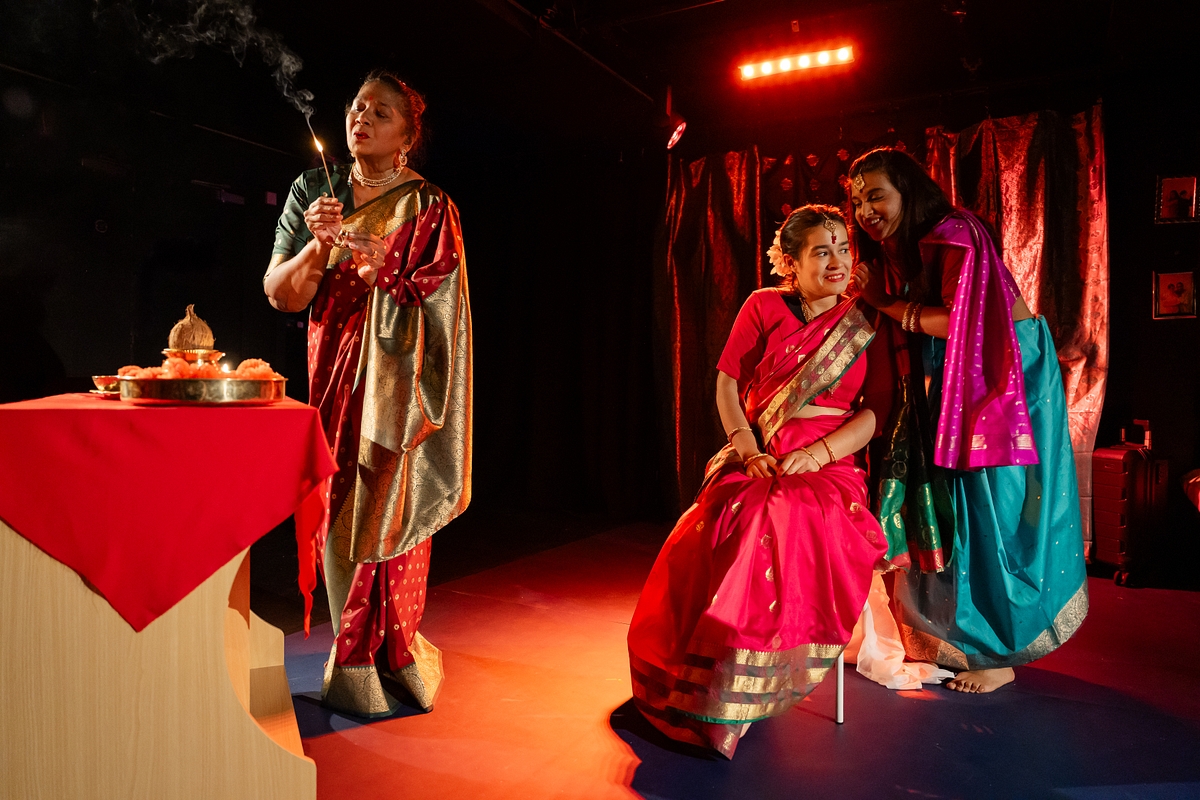
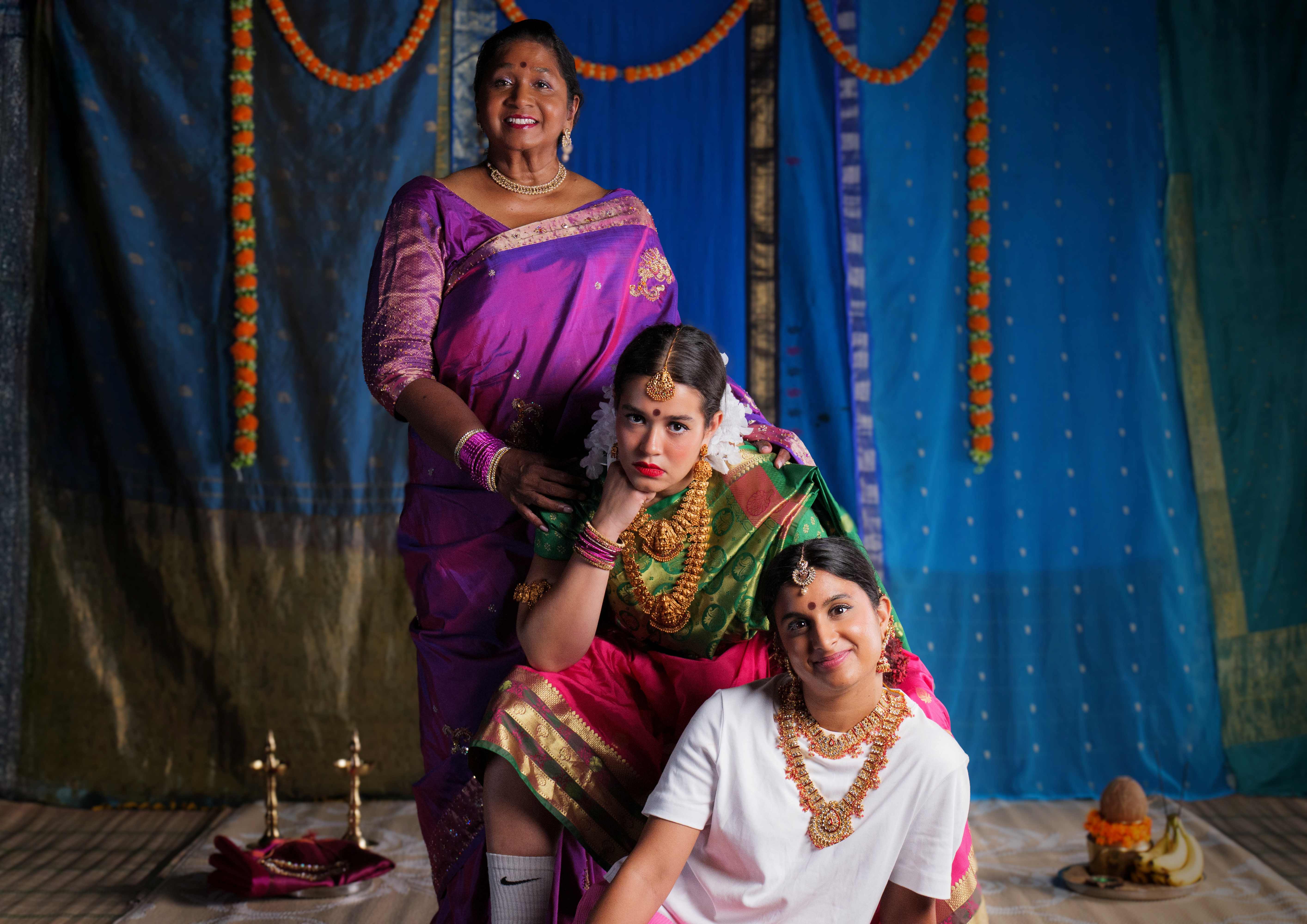
When the first lockdown brought Gayathiri’s work in sex education to a sudden halt, it also gave them the time and space to reflect and write. Drawing on years of experience leading conversations in schools and community groups about consent, sexuality, and the shame many young people feel about their bodies, they discovered a new creative outlet: theatre. Their debut play, Period Parrrty, was born from a writing workshop and centres on a queer teenager navigating the ‘samathiya-veedu’ also known as the puberty ceremony.
Your writing defies convention and constraint. How do you feel your writing reflects you as an artist?
I think I'm quite a “Oh, let's have a go” type person. Having those real conversations with students and then translating that into a play format, and then writing about… bodies and transness in a poetic form… I'm really interested in different forms. And I would say currently performing my poetry is where I feel the most powerful… It's an exchange of energy with the audience. And I really feel that connection, which is great. So maybe it’s about… not feeling too constrained to “I'm a poet” or “I'm a playwright,” or, “I'm a sex education facilitator,” but the values and the message is at the heart of what I do, and then disseminating that in different ways.
As someone who primarily works on the page, what made you decide to bring the story to the stage?
I've written one play so far and one book, and it's the hardest that I've ever had to think… like holding 400 pages of a book or 80 pages of a play.
Period Parrrty started off as that one scene. I think it's with a lot of encouragement that one scene became 15 minutes, and that 15 minutes went on at Hampstead Theatre a few years ago, and then that 15 minutes becoming 40 minutes… it's really incremental.
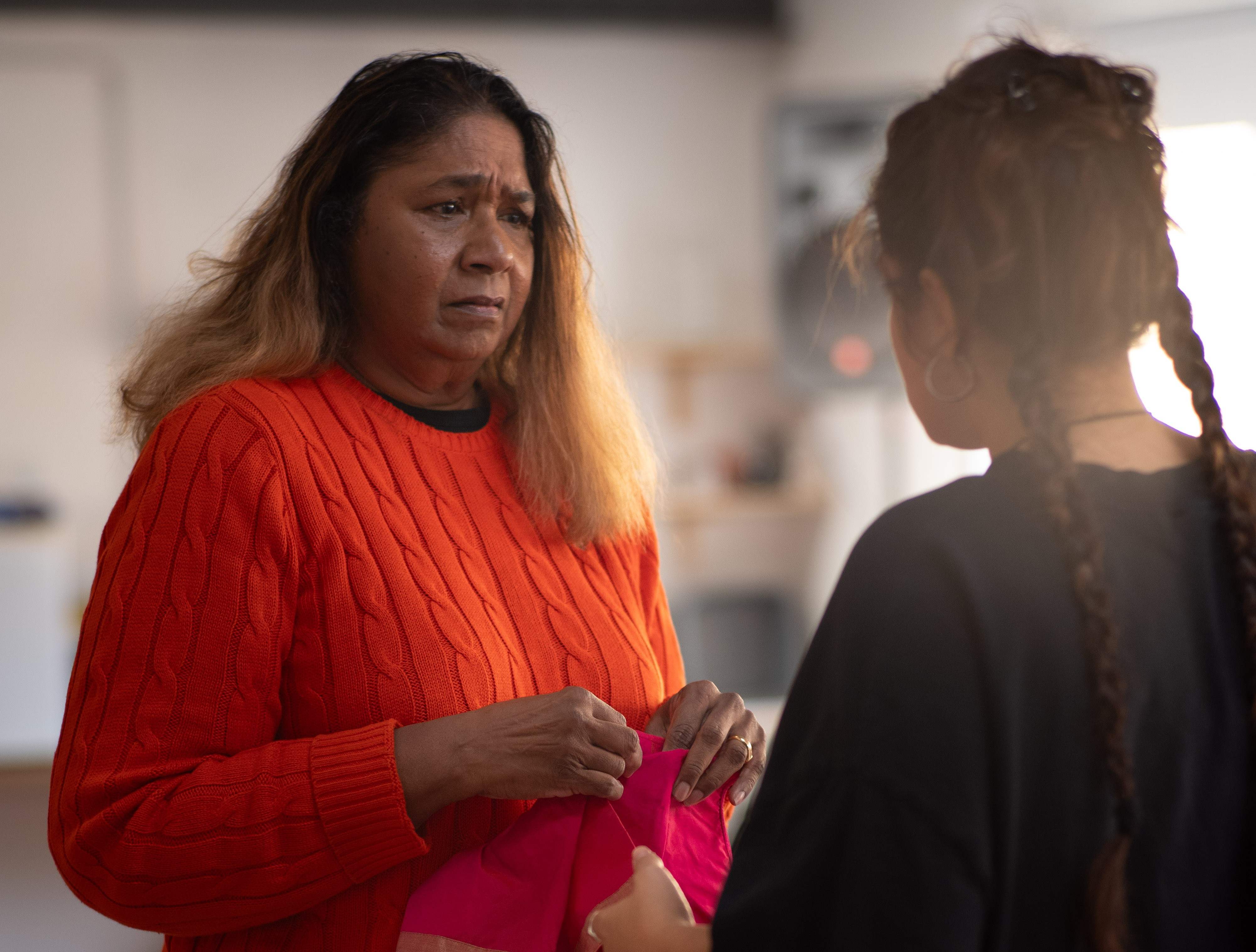
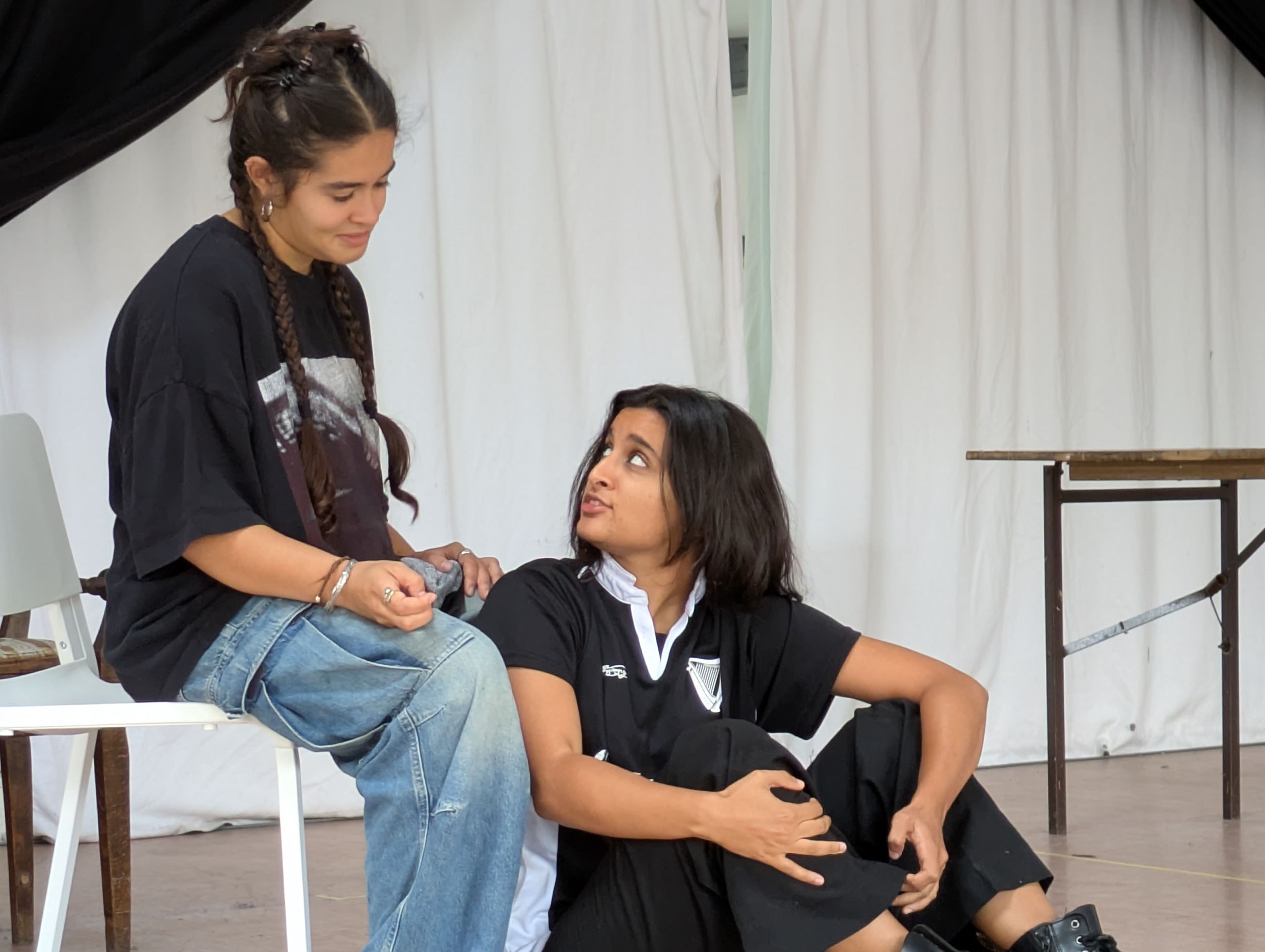
There's multiple love stories within Period Parrrty. There's the love story between the two teenagers and their queer coming of age… knowing they’re best friends, but discovering that there's something more there. There's the love story between the main character, Krish and their mum, Brintha. How do you love each other across this cultural and generational difference? Brintha has come as a refugee from escaping the civil war in Sri Lanka and is trying to separate - for Krish - all of that trauma that she holds. She's like, “Oh, I don't want you to worry about that. I want you to focus on your future.” And Krish is like, “I want to know you, and I want you to know me but I'm also scared,” because Krish is non binary, and that really is something new for Brintha, through no fault of her own; there's the colonial transphobia that Brintha would have inherited.
Krish is finding themselves - falling in love with themselves. So, all of that is really alive and juicy. I think it needs to be a play because we need to see each character go through their journey so that we can empathize and really feel for them. Yeah, in no way do I want elders in
Krish’s life - Krish’s mum - to be villains. If anything, I'm like, “Brintha’s creative act of coming to try and find some stability in the UK to escape the genocide - there's so much love in that act, you know? I think [with] a play, really, you're asking the audience to kind of live and move on that journey with you.
The samathiya-veedu is an interesting event. What drew you to explore this event for your production?
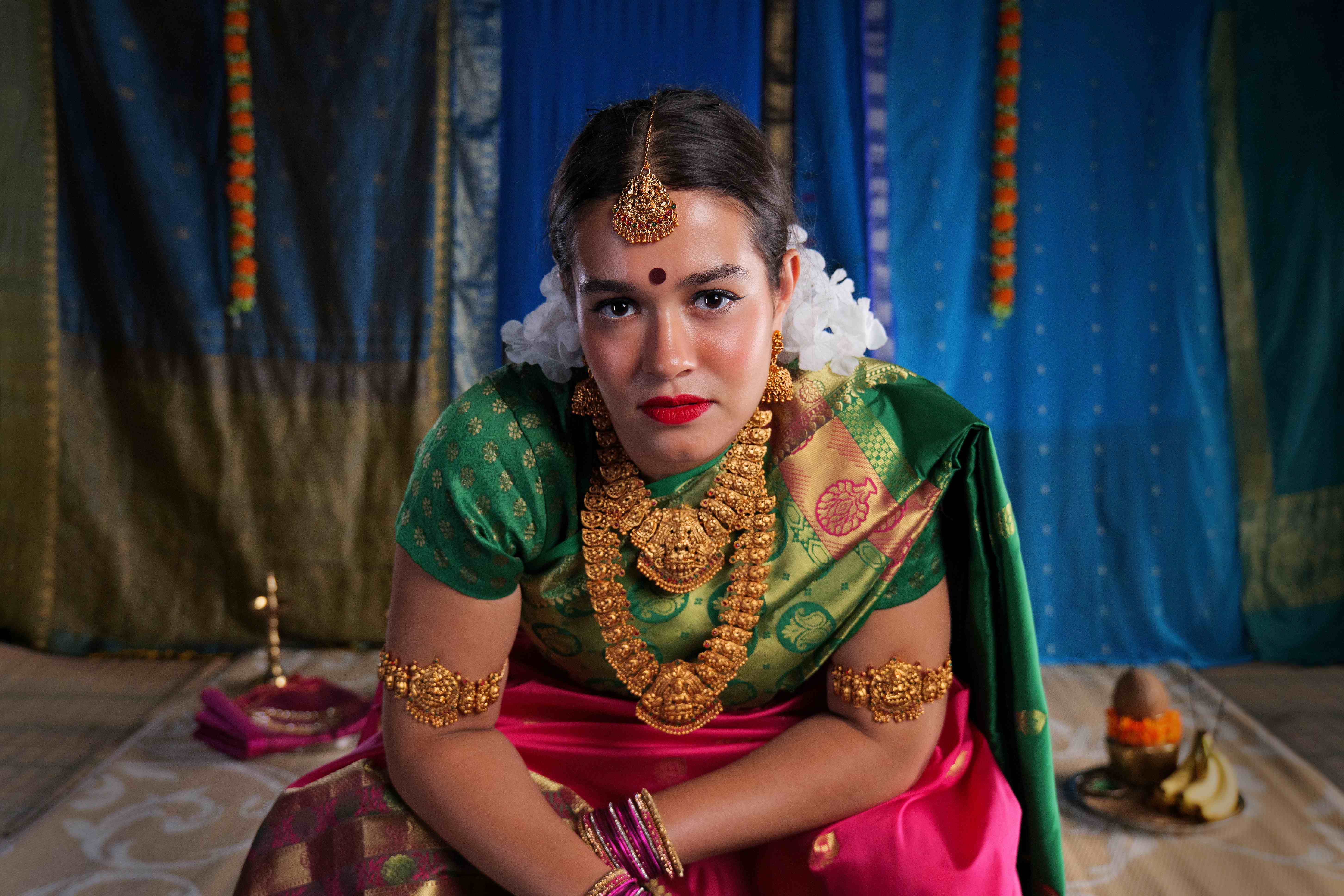
When I was working in sex education, I had a Tamil colleague, and we were talking about [how] this is quite a landmark occasion. It is a sign of stability. We gather together as a community - there is strength in that, right? And so it can be a good thing. It's also cool that we're celebrating the period. But also we’re not necessarily asking that young person how they want the day to be. Do they even want that day? Some people really love it and some people don't want it. Whatever your reaction to a period party for yourself is fine, and that should be listened to. And sometimes it's exciting to wear a sari for the first time, but in Krish's case, in the play, it makes them feel dysphoric. It makes them feel like they're being set on this path towards womanhood, motherhood. But they don't identify as a girl, and so it is quite distressing. However, they know that the day is important because it’s part of keeping our [Tamil] culture alive. And so the food, the ritual, the sari, the music - all of that culminates on this samathiya-veedu day, right? And so they're like, “ I want my mum to have this and to enjoy this, and to bring the community together.” So, there is a negotiation between mother and child in this story.
But with my colleague, basically, she asked me the question, what do you think a queer samathiya-veedu would look like? Or what would queering this occasion look like? And that is a question I had never asked myself before. So I'm not saying, “We need to cancel this,” I'm not interested in cancel culture in that way. But I am interested in, “How do we centre the person, their bodily autonomy, the person who started bleeding? How do we make this day feel right for them?” Whilst keeping our Tamil traditions alive as well – which are also inherently queer - before the British came and the very anti-queer laws came in. So, how do we go back to our roots? And how do we bring in that young person to ask them: what do you want this day to look like for yourself? The play would not exist if she had not asked me that question.
There's an interesting question on your profile that asks: whose imagination are we living in? Would you care to expand on that?
Akwaeke Emezi is a Nigerian Tamil author that has really shaped the last five years of my writing practice. They wrote a letter - it's published online. It's called ‘On The Toni Morrison Quote That Changed My Life.’ In it, Akwaeke Emezi writes that Toni Morrison said, “Claim the margins as central.” So, you don't need to go over to whatever the mainstream centre is currently. So, whether that's white supremacy, institutional racism - like that being the power holder. You don't need to try and mold yourself to fit into a palatable version for that. You claim where you are standing, and you do the work that you can do, and you wait. So ‘claim the margin as central’ is the line. That letter - I've got it framed on my wall. That really is the starting point for how I write; adding Tamil into a mainly English script, for example, and not over-explaining any of the rituals or the way that Brintha talks about back home like, ”Oorula naan ippadi seidhanaan, appadi seidhanaan…” I'm not over-explaining it to… what you perceive the mainstream theatre audiences to be currently - maybe majority white. But that has really been my guiding light. So, whose imagination are we living in…well, we get to live in ours. I'm literally creating the world - the world that these characters are living in.
For example, when I was little, and I don't know if you used to do this with crayons, you'd draw yourself, but you draw characters or yourself with blonde hair and blue [eyes]. Do you know what I mean? You don't draw yourself as brown, which says so much about how we're raised and the books that we're reading and the culture that we're absorbing. So, in trying to undo that assimilation… I just set myself an exercise of, ‘what if I only read queer writers of color?’ All the literature I was absorbing was by them (or by us), and it really changes your vocabulary - how much you feel you need to explain your culture or the way you use words. I think there's a real stretching of the imagination.
But also, I'm not too complicated. My mum does not find the character of Brintha too complicated. For example, why it is that she, on purpose, does not want to speak English in the house?” She can speak English, but she’s [like] “Tamil-dhaan pesaven.” She wants to speak Tamil. I don't need to explain that.
In school, like at uni - maybe some unis… have changed a bit now - they are populating our imaginations, and the building blocks with which we can start to imagine. All of that is very white culture and so we're not even observing and sitting with what is so rich and interesting about our own houses and the food and and the language. So, like ‘adhu paavum.’ So, the word ‘paavum’ in Tamil - I really like this word and I started to just use it in my day to day with whoever I'm speaking to, whether they're Tamil speakers or not. It's like pity or sympathy. It's more than sympathy, like, “ava paavum illaiyo?” I pity that person, but in a very positive, kind, generous way, right? But in English, if you say, “Oh, I pity that person,” that’s sort of negative - it's sort of condescending. So there's not really a word for ‘paavum’ in English. It's brilliant - such a soft, warming word with very good intention. That's just one tiny example of the richness within… the Tamil language. I'm learning now - I'm not fluent, but I can understand a lot. When you open yourself up to a language, like so much of that culture… is building the way that you think and behave.
You mentioned the word ‘belonging’ a few times in your profile. What does ‘belonging’ mean to you as a queer diasporic Tamil?
I first felt this sense of belonging to a queer Tamil community when… do you know The Tamil Channel? Sabtha runs it on Instagram and she also runs Tamil classes. So, she posts one word - let's say a week - and there'll be a theme. So, there might be Pride Week, and she'll post seven words to do with Pride. It's not all queer stuff - she had a collab with Anbu, so there [were] lots of words on consent and boundaries.
I first saw the word for non-binary. I didn't know there were any words for queer or bisexual, pansexual in Tamil, because no one had taught me. But, of course, that makes sense. And so ‘irumaiyinmai’ is the Tamil word for non-binary. And just seeing that I do exist in our language - that was huge. And we say, “Oh, we don't have that in our culture.” I didn't know that it was being unearthed or shared or coined. I think there's a mix of that happening - bringing words that have been buried to light. But also, words are always evolving, so people are coining terms, and people like Sabtha [are] doing such important work to evolve our knowledge of the Tamil language. That gave me a lot of confidence, because it's not, something ‘other’ or, “it's this English thing over there. It's got nothing to do with us.”
And, there's so much nuance. There's words for gender affirmation, agender, queer… I started learning Tamil with her, and she's so sort of generous and encouraging: “Pizhaivittal, don't worry about that. Just keep trying.” She has these specific queer Tamil beginner classes, so you might just be learning ‘aana/aavana’ you know, but with five or six queer Tamils. It's really transformative when you think you're the only person who's queer and Tamil; when you've been brought up to think that. So, that's probably the time when I felt the most seen, and it gave me friends that I met online through The Tamil Channel.
And then I set up Inclusive Tamil Arts. So in lockdown one, we had these workshops online, all facilitated by queer Tamil people. And we discussed different art forms: poetry, acting, publishing. There was a dance and yoga workshop. If you want to be anonymous, you can put your video off, I can not put my surname - there's a level of safety there… accessibility. And with that, you grow in confidence. And now I've met loads of those people. They are my friends in real life now!
You said you've got a 400 page novel. I'm guessing that's the upcoming one, Bad Queer. What can we expect from it?
It is a young adult verse-novel. It's all in poetry form, and I was imagining there's a queer Tamil family. There's a trans parent, and as a couple, they are queer, and they have this child. What would our children learn from us? How would we want to raise children in the future? That's the starting point. And then, there's also the grandparents who have come as refugees from Sri Lanka. So there's still that narrative thread that it shares with Period Parrrty but I'm really focusing on the next generation to come. For me, when I'm writing, I'm also planning and rehearsing the future. If I can imagine it happening first - what kind of parent would I want to be? And how do I teach my child about consent and gender and freedom and bodily autonomy, you know?
So, the main character, Surya, is non-binary and it's about them falling in love. It's a teen romance drama. There's some very light hearted moments. It's them exploring sex and touch and what feels good, what doesn't feel good. And there's also some gender dysphoria that they experience. So how to navigate that, especially when you're in a relationship for the first time, and how do you communicate that to your partner? Actually when I was teaching sex education, often young people had language to describe sexual violence. They had vocab to talk about that and the stuff around non-consensual activity. But how do you talk about what you do want? That felt a bit more awkward and really - fair enough - it can be awkward to say, “This is what would feel good,” or, “Could you try this?” But I wanted to have a character who was trying to have these conversations before the touch actually happened. Because I think that's a healthy, communicative way to enter a physical relationship. And they're clumsy and awkward and funny and giggly, but that's all really real and gorgeous.
Also, the main character is a poet themselves. So there's some performances they do, and them stepping into their power and who they are. So, I hope it's fun. I think we deserve teenage romance, some comedy - that kind of vibe.
What advice would you give a young person starting out with their career in theatre or writing?
Read widely. If you don't like something, ask yourself, why - it's really valid. I think it's also good to know why you don't like a certain type of writing: whether it's political, whether it is stylistic like the voice. If what you're writing doesn't sound like you in terms of vocab and tone, then is that a choice that you're making or are you changing who you are to sound more ‘writerly’? I had to really think about, what are the ways this character is really fifteen and Tamil and from North London where they're surrounded by lots of Tamil communities? I don't want to edit that out of the character. So, how do they sound? And is that on purpose?
A big one for me in terms of writing as a freelance job is asking people how much they're being paid… your friends and colleagues for facilitating a creative writing workshop or for a commission. For example, I was able to write this novel because I got a grant from the Society of Authors. I was able to not do other freelance work for two months.
It's actually really hard to set yourself a rate. If a venue wants to hire you for a poetry workshop, and they're like, “How much do you charge?”, it's impossible to know when you're first starting. I have asked lots of people, “How much was your advance?” And I think transparency in that way is really useful for us in this gig economy. For us to collectively ask for more money, because artists are increasingly just being expected to work for free a lot of the time. That's a huge thing.
And then one that everyone says is just write a draft zero. It doesn't matter if it's ‘rubbish’ - just get your 80 pages done, or, just get a really shoddy draft done and then edit, and then, nitpick. For me, working with something rather than nothing is when the play or the book actually started to become a reality.
Five works of art which have inspired Gayathiri Kamalakanthan.
1. The works of Priya Guns - The first thing that I read that she wrote is from the Tamil Futures magazine, created by Tamil Archive Project. It's called ‘A Letter to My Unborn Child(ren),’ which is an article online. And then she wrote ‘Your Driver is Waiting.’ That first letter, I read in 2020 and it was thinking about the world as it is. The pandemic had hit, the BLM resurgence was happening and thinking about whether you want to bring a child into this world, and if so, what would you teach them? We're going back to that ‘whose imagination are we living in?’ From that letter also to ‘Your Driver is Waiting,’ the politics of that is front and centre. She also talks about the gig economy and collectively requiring - whether it's institutions, organizations - to pay people a livable fee.
She was the first queer Tamil writer who… the politics was on her sleeve, if you will. It wasn't too edited or watered down or made palatable. And so her writing is a big influence, talking about transness and and also casteism… talking about the genocide in Sri Lanka. I sort of took her lead - I'm not going to shy away from these things. I feel the Civil War is really this undercurrent to everything that my parents do - the reason why they want us to succeed and be stable.
2. Because It’s in the Lonely Planet Top Five Places to Visit (Arji Manuelpillai) - It is a poem about this English white couple talking to a Tamil guy on a train about how much they love Sri Lanka and how it's their home away from home. It cuts between the English couple talking about Sri Lanka as this paradise and then the Tamil guy reflecting on Sri Lanka as a war zone. And just the juxtaposition of those two scenes… it hits at the core of how Sri Lanka is seen as this ‘Top Five Places to Visit,’ but the history of it is often buried.
3. Layla (dir. Amrou Al-Kadhi) - This is a film about a queer, Muslim person. At every turn, when you think, “I know what's going to happen - this person's going to fall for this white guy who exoticizes them and who shrinks them and minimizes their transness…” When you think it's [going to] turn into a misery memoir-esque film, it actually allows the main character to step into their power and to make different decisions for themselves. I was… steeling myself to take the hit of when this person is heartbroken, but the character makes these really empowering decisions and I want to see more of that.
4. Polite Society (dir. Nida Manzoor) - I don't think it got the reception that it deserved. I thought it was the best film of that year when I saw it - such a blend: action comedy, romance, family drama, really taking the plot as far as it could go… futuristic sci-fi vibes. I love all that, like when we were talking about constraints earlier and having a go and saying yes. I've never seen that before. It's so ambitious… so many references to Kung Fu but also Bollywood. I just feel as a writer and director, she was like, “I have a vision, and it's going to work. It's not too much. I'm not going to water this down.” That's the kind of writer that I would like to be.
5. The Feminist Killjoy (Sara Ahmed) - I have been listening to the audiobook because Sara is a great narrator. It's really been quite a coach in terms of my values. One of her statements is that when you raise a problem or uncover a problem, for example, sexual harassment in the workplace, you become the problem. You're seen as ruining the vibe of the workplace. It’s like ‘you're making it really awkward’ or, ‘shush and get by.’ For example, the genocide in Palestine - people in some workplaces that I've been in trying to be neutral or be on the fence. “We can't be seen to take a side,” and all of that being complete nonsense. What is happening in Palestine, happened to Tamils in Sri Lanka. We have a choice to speak up and to be the ‘killjoy.’ But also you're not on your own. So, having this ‘killjoy collective.’ When I read that book, I felt, “I'm not alone.”
I've made a lot of choices in the last three years where I have moved away from certain places of work or friends or colleagues, because I think actually my time is best placed elsewhere, where we're not pretending like state violence is not happening because it's more comfortable for us. It's also what I write about. You can have a teen rom-com, but you can also point to violence when it's happening at the same time. These things don't need to be unlinked. And I think Sara Ahmed has been a life coach through her book.
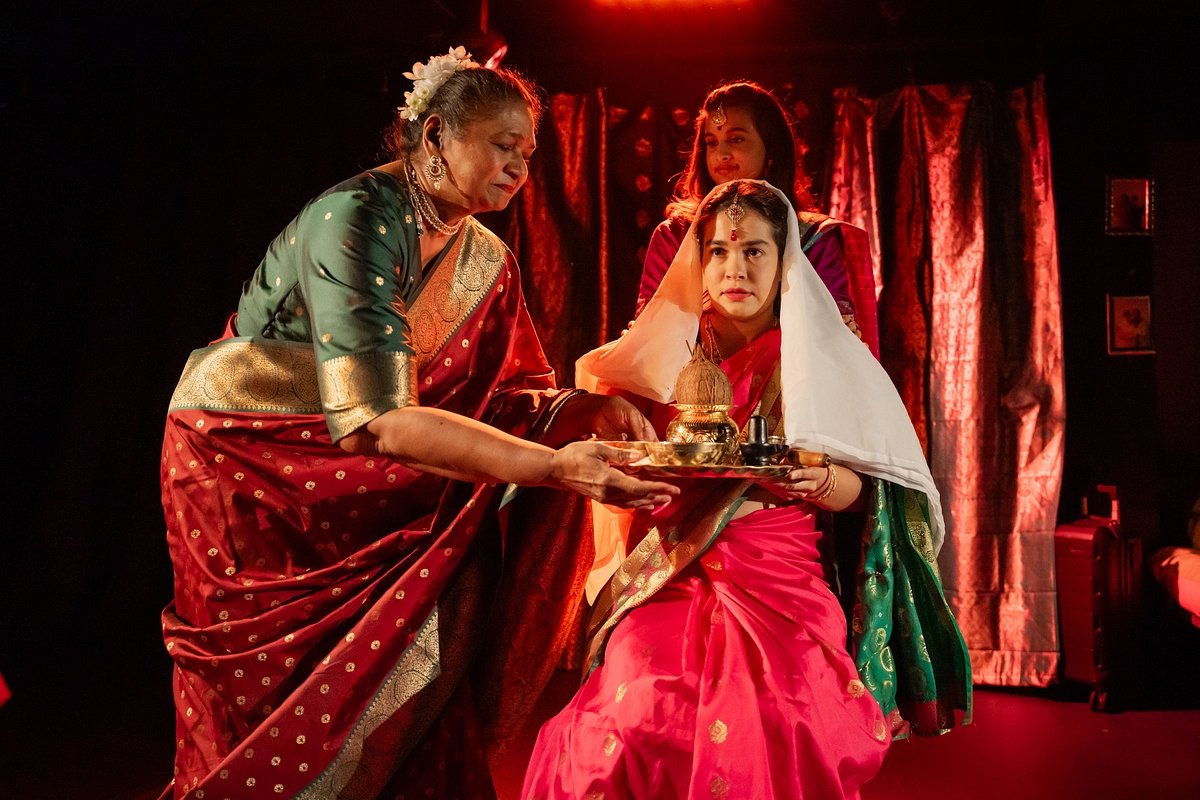
Period Parrrty will be playing at Soho Theatre from October 23rd to November 22nd.
Photographs by Michael Boffey.