
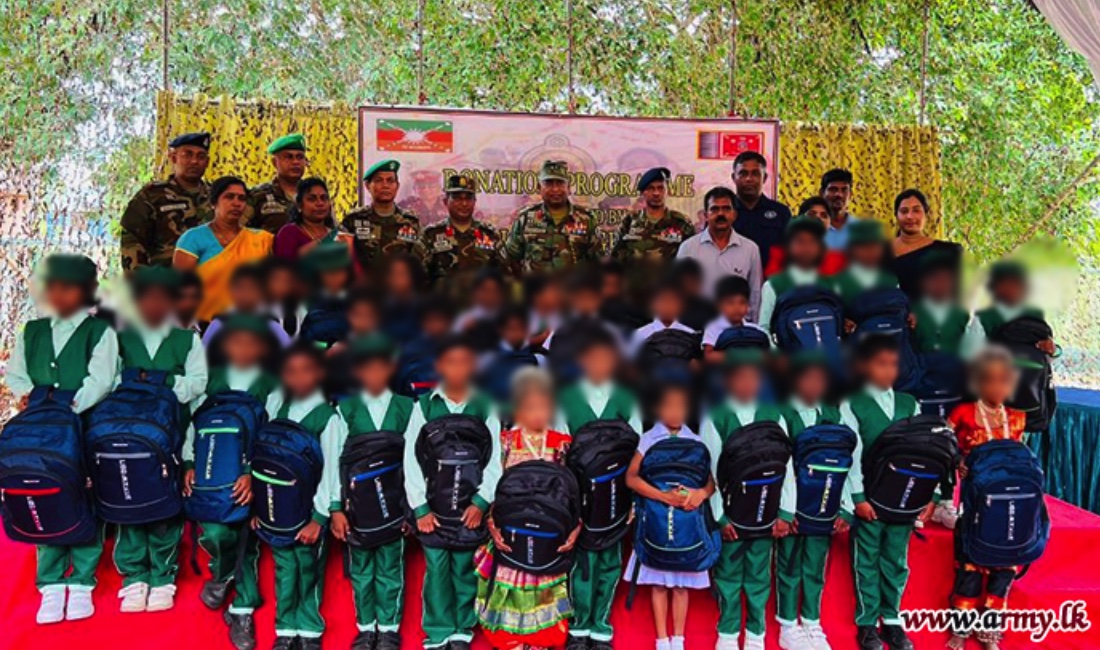
File photograph: Occupying Sri Lankan soldiers in a Tamil school earlier this year.
Sri Lanka’s tax policies have been a central factor in driving the country’s 2022 economic collapse and the long-term decline of its public education system, Human Rights Watch (HRW) said in a new report released this week.
The 101-page report, “Tax Giveaways, Struggling Schools: How Low Taxes Drove Sri Lanka’s Economic Crisis and Squandered its Education Lead,” finds that successive governments starved the country of revenue through decades of tax exemptions and regressive fiscal policies, fuelling economic instability and violating basic social rights.
HRW said that the government of Sri Lankan president Anura Kumara Dissanayake must “urgently adopt measures to uphold its human rights obligations and enact reforms to a system that presently favours companies and wealthy people while failing to deliver adequate revenues.”
The organisation warns that these policies have pushed Sri Lanka from being a post-independence leader in public education to one of the world’s lowest spenders. Education funding, once around 3 to 5 percent of GDP, fell to just 1.5 percent in 2022.
A widening divide
In the Tamil North-East, where Tamils continue to face militarisation and economic neglect sixteen years after the war’s end, underfunding in education and basic infrastructure has deepened disparities.
According to official figures, the North-East contributes just under 9 percent of the island’s total GDP. More than 16 years after the end of the armed conflict, successive government’s neglect and inequitable fiscal priorities have left the Tamil homeland trapped in poverty, highlighting not just economic mismanagement but a willingness to allow these regions to bear the brunt of any economic crisis.
“It is important to note that the dislocation, destruction of infrastructure, and psychological trauma from the war had devastating impacts on children’s education, particularly in the northeast,” said HRW.
Public schools often operate with few teachers, limited learning materials, and damaged facilities. Families in areas such as Batticaloa report paying informal fees and tuition costs despite Sri Lanka’s nominally free education policy.
“Among national schools, 58 percent are “highly privileged,” as are over half in the Southern and Western Provinces, which are among the wealthiest,” said the report, noting that “highly privileged schools have a higher share of teachers with experience in their field and students have significantly better outcomes.”.
“In contrast, less than a third are “highly privileged” in the Northern and Eastern provinces, the two poorest.”
“A decades-long decline”
The report details how successive governments, from the late 1970s onwards, adopted policies that prioritised liberalisation and private investment over social welfare. HRW notes that the widespread use of corporate tax exemptions, low personal tax collection, and weak enforcement have made the country “unable to meet its human rights obligations.”
The decline was exacerbated by the sweeping tax cuts introduced by former president and accused war criminal Gotabaya Rajapaksa in 2019. These “imprudent” policies, according to Sri Lanka’s own Supreme Court, triggered a domino effect that contributed directly to the 2022 default, which was the country’s worst financial crisis since independence.
By 2022, the cost of tax exemptions had reached the equivalent of 56 percent of total tax revenue, or nearly three times the national education budget. As a result, HRW found, the state became dependent on indirect taxes like VAT, which disproportionately impact the poor.
Human rights and economic collapse
HRW’s senior researcher Sarah Saadoun said the crisis exposed “decades of economic policies that starved the government of revenue and reflected a myopic focus on GDP growth.”
“In practice, that means education spending has fallen well behind the pace of growth, turning the country from a global leader in public education to a laggard,” she said.
Continued military spending
Adding to the strain, Sri Lanka’s military spending remains disproportionately high despite the country’s economic struggles. The 2025 budget allocates 442 billion rupees (around $1.5 billion) to the Ministry of Defense - a 3 percent increase from 2024 and 15 percent higher than 2023. A large portion of the Ministry of Public Security’s $540 million budget goes to recurrent expenses, primarily for troops stationed in the North-East. These forces are heavily involved in civilian life, maintaining an occupying military presence in the Tamil homeland while the region continues to face economic neglect.
Dissanayake urged to act
While the current administration came to power on promises of economic reform, HRW notes that Sri Lanka still spends only marginally more on education. The government’s 2025 budget raised the education allocation by just 3.5 percent.
The report urges Colombo to end corporate tax exemptions, expand direct taxes on wealth and high incomes, and progressively increase education spending to meet international benchmarks of 4–6 percent of GDP.
It also calls on the International Monetary Fund to ensure that loan programmes do not undermine social spending and to assess the human rights impact of fiscal reforms.
“Sri Lanka’s economic quagmire makes clear that growth alone is not enough to fulfil human rights,” Saadoun said. “The government should finally establish a progressive tax system and use its income so that it adequately funds education and other public services that benefit all Sri Lankans.”