
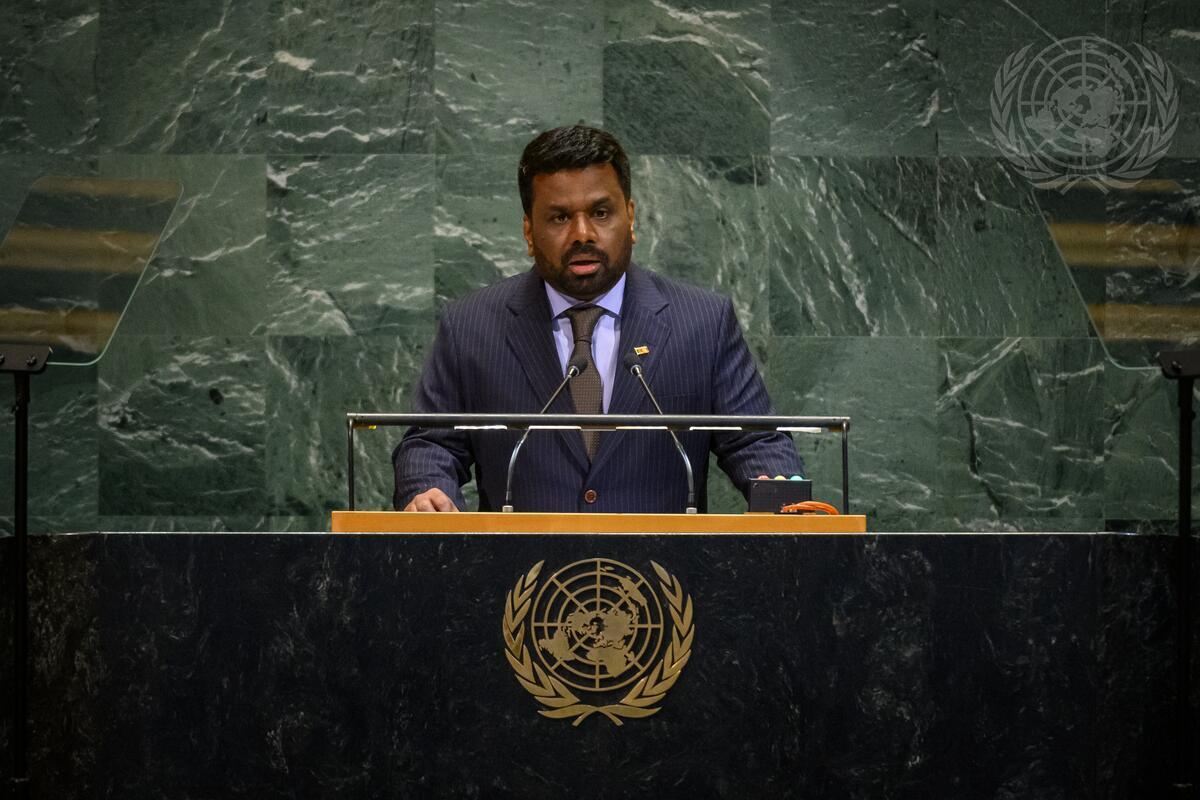
Sri Lankan president Anura Kumara Dissanayake delivered his first address to the 80th session of the United Nations General Assembly this week, outlining his government’s priorities on poverty reduction, corruption, and digitalisation, while failing to address mounting calls for accountability for mass atrocities committed against Tamils.
In his first address to the Assembly as president, Dissanayake congratulated Germany’s Annalena Baerbock on her election as President of the session, before setting out his vision for tackling poverty. He described poverty as a “terrible enemy with many faces”, and criticised the way debt servicing forced low-income countries to spend “twice as much on debt servicing than on education or healthcare”. He called on the Assembly to “pay special attention to eradicate extreme poverty”, emphasising education as the foundation for global progress.
Turning to the global drug trade, Dissanayake cited the UN’s 2025 World Drug Report, warning that cartels were “turning entire states into their hunting grounds” and posing threats to health, politics, and stability. He appealed for international collaboration on rehabilitation programmes and stronger enforcement measures. On corruption, Dissanayake called it “an epidemic causing widespread harm” and “a decisive threat to democracy”. He urged member states to adopt anti-corruption as part of their political cultures. “Fighting corruption is dangerous, but not fighting corruption is even more dangerous,” he told delegates, positioning Sri Lanka as having “begun the struggle against corruption for the future generations of our country and the world”.
Dissanayake went on to declare that “there is no nation in the world that desires a war”.
“The result of a war is a tragedy wherever it happens. We all know that. Even now, many countries of the world are experiencing the pain of that tragedy. As a country that lived through a three-decade war, we know well the futility of war. No one who sees the pain and the suffering of parents, spouses and children of the victims of war would never dream of another war.”
“We have witnessed these painful sights with our own eyes. Even as suffering caused by conflict has reached unprecedented levels, the international community has become reduced to bystanders.”
“Opportunistic power politics has turned the lives of children and innocent civilians into a game. No one has the right to inflict pain and suffering on another to enhance one’s own power. The duty of a ruler is not to destroy lives but to protect them.”
But instead of addressing Sri Lanka’s own history of mass atrocities and unaddressed demands for justice, he went on to express concern over the devastation in Gaza, calling the enclave “an open prison full of pain and suffering” and urging an immediate ceasefire and humanitarian relief.
“We recognise the Palestinian people’s inalienable right to their own state,” he said, while also referring to Israel’s “legal, security and humanitarian concerns”. Sri Lanka, he reiterated, supported a two-state solution on the basis of 1967 borders.
His call for a ceasefire contrasts sharply to the Sri Lankan president’s own actions on the ethnic conflict on the island.
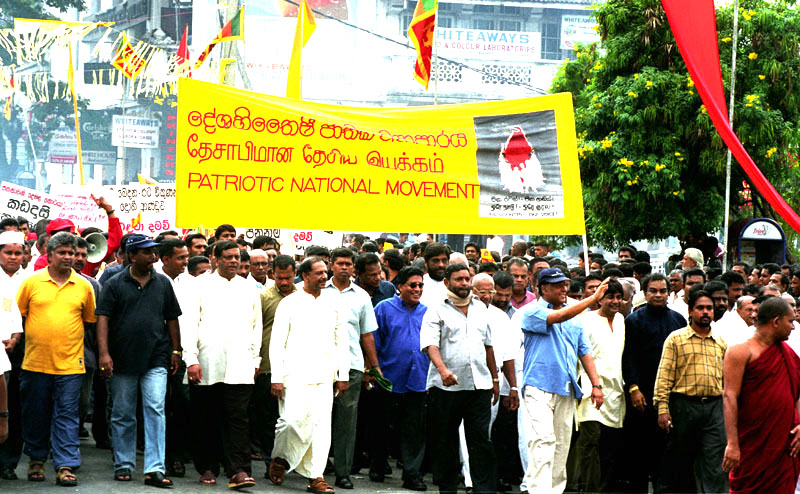
A 2003 anti-peace rally in which Dissanayake participated.
When a 2002 ceasefire agreement between the Liberation Tigers of Tamil Eelam (LTTE) and the Sri Lankan government was initially signed, Dissanayake was amongst the parliamentarians who fumed against it, telling parliament that ‘the LTTE had laid a foundation to establish a separate state in the island’. He repeatedly protested the agreement, leading JVP rallies such as the 2003 five-day, 116 kilometres foot march from Kandy to Colombo, demonstrating against the deal. In 2004 the party’s continued agitation and campaigning explicitly on an anti-ceasefire platform, led to it forming an alliance with the Sri Lanka Freedom Party (SLFP) and allowed Dissanayake to take up a position as the Minister of Agriculture, Lands and Irrigation. Dissanayake and several other JVP parliamentarians would resign from the government a year later, displeased with the ongoing peace process. Instead, his party backed Mahinda Rajapaksa at the 2005 presidential polls, running on a platform specifically opposed to the ceasefire. In 2006, Dissanayake was present as the JVP launched an organisation known as the “Joint Front to Protect the Nation" to defeat the LTTE and to work for the abrogation of the ceasefire.
As the Sri Lankan government launched a massive military offensive against the Tamil independence movement, the JVP world frequently rally in support of the state.
Concluding his speech, Dissanayake told the Assembly, “Our people have chosen light over darkness. They have given their approval to realise the vision of a thriving nation, a beautiful life.” He pledged that his government was working step by step towards “non-corrupt administration, poverty eradication, and digitalisation”.
On the sidelines of the UN General Assembly, Dissanayake held talks with Australian Prime Minister Anthony Albanese and Pakistani Prime Minister Shehbaz Sharif.
He also met with Sergio Gor, the US Special Envoy for South and Central Asia, who praised Sri Lanka’s “regional security leadership” and reaffirmed Washington’s interest in strengthening ties.
Special Envoy for South and Central Asia Sergio Gor met with Sri Lankan President Dissanayake on the sidelines of the UN General Assembly. He reaffirmed the strong U.S.-Sri Lanka partnership, commended Sri Lanka’s regional security leadership, and discussed expanding ties to… pic.twitter.com/h5Z4qTKYHn
— State_SCA (@State_SCA) September 24, 2025
Dissanayake further met with UN High Commissioner for Human Rights Volker Türk, whose latest report again called for accountability for mass atrocities committed during the armed conflict.