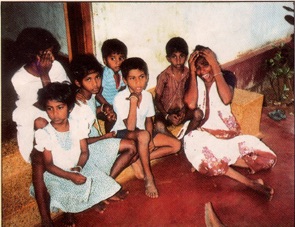
36 years ago, up to 64 Tamil civilians were killed by the Indian Peace Keeping Force (IPKF) in Valvettithurai in a massacre that was termed “India’s My Lai”.
The massacre, which saw dozens killed, came on the background of escalating violence and rights abuses committed by Indian forces across the Tamil homeland. As Tamil militant groups continued hostilities with the IPKF, the Indian forces imposed a curfew on August 2, 1989, following an ambush attack.
Indian soldiers then embarked on a systematic killing spree in Valvettithurai. Many in the town were blocked from receiving urgently required medical treatment for at least two days, whilst the curfew was in place.
See a timeline of some of the many instances of violence by Nadarajah Anantharajah, the then-secretary of the Citizen Committee Valvettithurai and a survivor of the IPKF massacre, and compiled by PEARL here.
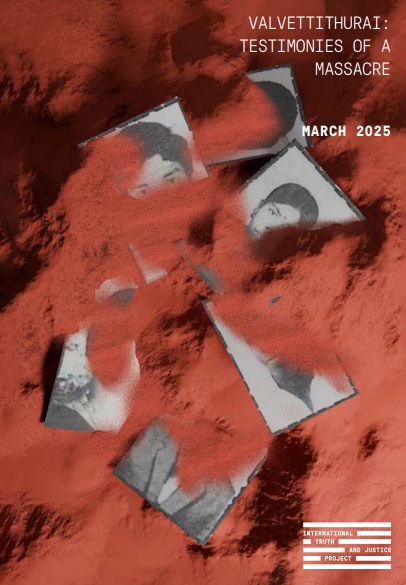
Earlier this year, the the International Truth and Justice Project (ITJP) released a report, titled "Valvettithurai: Testimonies of a Massacre", which presents damning evidence of mass killings, torture, and destruction inflicted upon Tamil civilians, calling for criminal accountability, reparations, and exhumations of mass graves.
Over three days in August 1989, IPKF soldiers killed more than 60 Tamil civilians in Valvettithurai, including five children under the age of 16 and an infant. Survivors recounted harrowing experiences—watching their loved ones executed in front of them, being forced to play dead in pools of blood, and witnessing widespread destruction of homes, businesses, and food supplies.
The report details how Tamil civilians suffered indiscriminate violence, with their town reduced to rubble in what appeared to be an act of collective punishment.
Despite initial denials by Indian authorities and attempts to dismiss the massacre as collateral damage in crossfire, local documentation efforts by Tamil activists preserved critical evidence. School principal Nadarajah Anantharaj painstakingly collected around 200 affidavits from survivors, ensuring that the truth of what transpired was recorded for future generations.
The ITJP report highlights that despite the passage of 35 years, there has been no justice for the victims of the Valvettithurai massacre. Successive governments in Sri Lanka failed to hold the IPKF accountable, and Indian authorities have not pursued criminal prosecutions against those responsible.
“The survivors of this massacre have never had access to an effective remedy,” the report states, adding that families have faced a systematic cover-up, diplomatic obstructions, and even assassinations of those who sought accountability.
In light of the ongoing failure to prosecute those responsible, the ITJP recommends that Sri Lanka should impose targeted sanctions and visa bans on former IPKF officers implicated in the massacre. The report also urges the application of the Leahy Law in the United States, which would prohibit military assistance to any unit found responsible for gross human rights violations.
David Housego, a journalist for the London Financial Times, published a piece on the massacre on 17 August 1989. See an excerpt from his article below.
“On Tuesday I was the first western reporter to visit Valvettiturai, a small coastal town near Jaffna, where Indian troops carried out reprisals on August 2 after the Tamil Tigers, the Tamil guerrilla movement, ambushed one of their patrols close to the main square…
Most of the killings took place in the hours after the ambush, but the burning and ransacking continued, for another two days while Valvettiturai was under curfew and surrounded by Indian troops. What is also certain is that the official Indian explanation for the deaths - that civilians were caught in crossfire in the wake of the ambush - has no credibility.”
Almost a fortnight after the event, a smell of charred remains hangs over Velvettiturai. Of the 15,000 people perhaps half have left in fear or despair. Many who remain are distraught over the loss of relatives or belongings, and uncertain how to begin again or where."
Several eyewitness accounts were also published in the Indian Express on 24 August, 1989. See excerpts below.
"There were many males and females in addition to children inside the house. We confined ourselves in a room. At about 2.30 pm somebody knocked at the door of the house.
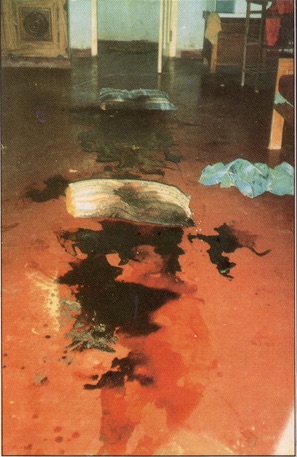
The Indian Peace Keeping soldiers who came inside the house first shot Mr Subramaniam and ordered the males and females to stand separately. They shot the males and then shot the females. I fell on the floor along with the dead and pretended to be dead and got up after the armed forces left. I saw my mother and brother dead, all totalling nine people.
When the soldiers came into the compound they fired at the house, set fire to the car and then came into the kitchen, into which we had all run. As one of the soldiers pulled my husband into the yard, his mother and I held on to his hands and tried to drag him back, pleading with the soldier to let him go. The soldier just didn't heed our pleas, and pushing us aside shot my husband dead. They did the same to Vellummylum. We pleaded, we begged on our knees, even my 75-year old mother-in-law Valliammal did so.
Fourteen-year-old Umadevi was witness to yet another scene of horror:
"The IPKF soldiers ordered the men to kneel down and opened fire. Four died on the spot and four were seriously wounded."
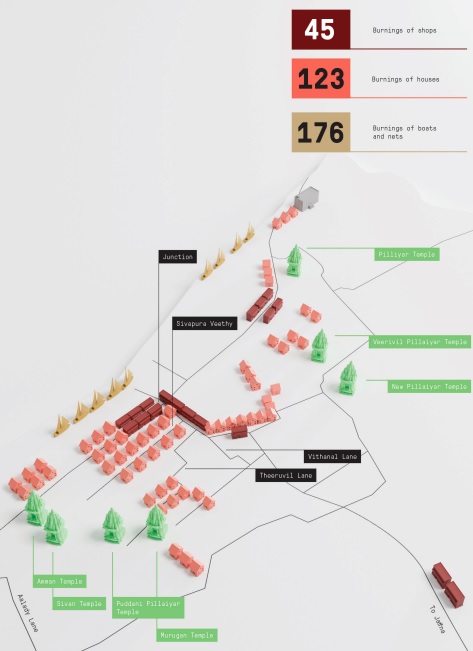
Fifty two bodies have been identified, 12 persons are still on the missing list and presumed dead, 43 injured, 122 houses and 45 shops burnt, ten cars, 50 bicycles, 175 fishing nets and fishing gear destroyed."
George Fernandez, an Indian opposition parliamentarian who would later serve as the country's defence minister, commented on the massacre a few months later.
"When in early August, 1987, I had said that Mr. Rajiv Gandhi's military adventure in Sri Lanka would be India's Viet Nam, I had not anticipated that India's Viet Nam would also have its own My Lai. Of course, I was aware and I had also said repeatedly that soldiers everywhere alike, their training and the rigours of their life, not to speak of the brutalisation caused by war, making them behave in the most inhuman ways when under pressure.
Now, in Velvlettiturai, the Indian army has enacted its My Lai. London's Daily Telegraph commenting editorially on the barbarism exhibited by the Indian army in Velvettiturai says that, if anything "this massacre is worse than My Lai. Then American troops simply ran amok. In the Sri Lankan village, the Indians seem to have been more systematic; the victims being forced to lie down, and then shot in the back".
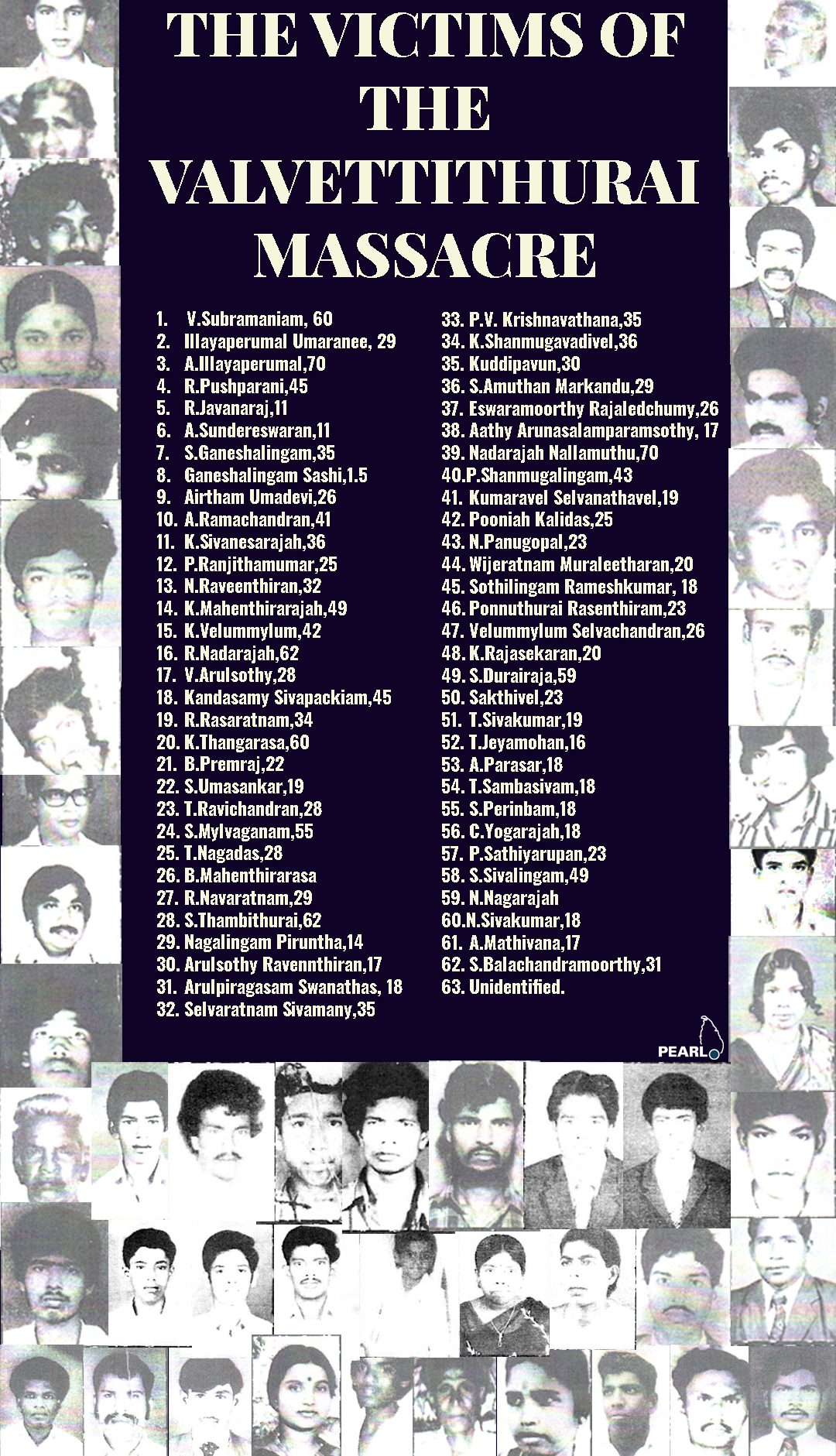
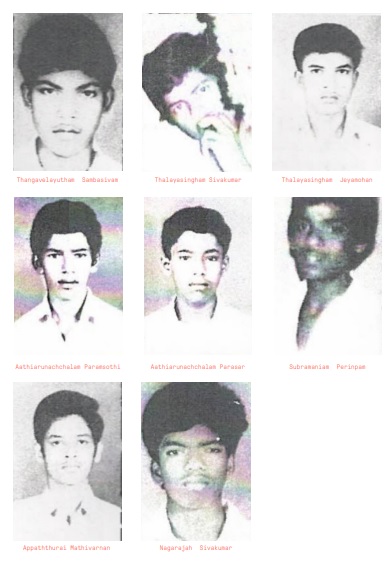
See a list of the victims below.