
This week, France’s president Emmanuel Macron announced his government would move to recognise the State of Palestine. Though not the first state, nor even first European country, to do so, as a G7 nation and permanent member of the UN Security Council, the move carries significant weight. The declaration sends a powerful political message across the globe: that the Palestinian people are a nation, deserving of statehood and self-determination. It will be watched closely not just by those following the crisis in Gaza, but by other nations around the world still struggling for their own liberation.
Macron’s move has been a long time coming. More than 140 countries recognise Palestinian statehood so far, and pressure has been building on others around the world, including in the UK, where over 200 cross-party MPs have written to Prime Minister Keir Starmer to follow suit.
Recognition alone does not secure peace. But in the wake of Israel’s devastating offensive, one many legal scholars, human rights experts and governments are now calling genocide, it is more than just a symbolic gesture. It can serve as a powerful political, legal, and moral affirmation of a people’s right to self-determination. It shatters the narrative that the conflict is merely an “internal” issue, or even reducible to a problem of “terrorism”, to be dealt with by the tools of the oppressors. Instead, it forces open the door to greater scrutiny at an international level. And in the face of a genocide, the move provides a platform for justice, accountability, and long-denied dignity. Indeed, the fact that now is when states around the world are heading towards recognising Palestine, shows that it can also be a tool towards halting genocide. Even if a nation is bombed and occupied, it cannot be destroyed.
Palestinian recognition is long overdue and should undoubtedly be applauded. But this moment also holds a mirror up to the world and to all who have spoken the language of human rights and freedom while ignoring other, equally legitimate, claims to statehood. Among them is the Eelam Tamil nation.
The parallels between the Palestinian and Tamil struggles are striking. Both are nations with distinct languages, histories, cultures, and identities. Both have endured decades of systemic discrimination, militarised occupation, state-sponsored displacement, and brutal campaigns of violence. Both have faced repeated betrayals by the international community, even in the face of overwhelming evidence of mass atrocities. And in both cases, the people have consistently and courageously demanded self-determination.
That this is an enduring desire of the Tamil people is no secret. Every major Tamil political party still ensures that liberation for the homeland, remains at the core of any campaign. One need look no further than this week to understand why. The commemorations of the Black July pogrom, to the uncovering of mass graves in Chemmani in the North and Sampur in the East, and the continued military occupation are all reminders of the enduring injustice faced by Tamils.
The armed conflict may have ended 16 years ago, but the oppression has not. Military camps remain embedded across the Tamil homeland. Land seizures continue. Political prisoners remain behind bars. And Sinhala nationalists still cling to “territorial integrity” as a justification to block any meaningful power-sharing and continue the suffocating occupation. The very persistence of these policies is proof of how deeply the idea of Tamil sovereignty still unsettles the Sri Lankan state.
It is especially galling that Sri Lanka champions the Palestinian cause in international forums, at least superficially, yet remains hostile to even the most basic articulation of Tamil identity and nationhood. Colombo has supported resolutions in favour of Palestinian statehood at the UN, and makes public declarations of solidarity (even whilst rapidly expanding ties to Israel and providing much-needed economic support). Yet this same state condemns Tamil demands for autonomy, refuses to acknowledge the genocide committed by its own military, and continues to occupy the Tamil homeland. That double standard is not lost on Tamils, and nor should it be lost on the international community.
This is why international recognition of Tamil Eelam is not simply a far flung demand, but a laudable and legitimate step towards long-term peace. The argument that such a move is destabilising rings hollow when we consider the alternatives — decades of violence and repression, land grabs, demographic engineering, military occupation and the denial of fundamental political rights. It is far more destabilising to continue pretending that the Sri Lankan state can somehow reform itself into a genuinely pluralistic, rights-respecting democracy. After more than 75 years of Sinhala-Buddhist ethnocracy, how much longer must Tamils wait?
France’s recognition of Palestine also serves as a rebuke to those who insist that self-determination must wait for a more “favourable” geopolitical moment. There is no perfect time to recognise nationhood.
The longer the world waits, the more it emboldens states that seek to erase entire peoples.
_____
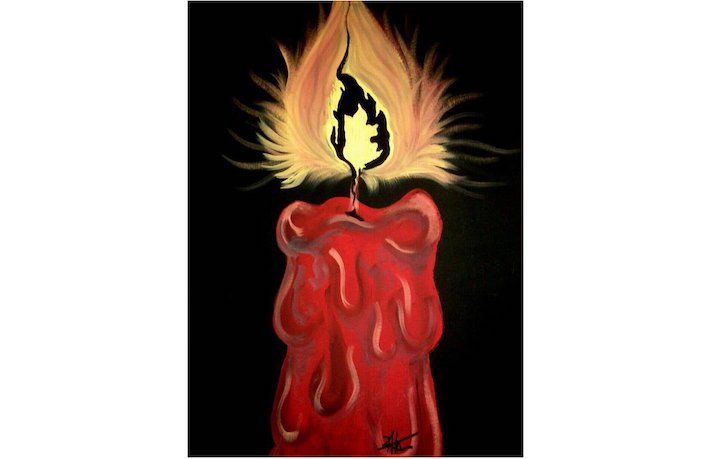
Illustration by Keera Ratnam.