
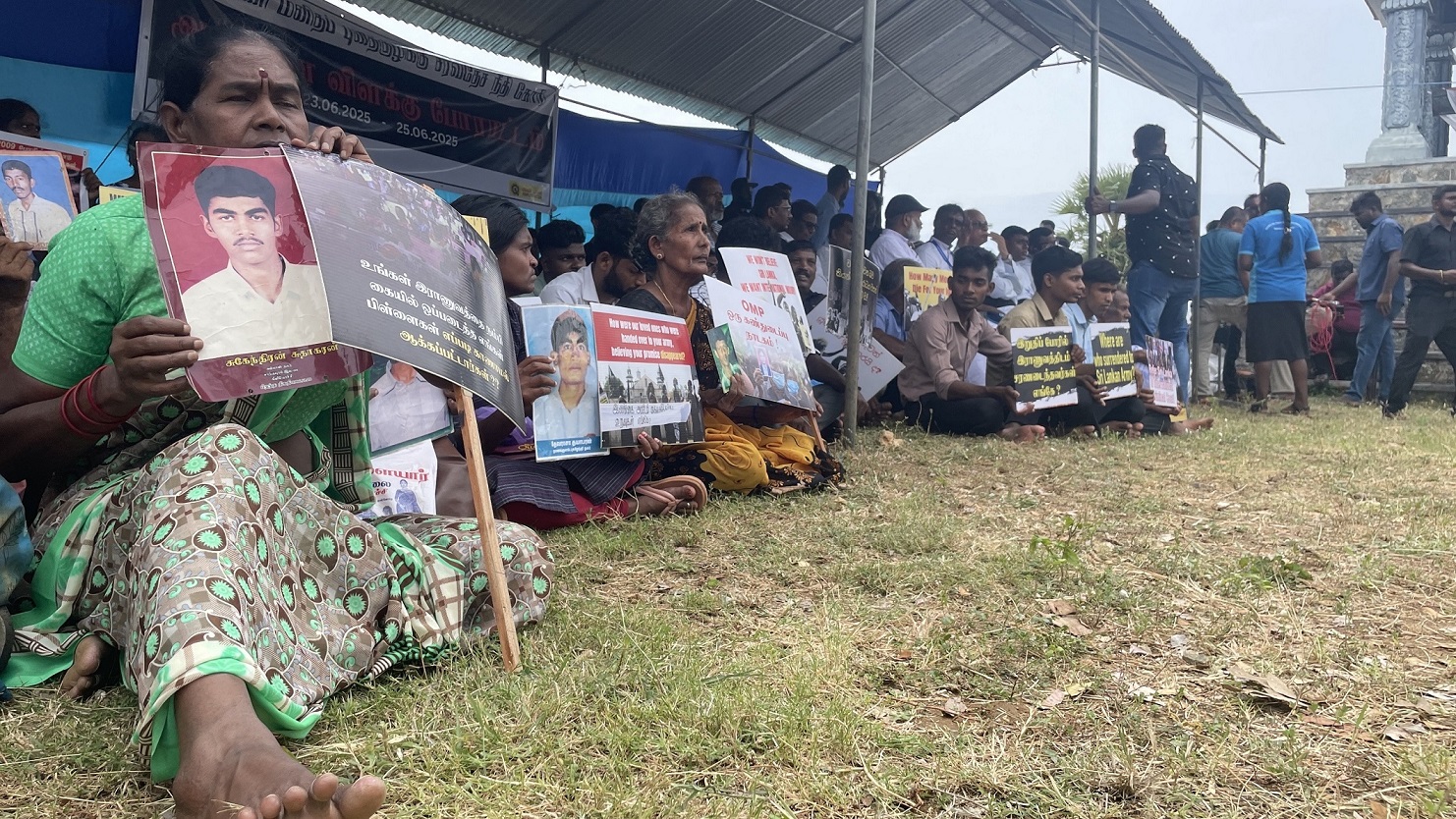
To dispel the darkness surrounding the Chemmani mass graves and demand international justice for enforced disappearances, the “Anaiya Vilakku” (Eternal Lamp) protest was held in Chemmani, Jaffna. Organized by the volunteer youth collective “Makkal Seyal” (People’s Action), this protest took place on June 23, 24, and 25. It drew participation from families of the disappeared, religious leaders, university students, civil society representatives, politicians, and large numbers of the general public.
What is the ‘Anaiya Vilakku’?
In Tamil devotional tradition, the “Anaiya Vilakku” or “Eternal Lamp” is a sacred practice of lighting a lamp with ghee or coconut oil and keeping it burning continuously until a heartfelt wish is fulfilled. This act symbolizes unwavering focus and determination - believing that by sustaining the light, one’s prayers and intentions remain alive until realized. The eternal lamp becomes a symbol of resolve, embodying the belief that persistent prayer or struggle will lead to success. In this protest, the eternal lamp was adopted as a symbol of the demand for justice for the Chemmani mass graves and the forcibly disappeared.
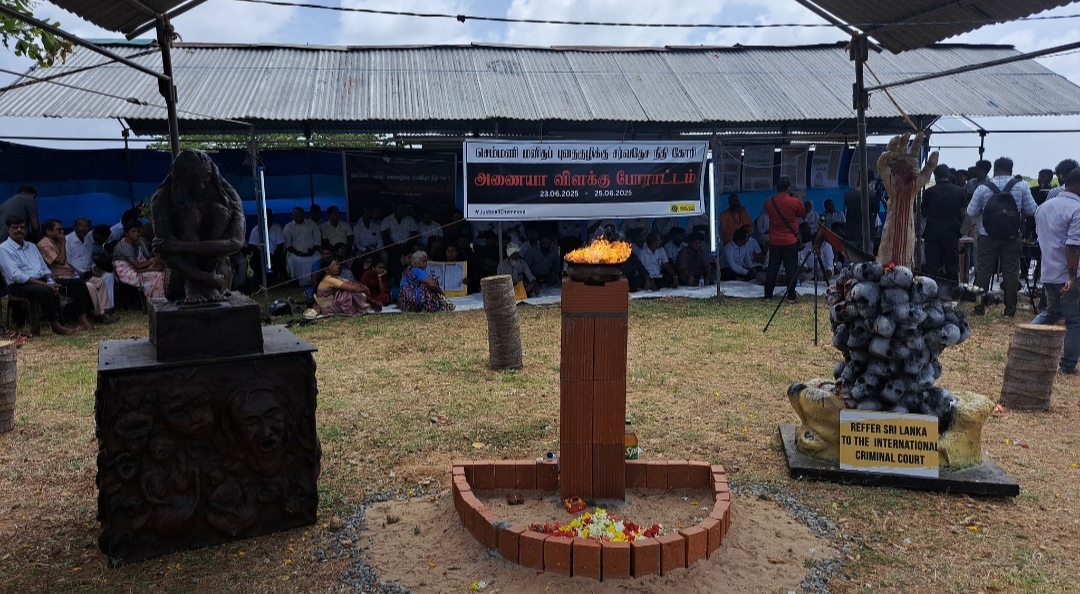
On June 23 at 10:10 AM, families of the disappeared lit the eternal lamp. It burned continuously, day and night, for three days. Protesters protected the lamp from the strong Chemmani winds, constantly refilling it with oil and wicks donated by supporters. This collective effort kept the flame alive until the end of the protest.
On the third day, as the protest concluded, the eternal lamp was taken from the protest ground in a decorated vehicle. Its flames were divided and placed at key memorials in Jaffna: the Thiyagi Thileepan Memorial, the Mullivaikkal Massacre Memorial, the Father Selva Memorial, the Jaffna Public Library entrance, and the slain journalists’ memorial. The remaining flame, along with the clay pot, was ceremonially immersed into the sea at Thondamanaru by protesters.
The attention-grabbing bronze plaque
For the past fifteen years, the Tamil people have engaged in peaceful struggles, often concluding with petitions or memoranda that faded into obscurity. In contrast, the Anaiya Vilakku protest inscribed its six demands onto a bronze plaque—a permanent historical record that cannot be easily discarded or forgotten.
.jpg)
The six demands inscribed on the bronze plaque:
1. The Sri Lankan government must allow the Office of the High Commissioner for Human Rights’ Sri Lanka Accountability Project (OSLAP) to provide technical expertise and monitoring during all mass grave excavations, including Chemmani.
2. In accordance with UNHRC Resolution 46/1, the Sri Lankan government must grant OSLAP officials unhindered access to gather evidence of genocide, war crimes, and crimes against humanity.
3. The government must permit the families of the disappeared to provide technical input in excavations using their community’s own resources.
4. The Sri Lankan government must approve all funding requests made by the Jaffna Magistrate’s Court for grave excavations.
5. The government must allow the reopening and international supervision of all mass graves revealed so far.
6. The UN High Commissioner for Human Rights must work to escalate Sri Lanka’s accountability failures to the UN General Assembly and Security Council, enabling prosecution through the International Criminal Court.
Unlike previous petitions on paper, this time the demands were engraved on a bronze plaque, handed over by families of the disappeared to the UN High Commissioner for Human Rights at the Chemmani mass grave site—designed to remain as a permanent testament, even if discarded.
Exhibition reviving memories of 1996
The protest site hosted a poignant exhibition displaying news articles, data, and photographs about disappearances in Jaffna during 1996–97, as well as materials on the rape and murder of schoolgirl Krishanthy. Many members of the public visited and viewed these powerful records. Notably, speeches by journalist Premananth—who reported live from Chemmani during the exhumation of Krishanthy’s body—and Vijayakumar, who founded the Association of Families of the Disappeared in 1996, captured significant attention. At night, documentaries on enforced disappearances across Sri Lanka were screened, readings of poems about Chemmani were shared, and a story about Krishanthy by writer J.K. was performed.
Signature campaign
A signature campaign supporting the six demands was held throughout the three days, with signatories also invited to write their thoughts about Chemmani and enforced disappearances on small notes. Organizers plan to compile these reflections into a comprehensive document.
Blood-stained school uniform display
.JPG)
A powerful installation recreated a military checkpoint outside the protest venue, with barbed wire fencing and a blood-stained school uniform draped over it. This scene, evoking the final moments of Krishanthy who was abducted at an army checkpoint, deeply moved visitors and passersby—reviving memories of her tragic fate.
Final day disruptions
The growing momentum of the protest became clear as large numbers of people voluntarily gathered on the third day. Political leaders, including ITAK Deputy Leader C.V.K. Sivagnanam and Batticaloa MP Rasamanickam Shanakiyan, attended and laid floral tributes. However, when they left, supporters of rival factions expressed anger, shouting at them to leave and causing brief commotion outside the protest site.
Later, Fisheries Minister Ramalingam Chandrasekaran and MP Rajeevan Jayanandamoorthy arrived to pay respects at the eternal lamp, but were heckled by certain YouTubers demanding they leave immediately. These vloggers sought to create sensational footage for more views, deliberately orchestrating confrontations. As tensions escalated, the ministers were forced to leave. National People’s Power MP Ilankumaran also arrived later but faced similar hostility and withdrew from the site.
The role of YouTubers in disruption
More than 200 YouTubers attended the protest, filming with phones and small cameras. While many captured genuine testimonies from the families of the disappeared, some focused solely on provoking incidents to generate sensational content. These disruptive vloggers planned coordinated efforts to expel visiting politicians, believing dramatic footage would increase their view counts. They even attempted to obstruct UN High Commissioner Volker Türk as he came to the eternal lamp, creating chaos and preventing mainstream journalists from capturing the event. Some international media photographers were unable to take a single photo before leaving in frustration.
Conclusion with the UN Visit
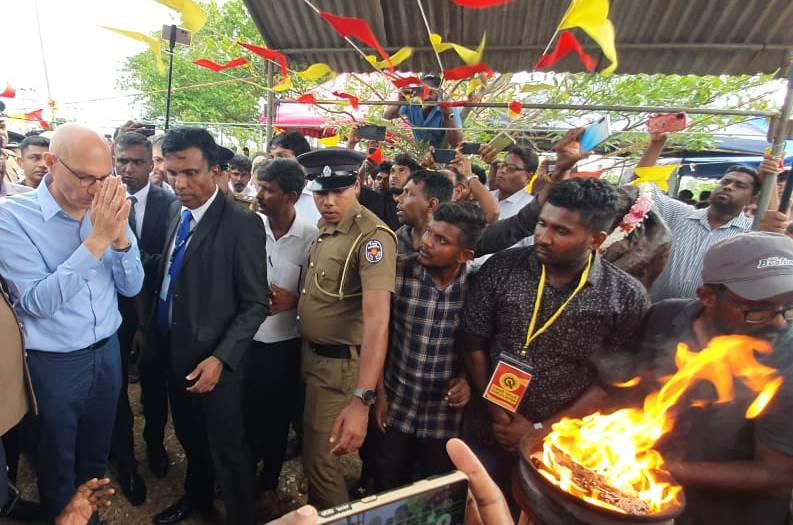
Despite these obstacles, protest organizers successfully brought the UN High Commissioner for Human Rights, Volker Türk, to the protest site. He paid his respects by laying flowers at the eternal lamp and humbly accepted the bronze plaque bearing the six demands from the families of the disappeared—marking a powerful moment of solidarity and recognition.
_____
Jera Thampi is an Eelam Tamil journalist based in the North-East.