
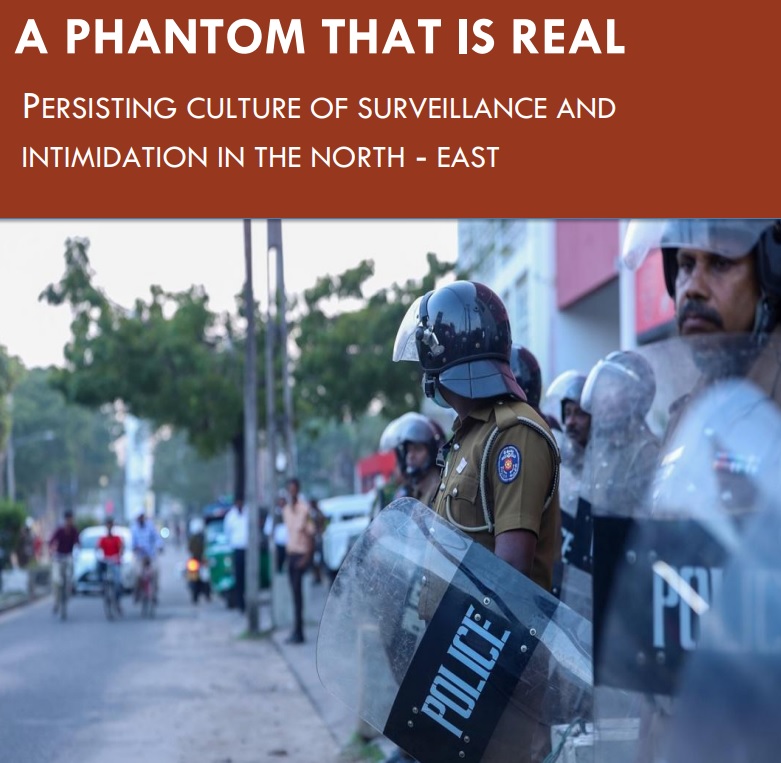
A newly released report by the Adayaalam Centre for Policy Research (ACPR) has detailed the extent to which Sri Lanka’s security forces continue to maintain an oppressive culture of surveillance and intimidation in the Tamil North-East, more than 16 years after the end of the armed conflict.
The report, “A Phantom that is Real: Persisting Culture of Surveillance and Intimidation in the North-East”, published in February 2025, documents a disturbing pattern of repression targeting Tamil activists, journalists, religious leaders, returnees, and civil society organisations.
"A widely held belief among the international and diplomatic community is that normalcy has returned to Sri Lanka following the end of the armed conflict in 2009," the report begins. "This narrative of post-war peace and stability is in stark contrast to the true condition of the Northern and Eastern Provinces (North-East)."
The 27-page report provides extensive evidence of ongoing militarisation and surveillance in the North-East, mapping trends of repression and the weaponisation of legal instruments to silence dissent.
‘A climate of fear’
The report details how surveillance by the Sri Lankan security forces, usually through the Criminal Investigation Department (CID), Counter Terrorism Investigation Division (CTID), and Terrorism Investigation Department (TID), remains routine. The draconian Prevention of Terrorism Act (PTA) continues to be deployed to detain activists arbitrarily, often for organising remembrance events or advocating for accountability.
"Overall, the prevalence of surveillance and intimidation establishes a climate of fear where, once you are seen as a target, you will be subjected to constant surveillance, intimidation, and interrogation with little cause or restraint," the report states.
Prominent Tamil activists, including current MP Thurairajah Ravikaran and Tamil families of the disappeared, have been repeatedly arrested and harassed for protesting land grabs, delays in exhuming mass graves, and Buddhist temple construction in Tamil areas.
One member of the families of the disappeared in Mullaithivu remarked: "There seems to be a hidden war – they [the CID] have gathered all this information and are chasing me with this… They do not want me to engage in advocacy here or abroad. I am scared to leave my children."
Repression of remembrance
The report documents systematic attempts to stifle Tamil remembrance of the Mullivaikkal genocide and other massacres. Court restraining orders, intimidation by police and military, and even physical attacks have become common.
"Police and intelligence officers often call individuals to intimidate them into not participating in events," the report notes. "In some instances, they follow them on their way to protest sites and visit them at their houses to intimidate them."
In May 2024, Tamil families in Muttur and Kalmunai were banned from serving Mullivaikkal kanji, a simple porridge served in remembrance of those who perished in 2009. In one case, women were dragged from their homes at night for distributing kanji, while Special Task Force units were deployed to prevent remembrance events.
"Court restraining orders will be issued to me by the police before each of the main memorialisation events," one families of the disappeared activist reported.
Religious repression and Buddhist colonisation
The report highlights ongoing efforts to deny Tamils the right to religious freedom. Hindu temples have been arbitrarily declared "Buddhist archaeological sites", with security forces deployed to enforce restrictions.
In Kurunthoormalai, the Department of Archaeology and the Sri Lankan army constructed a new Buddhist temple in violation of multiple court orders, driving away local Hindu worshippers.
Similar repression was documented in Vedukkunarimalai, where police disrupted Hindu prayers on Maha Shivaratri and arrested worshippers, including former MP Selvarajah Kajendran.
"These incidents not only amount to denial of the right to freedom of religion but also make clear that the security sector is a Sinhala-Buddhist one, and that proponents of Buddhism are considered above the law," the report warns.
Media intimidation
Tamil journalists also remain under constant threat, facing surveillance, harassment, and restrictions on their reporting.
"They monitor our comings and goings; know all our network; have individual profiles on us; call us and visit our houses to intimidate us," a journalist in Mullaithivu stated.
"These populations have been relentlessly targeted for decades and yet refuse to cave into the intimidation tactics and back down; they continue to peacefully struggle for their rights that they deserve," the report concludes.
"However, all of this comes at a price. For many people, the choice between their safety, sanity, or survival, on the one hand, and the ability to stay and fight for their rights is a difficult one to make, taxing them both physically and psychologically. As Sri Lanka continues to see a shrinking civil space, if the international community fails to act and assist the marginalised voices of the Tamil-speaking population in Sri Lanka that are often silenced due to fear of reprisals, the state will continue their illegal and abhorrent practices and sends a message to the world that their actions face no consequences and that the voices that matter the most will always be allowed to be silenced.”