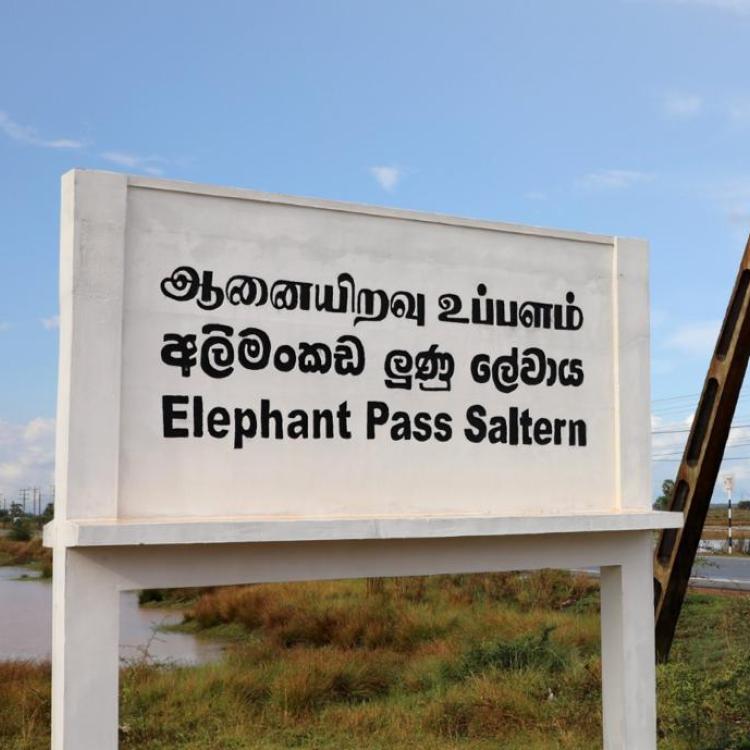

Tamil workers at the Elephant Pass Saltworks have entered the second week of protest, demanding redress for poor working conditions and managerial misconduct, as the island faces a severe salt shortage.
On 22 May, four employees accompanied by Jatson Pigrado, Director of the Mannar Socio-Economic Development Corporation, travelled to Jaffna to lodge a formal complaint with the Human Rights Commission. The submission, coordinated by the Mannar Socio-Economic Development Institute, detailed allegations of abuse by senior management, including the general manager, assistant manager, and supervisors.
“We are not given proper work. There are no medical facilities for us in the salt mine. There is a problem with drinking water—we have to carry it inside from outside tanks,” said the protesting workers.
They noted that they were allocated only four working days since the beginning of May, with some not offered any work at all. Other grievances included the prioritisation of machinery over manual labour, the absence of uniforms or protective equipment, and what they described as retaliation from management when concerns were raised.
The Human Rights Commission in Jaffna has reportedly pledged to launch an urgent investigation into the claims.
The protest has emerged amidst a crippling salt shortage across the island. Salt prices have surged to as much as Rs. 400 per kilogram, more than doubling in recent weeks.
Supermarket shelves lie empty, and frustrated citizens have taken to social media to highlight the scarcity. Supermarket shelves are reportedly running out.
The crisis, driven by disrupted domestic production due to unseasonal rain, has exposed deeper structural issues within the industry. Despite Sri Lanka’s proximity to the ocean, major salterns in Hambantota, Puttalam, and Elephant Pass have struggled to meet demand. Last week, heavy rains destroyed nearly 15,000 metric tonnes of harvested salt in Puttalam alone, a region that produces 60 percent of the country’s supply. Domestic production falls far short of the 180,000 metric tonnes needed annually.
Government officials have scrambled to import salt to ease the crisis. Trade Minister Wasantha Samarasinghe announced that 3,050 metric tonnes of salt from India are expected imminently. He acknowledged that initial optimism over a strong harvest had delayed imports, but the continued failure of production has made external sourcing unavoidable.
Meanwhile, tensions surrounding the Elephant Pass Saltworks were heightened in Parliament on 22 May. Minister of Industry and Entrepreneurship Development Sunil Handunnetti accused MP Archuna of regional discrimination, after the latter called for the transfer of the salt factory manager.
“There is no such thing as ‘Prabhakaran salt’ anymore in Sri Lanka,” Handunnetti declared. “There is no such thing as northern salt or southern salt, it is all Sri Lankan salt.”
MP Archuna denied the allegation, insisting his concerns were solely in support of the protesting workers. “I never said northern salt should not be sent south. My plea was solely to seek solutions to the workers’ grievances,” he clarified, and added that he could consider filing a defamation case against Handunnetti for misrepresenting his stance.
The salt crisis underscores broader economic vulnerabilities in Sri Lanka, which is still reeling from the effects of the 2022 financial collapse.