
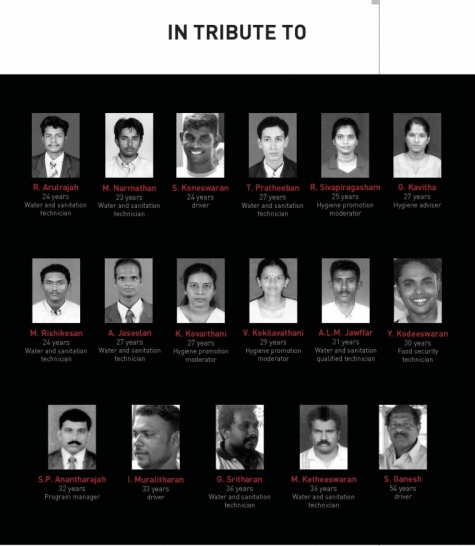
Action Against Hunger has called on the Sri Lankan government to open a new investigation into the 2006 Muttur massacre, in which seventeen of its aid workers, sixteen of them Tamil, were executed, urging an end to "decades of impunity" as the killings approach their twentieth anniversary.
In a letter sent to the Sri Lankan president in May, the president of Action Against Hunger, Dr Robert Sebbag, requested an account of the efforts made by Sri Lanka's governmental and judicial authorities to investigate the massacre and bring those responsible to justice, "in accordance with Sri Lanka's international obligations", and asked to meet the president to discuss progress towards "an impartial, transparent and effective investigation into the killing of our colleagues".
"We are deeply concerned that twenty years on there has been no justice for our colleagues," the letter said, adding that the families of the victims continued to endure "the trauma of a decades long wait" for accountability. That the case file remained open, it warned, offered "a dangerous signal that such attacks on humanitarian workers can be perpetrated without consequence". The organisation noted that Sri Lanka is a signatory to the recent Declaration for the Protection of Humanitarian Personnel, under which it affirmed its determination to end impunity for attacks on aid workers.
In an accompanying press release published on 15 June, the agency called on the international community to support the request and to do everything possible to ensure that the truth about the crime is brought to light.
On 4 August 2006, the seventeen staff members of the French non-governmental organisation were executed in their office compound in Muttur, in the Trincomalee district, while wearing t-shirts and vests identifying them as humanitarian workers. They had been delivering relief following the 2004 tsunami. Sixteen of the seventeen were Tamil, four of them women, and the other a Muslim. The killings followed days of fighting between government forces and the Liberation Tigers of Tamil Eelam for control of the town.
Action Against Hunger and several international bodies have, in its words, "repeatedly concluded that this attack was likely committed by Sri Lankan security forces and that it was subject to attempts of concealment by authorities". The University Teachers for Human Rights (Jaffna) found that two police constables and naval special forces commandos were directly responsible, with senior police and justice officials linked to a cover-up, while the Sri Lanka Monitoring Mission accused the security forces at the time.
No one has been prosecuted in the two decades since. A Presidential Commission of Inquiry established by then president Mahinda Rajapaksa exonerated the army and navy in 2009, instead blaming the LTTE or Muslim militia, obstructed witnesses, and never published its full report. Action Against Hunger withdrew from Sri Lanka in 2008, abandoning the domestic proceedings as a failure and calling for an international inquiry, while relatives who testified reported being threatened by security force personnel.
"Twenty years on, we continue to fight for justice for the brutal murder of our 17 colleagues, who were killed while delivering vital aid," said Perrine Benoist, co-director of Action Against Hunger France. "Many were at the beginning of their careers, and their families, like our colleagues, cannot accept that the perpetrators have not been prosecuted."
"Even after 20 years, the pain of what happened is still present in my heart. I miss my brother. Those responsible must be punished," said one relative of the victims.
The agency noted that attacks on humanitarian workers have been rising worldwide, with more than 1,000 killed in the last three years in Palestine, Sudan, South Sudan, Ukraine and the Democratic Republic of Congo. The failure to punish the Muttur killings, Benoist warned, had sent a signal that such attacks can go unanswered, making it imperative that Sri Lankan authorities now provide answers and that justice is served.