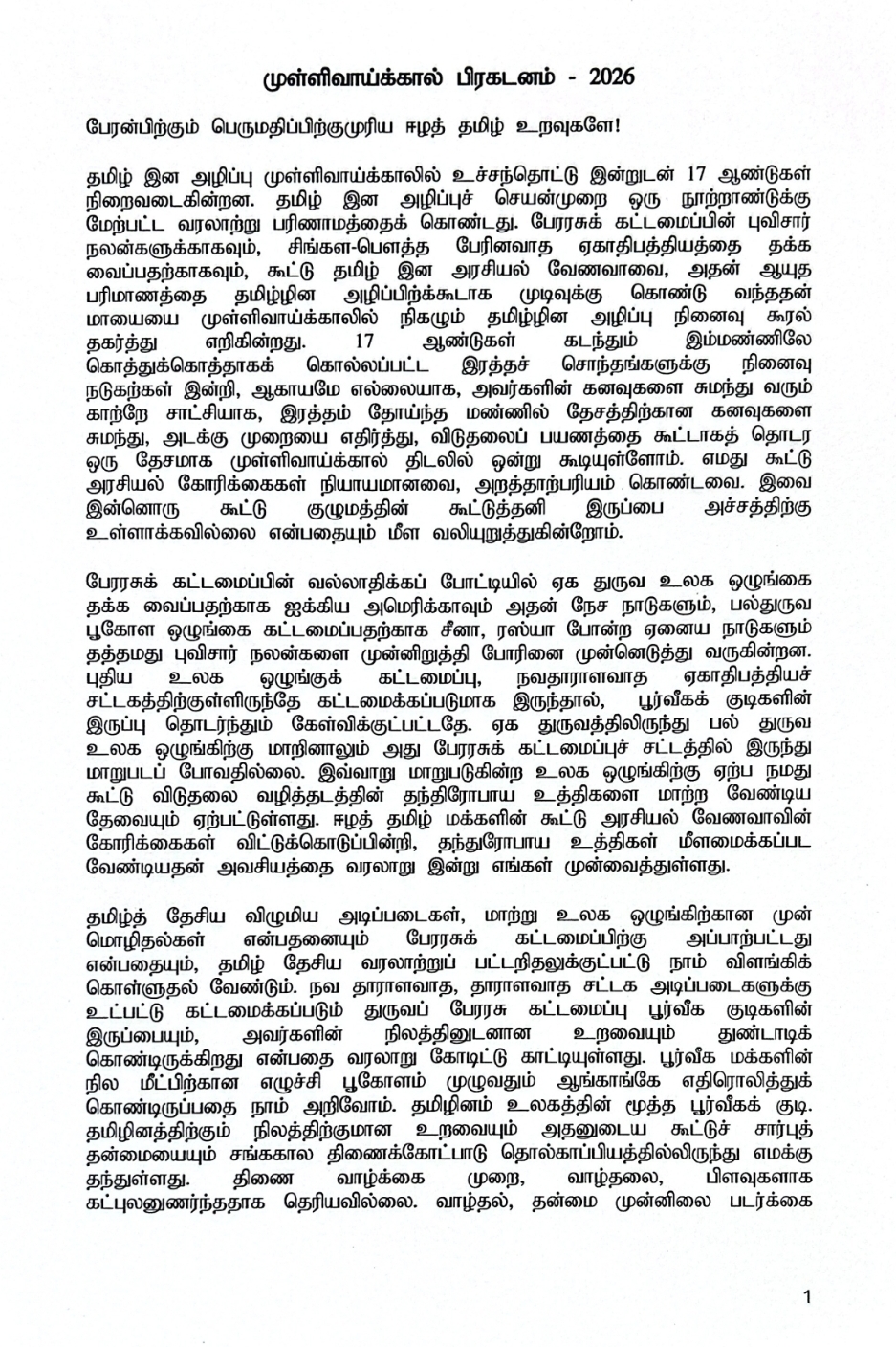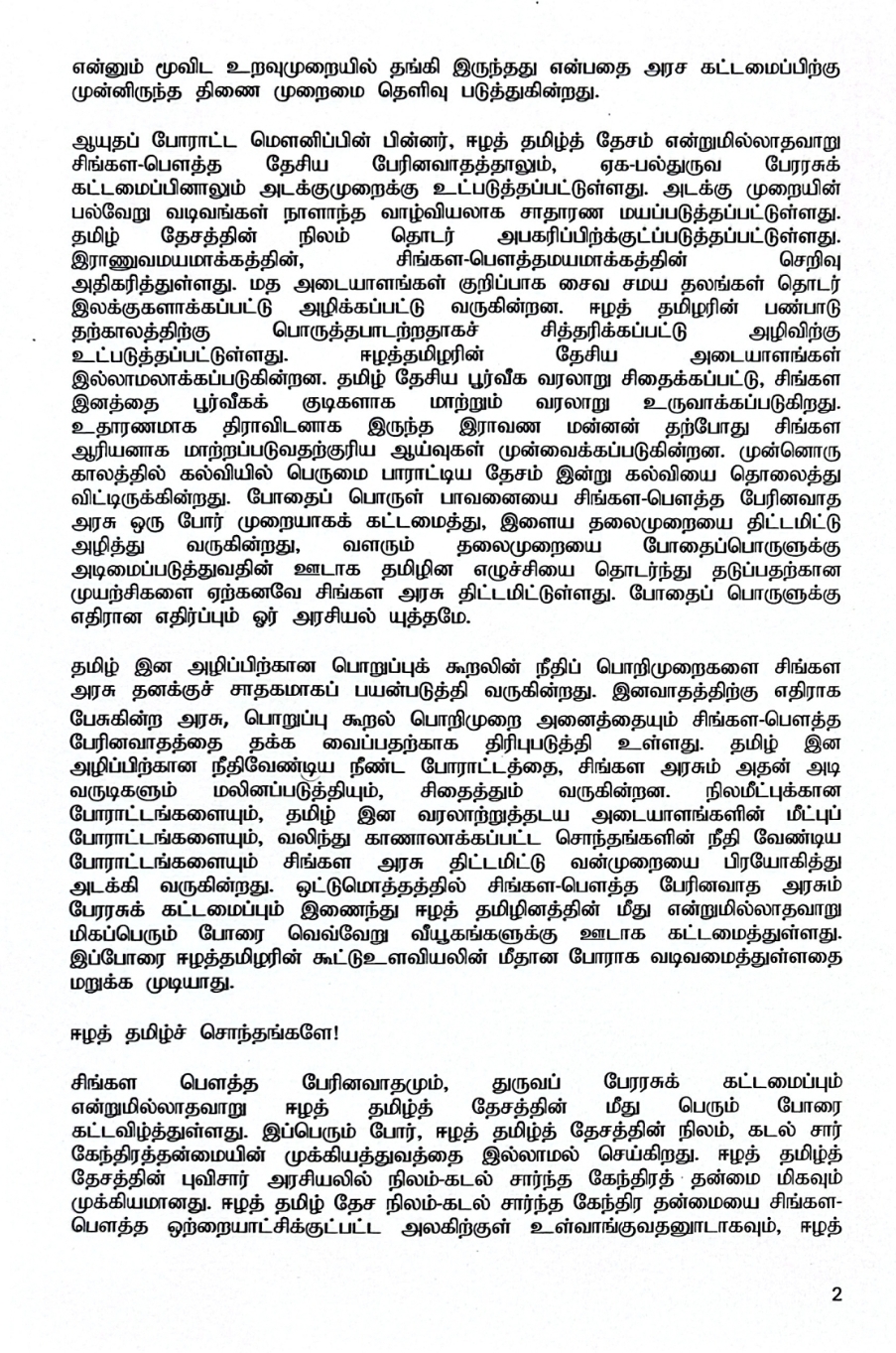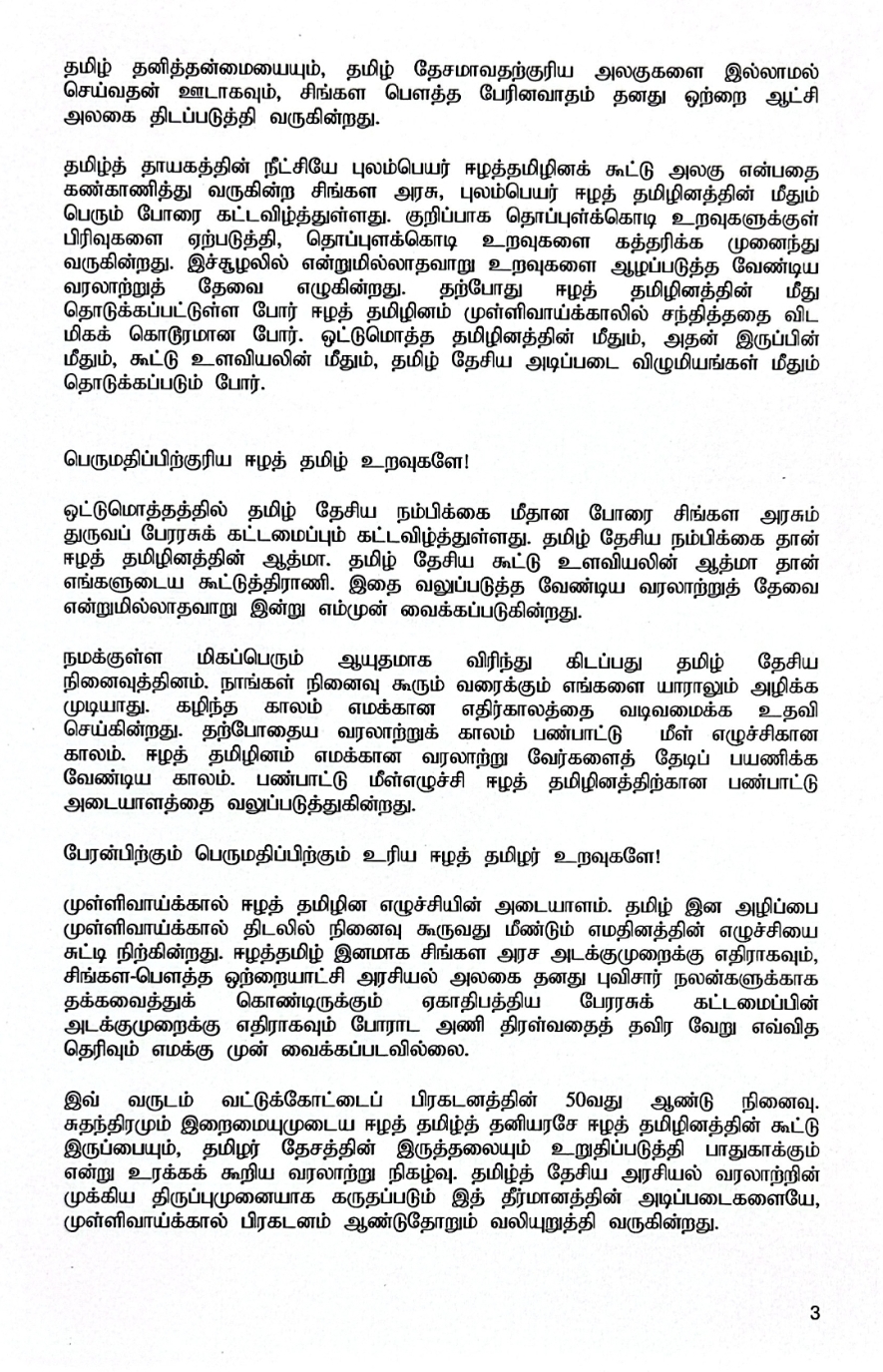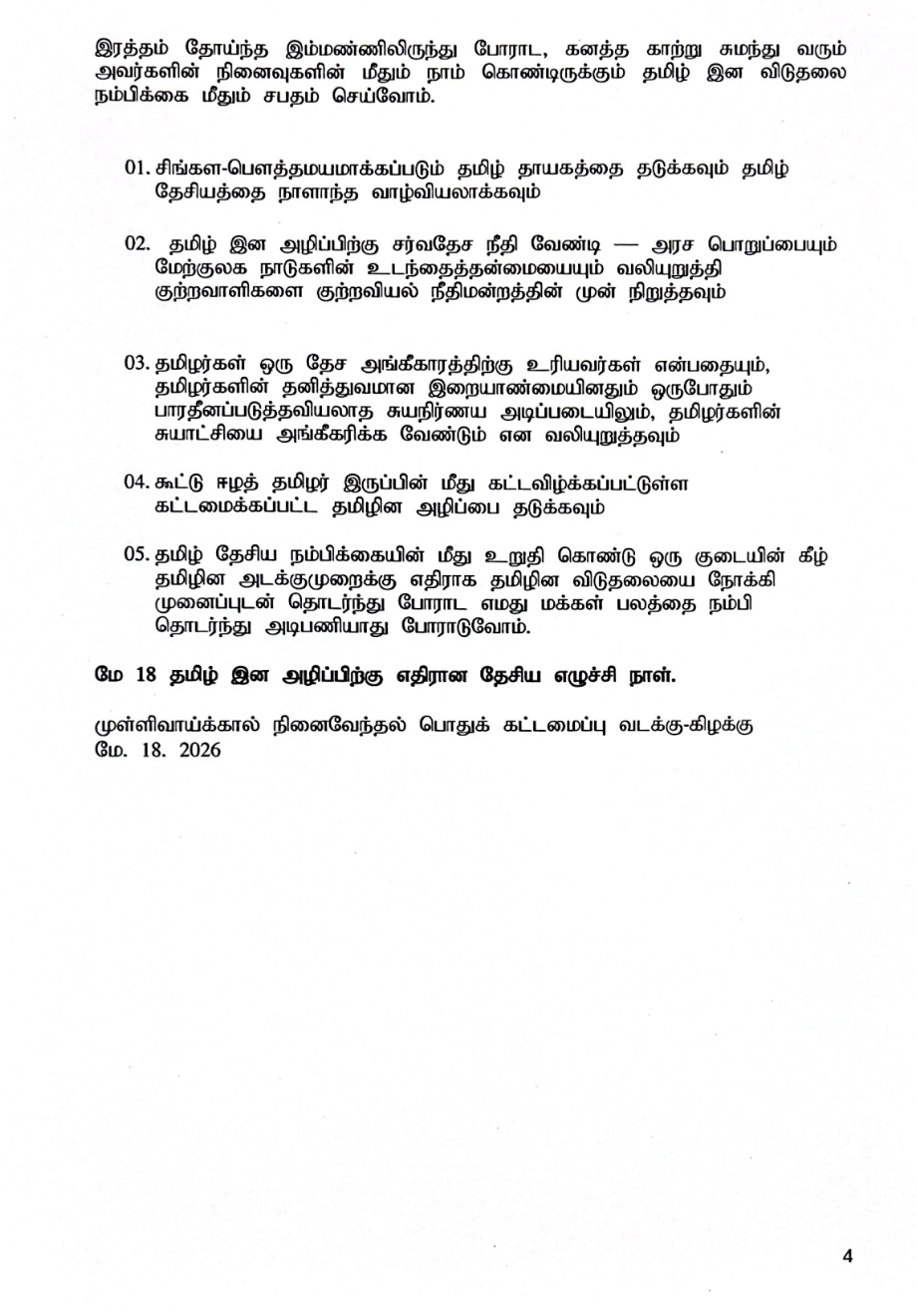
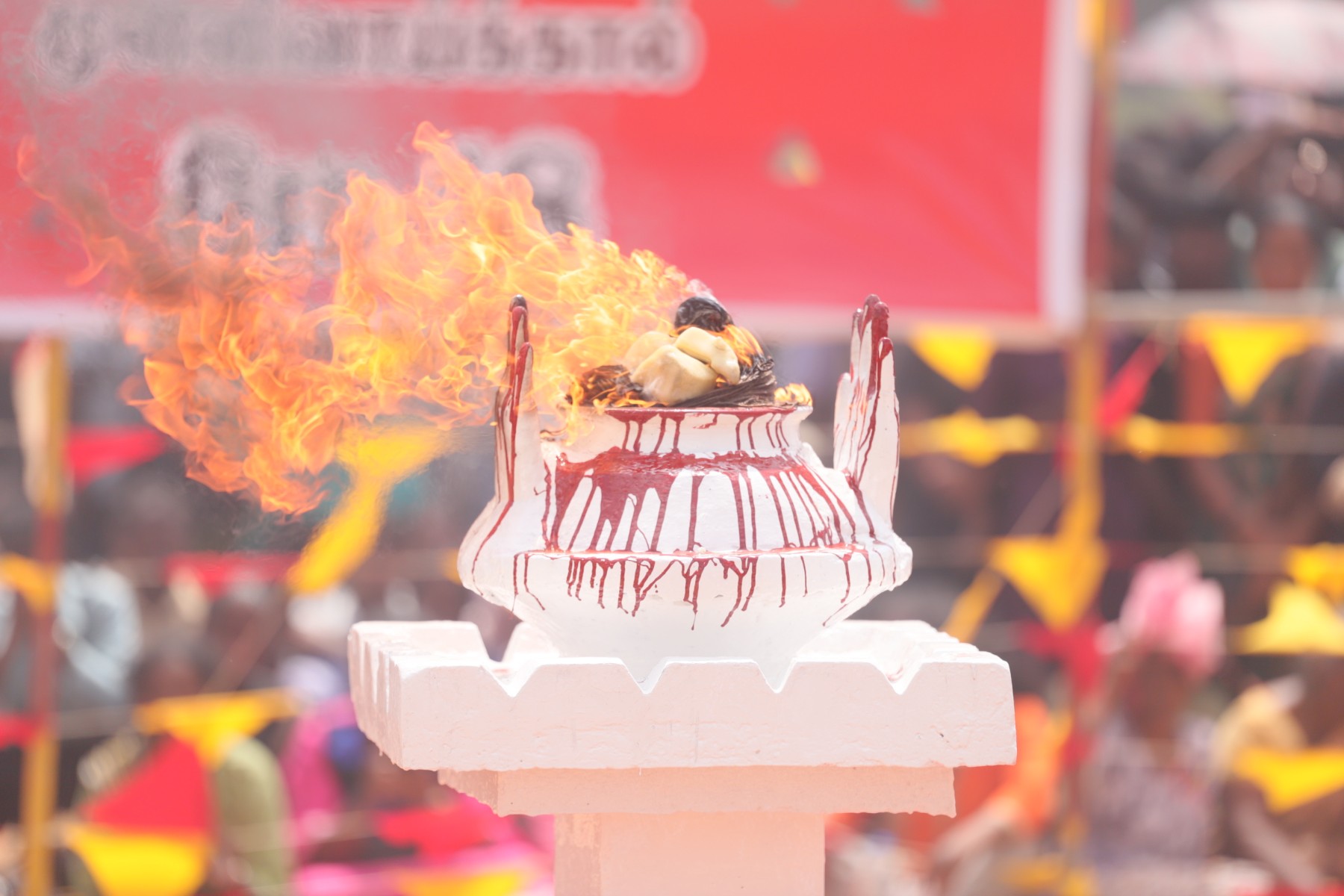
Thousands of Tamils gathered at Mullivaikkal on Monday to commemorate the 17th anniversary of the Mullivaikkal genocide, where a declaration issued at the remembrance event warned that the Tamil nation continues to face systematic efforts to erase its identity and called for a renewed Tamil cultural resurgence as a form of resistance.
The commemoration, held on May 18 at the Mullivaikkal memorial site in Mullaitivu, saw mourners light the common flame and memorial lamps before paying floral tribute to those killed during the final stages of the armed conflict in 2009. The Mullivaikkal Declaration was subsequently read aloud before the gathering.
The declaration stated that seventeen years after the massacres at Mullivaikkal, the structures responsible for the oppression of the Tamil nation remain intact. It accused the Sri Lankan state of continuing policies aimed at weakening the existence of the Tamil nation through militarisation, land appropriation, Sinhalisation and Buddhisisation across the Tamil homeland.
Central to the declaration was a warning that Tamil culture, history and identity are being systematically targeted in an attempt to undermine Tamil national consciousness. It alleged that Tamil historical landmarks and cultural symbols, particularly Hindu religious sites, continue to face destruction, appropriation and state-backed encroachment, whilst efforts are being made to distort Tamil history and disconnect younger generations from their heritage.
The declaration further argued that Tamil culture is increasingly portrayed as irrelevant to modern life and that the erosion of language, traditions and historical memory forms part of a wider project to weaken Tamil national identity. It also raised concerns regarding social issues affecting Tamil youth, including drug addiction, alleging that such problems have been allowed to deepen in ways that undermine Tamil national consciousness.
Describing the present moment as one requiring a “Tamil cultural revolution”, the declaration urged Tamils to reconnect with their historical roots, preserve collective memory and strengthen Tamil identity.
“Cultural uprising empowers the cultural identity of Tamil Eelam,” the declaration stated.
The statement comes amid continuing concerns across the North-East over the accelerated Buddhisisation of Tamil areas, including the construction of Buddhist monuments and viharas in historically Tamil regions, archaeological interventions in Tamil lands, and the appropriation of religious sites. Tamil political representatives and civil society organisations have repeatedly warned that such measures form part of a long-running state project aimed at reshaping the demographic, cultural and historical character of the Tamil homeland.
The declaration also criticised what it described as the international community’s prioritisation of geopolitical interests over the political aspirations and rights of the Tamil nation.
According to the declaration, despite the passage of seventeen years, those killed at Mullivaikkal remain without memorial stones, whilst families continue to gather at the site carrying the memories and aspirations of those who perished.
It maintained that struggles for accountability, justice for genocide victims, land rights and answers for the forcibly disappeared continue to face repression, whilst a broader assault is being waged against the political and psychological existence of Tamil national thought.
The declaration further warned that the Sri Lankan state has intensified efforts against the Eelam Tamil diaspora, which it described as an extension of the Tamil homeland. It alleged that attempts are being made to create divisions between Tamils in the homeland and those living abroad in order to weaken long-standing kinship ties and collective national consciousness.
The declaration argued that the present struggle confronting Eelam Tamils amounts to an assault on the very existence of the Tamil nation, its collective psyche and the fundamental values underpinning Tamil national identity. It stressed that the current circumstances demand deeper unity and stronger ties between homeland Tamils and the diaspora than ever before.
Despite these challenges, the declaration affirmed that Tamil national consciousness remains the foundation of the Tamil nation and asserted that collective remembrance of the innocent lives lost during the armed conflict ensures its survival.
“As long as we remember, no one can destroy us,” the declaration stated.
The declaration also noted that 2026 marks the 50th anniversary of the Vaddukoddai Resolution, recalling its assertion that only an independent and sovereign Tamil Eelam can safeguard and guarantee the existence of the Tamil nation.
Concluding the proclamation, organisers reiterated calls to prevent the Sinhalisation and Buddhisisation of the Tamil homeland, secure international accountability for the Tamil genocide, recognise the Tamil nation’s right to self-determination and self-rule, halt ongoing ethnic cleansing against Tamils, and continue the struggle for Tamil national liberation through unity and determination.
The declaration further proclaimed May 18 as a “National Day of Tamil Resistance Against Genocide”.
The event was organised by the Mullivaikkal Remembrance Public Structure – North-East (Mullivaikkal Ninaiventhal Pothu Kattamaippu).