

The CONIFA Asia Cup concluded last week in London with Tamil Eelam’s team defending their title in a dominant display of footballing skill. In a thrilling final, Tamil Eelam faced off against East Turkistan and secured a resounding 5–0 victory to retain the championship. For the players and fans, however, this win was far more than just another sporting trophy. It was a celebration of national identity, diaspora unity, and political defiance through the beautiful game.
The Confederation of Independent Football Associations (CONIFA) is the organisation that made this tournament possible. It has approximately 47 members covering 5 continents. In total, 334 million people are represented by the member associations. Members include indigenous peoples, self-declared states, and nations across the world. CONIFA provides an opportunity for such peoples to express their identity through football, a space where they can compete with pride under their own flags and anthems.
This year, the leopards truly were a transnational team, with Eelam Tamil players from eight different countries represented in the 22-man squad for Tamil Eelam Football Association (TEFA). Players from the United Kingdom, Canada, France, Belgium, Switzerland, Germany, Norway and the Netherlands had come together for the nation. It is a testament to the diligence and organisational capacity of TEFA that Eelam Tamil footballing talent can be brought together, the pool of players growing since their last tournament.
TEFA is an institution that champions Eelam Tamils from across the world with both a Men’s and Women’s team competing. However, its strength comes from the grassroots footballing culture, which has meshed with the Tamil diaspora.
Diaspora football and grassroots resistance
Wherever Tamil communities have found a home, they have brought with them a passion for football. Footballing and sports tournaments are a staple across the diaspora with Tamil school associations, village welfare associations, and numerous cups being hosted where Tamil teams compete – many held to remember Maaveerar and other figures in the Tamil struggle. In the UK, the footballing calendar tournaments occupy every Sunday from June through to August, with a sizeable number of teams, national and international, participating. These communal sporting events may appear on the surface as simple recreational gatherings, but they are inherently political spaces.
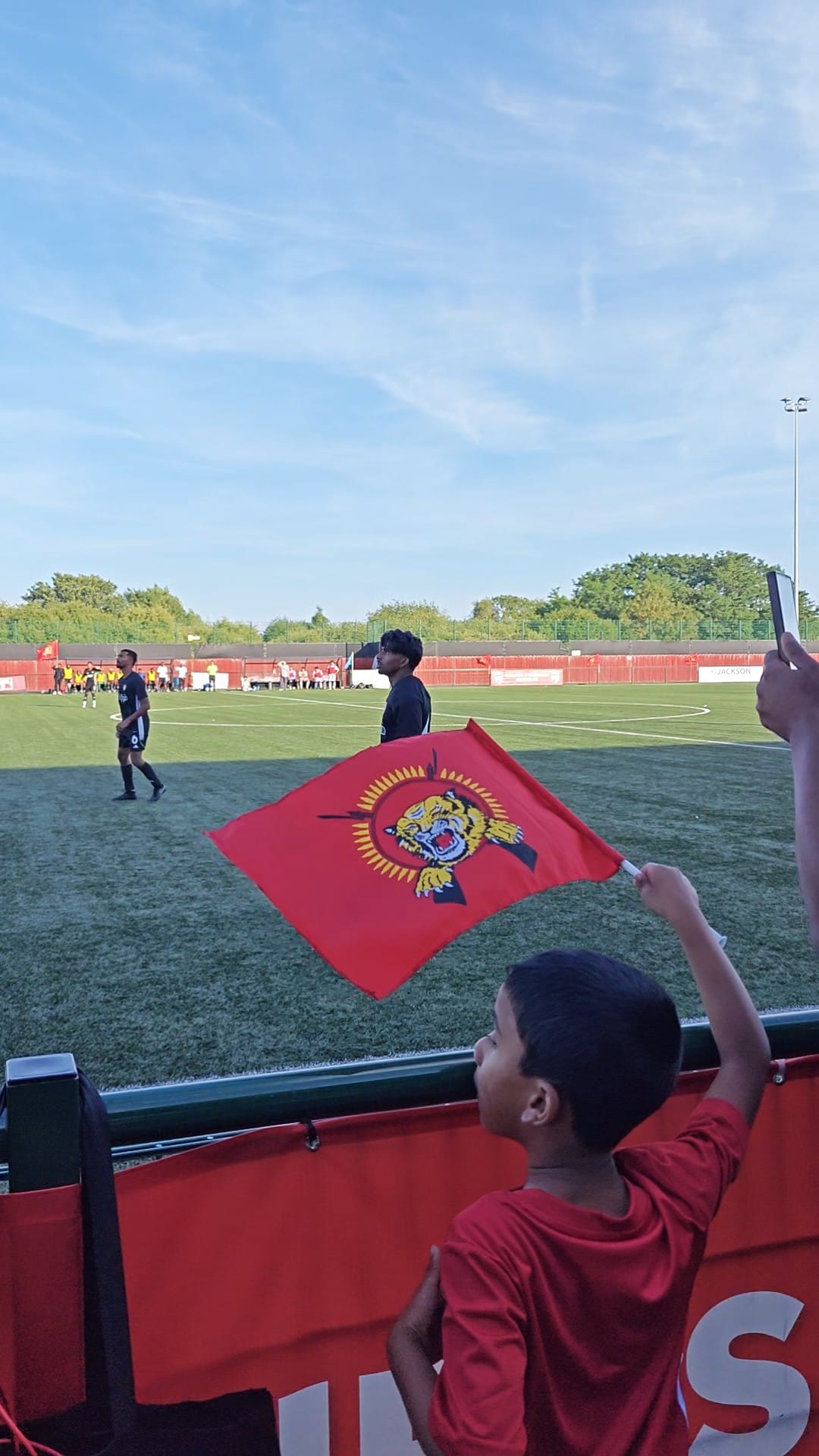
These tournaments are opportunities to express the Tamil identity, to find community, and to hold space and unite people through the medium of sport. These spaces are an act of resistance, an act of defiance against the genocide inflicted by the Sri Lankan state. The medium of sport, which brings the community together, acts as a buffer from the forced fragmentation of the Eelam Tamil population. To participate and attend events in this space, or to a certain degree any ‘Tamil’ space, is a way of asserting the legitimacy of an identity. It is through the dedication of volunteers within this sphere that the Tamil Eelam football team can go from strength to strength, representing our nation on the international stage. To play and celebrate as Tamils is to reject the notion that their nation can be extinguished.
Scattered by the genocide, the Tamil diaspora uses football as a way to rebuild community and unity. These sporting gatherings create a space where Tamils can freely express their culture and history, which is something that is violently denied to their counterparts in the occupied homeland. Across the North-East, the act of gathering, whether it be for protest, remembrance, or celebration, is surveilled and restricted by state forces.
Building our own Tamil space
The opportunity therefore to gather as Tamils in the diaspora and express our identity freely, is a political expression that elevates the voices of those who cannot speak. It is this ‘Tamil’ space where the imagination of its people can be free without the restraints of a chauvinistic ideology built on oppression.
The Sri Lankan team, which flies the lion flag and sports it own symbols of Sinhala supremacy, has long been rejected by Eelam Tamils. That is not, nor has it ever been, our flag or our team.
This was poignantly illustrated during the Asia Cup final celebrations in London. As Tamil families rejoiced in their team’s victory, news was emerging from the homeland of a grim discovery. In Chemmani, Jaffna, an excavation of a mass grave was uncovering skeletal remains of Tamils who were victims of the Sri Lankan state’s atrocities. The juxtaposition was powerful: children of the diaspora draped in the Tamil flag celebrating a football trophy, while children’s bones were being unearthed in the homeland as evidence of war crimes. It underscored exactly why these diaspora spaces are living proof that the Tamil nation survives, even as the Sri Lankan state tries literally to bury it.
It is this ‘Tamil’ space where we can be allowed to imagine a future which goes beyond our current conditions. Sport is a medium that can create that space, football in particular, with its roots tied deeply to collective organising, is the perfect marriage of individual expression and collective endeavour. The ‘beautiful game’ has so much more to offer than the 90 minutes of playing time, but for us Tamils, the struggle to enjoy the beauty in this game is hard fought and one that must be continuously defended.
Protest and sport
Fittingly, the final match of the Asia Cup was opened with overt acts of remembrance and protest. As Tamil Eelam and East Turkestan lined up for their respective national anthems to be played before the final, both teams held banners. East Turkestan held a banner highlighting the ‘Urumoi Massacre’, whilst Tamil Eelam held a banner stating ‘Free Tamil Eelam’ and ‘We remember the Tamil Genocide’.
Protest within sport is not a new phenomenon. It is actually deeply tied to its history. Even on Robben Island, the infamous South African prison, football became a form of resistance. Political prisoners under apartheid organized the Makana Football Association as a way to maintain their dignity and solidarity behind bars. For 23 years, despite harsh conditions, hundreds of prisoners across different political factions ran football leagues on Robben Island. They kept meticulous records, had multiple divisions, and played with passion. The very act of playing by their own rules was, as one former prisoner put it, a way of saying “we shall overcome”. Football brought hope to men like Nelson Mandela and his comrades, even though Mandela himself was barred from playing. The Makana FA’s story shows how even in the darkest of circumstances, sport can be wielded as a tool of defiance and hope.
Another famous example is Sócrates, the legendary Brazilian captain of the 1980s, who turned football into a platform for political expression. Sócrates was a leader of the Democracia Corinthiana movement, which used club football as a vehicle to challenge Brazil’s military dictatorship. He and his teammates would take the field wearing slogans like “Dia 15 Vote” (“Vote on the 15th”) on their jerseys, urging Brazilians to demand free elections. As he later reflected, “While I was a footballer, my legs amplified my voice.” He understood that his fame on the pitch gave him a platform to speak out for the oppressed.
Protest in sport can also be found in the stands and among fans. A recent example comes from Scotland’s Celtic F.C. supporters, who have repeatedly demonstrated solidarity with the people of Palestine. In 2023, during the UEFA Champions League, Celtic fans defied authorities by waving a sea of Palestinian flags in the stadium, despite warnings and fines. Their Green Brigade fan group declared “unequivocal support” for Gaza and used the global football stage to highlight the plight of Palestinians. Sports arenas have never been insulated from politics.
Sport has also been a field of boycott and sanction against oppressive regimes. History provides numerous instances where the sports world took a moral stand. During the apartheid era, South Africa’s all-white teams were banned from the Olympics and FIFA, and subjected to a global boycott until the racist system was dismantled.
In a similar vein, many activists have pushed for boycotting Sri Lanka in sports due to its atrocities against Tamils. Tamil diaspora youth organizations have campaigned for “Boycott Sri Lanka Cricket”, urging international cricket boards to cancel matches with Sri Lanka. They argue that allowing Sri Lanka to participate in global sports helps it sportswash its image despite being responsible for mass atrocities. The campaign drew parallels to the boycotts of apartheid South Africa and Robert Mugabe’s Zimbabwe, emphasizing that athletic boycotts have been effective in pressuring repressive states.
The Olympics and other international competitions have likewise seen boycotts and protests, such as the iconic Black Power salute by Tommie Smith and John Carlos in 1968.
Not just a game
Sport is not apolitical - it does not exist in a vacuum. It is shaped by the politics of power on display around us. Today, we live in an era of unprecedented interconnectedness and visibility. The genocide in Gaza, for instance, has been effectively livestreamed on social media – horrific images and videos of bombardment and civilian suffering are impossible to ignore. In Sudan, a civil war has unleashed what humanitarian agencies call the world’s largest displacement and humanitarian crisis, with nearly 13 million people forced from their homes and millions on the brink of famine. Around the world, hard-fought rights are being rolled back by authoritarian-leaning governments. In such a context, claiming that any space, least of all the globally-watched arena of sports, can remain “apolitical” is naïve at best.
On the contrary, sports can create human moments that transcend nations and speak to universal values. When athletes or teams take a stand, it resonates widely. We saw it in the solidarity kneeling protests against racism inspired by Colin Kaepernick in American sports, which spread internationally. We see it when fans around the world hold banners or wear symbols supporting Sudan or Palestine or any number of causes. These acts might seem small against the enormity of wars and genocides, but they matter.
As the Tamil Eelam football team jubilantly celebrated their Asia Cup victory, they broke into a chant that diaspora Tamils know well – one popularized during the global protests of 2009 at the peak of the Tamil Genocide. A video clip of this celebration has since resonated deeply with Tamils worldwide.
Watching it, one may ask “who cares?”
Who cares about a small football tournament of unrecognised nations, taking place while so many big global crises burn? Who cares about a diaspora team singing an old protest song?
Ultimately, the Tamil Eelam team’s victory provide a glimpse of a more hopeful future. It shows what can happen when a people refuses to let its identity be crushed and finds ways to keep its spirit alive through something as joyous as sport. It also shows the potential for sports to uplift the most marginalised, to give them a platform and a voice on the international stage.
Who cares? We do. All of us who believe in justice, human dignity, and the right of every people to exist and celebrate their nation should care.
The story of Tamil Eelam’s football journey tells us that even amidst genocide, displacement, and oppression, a ball can be kicked, a goal can be scored, and a song can be sung – and each of those acts can carry the weight of a revolution.
_____
Malaravan is a staff writer at the Tamil Guardian