Environmentalists and wildlife officials have warned that wild elephants in the Amparai District continue to die after consuming improperly disposed waste, accusing Sri Lankan government authorities and local councils of long-standing neglect in addressing a crisis that has persisted for years.
Conservationists say a significant number of elephant deaths recorded in recent years have been linked to abdominal and digestive illnesses caused by the ingestion of garbage, particularly non-biodegradable polythene. Responsibility, they argue, lies squarely with authorities that continue to practise irregular and unsafe waste disposal despite repeated warnings from wildlife experts.
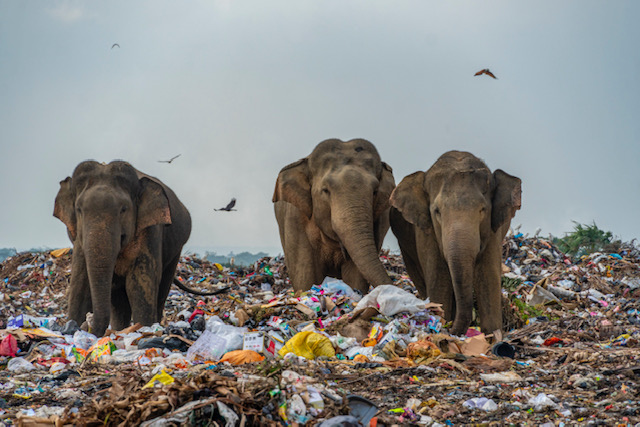
According to conservationists, elephants are drawn to open dumping sites in search of food and inadvertently consume plastic, polythene wrappers and other non-degradable materials mixed with household waste. Once ingested, these materials accumulate in the digestive system, leading to chronic infections, intestinal blockages and eventual death.
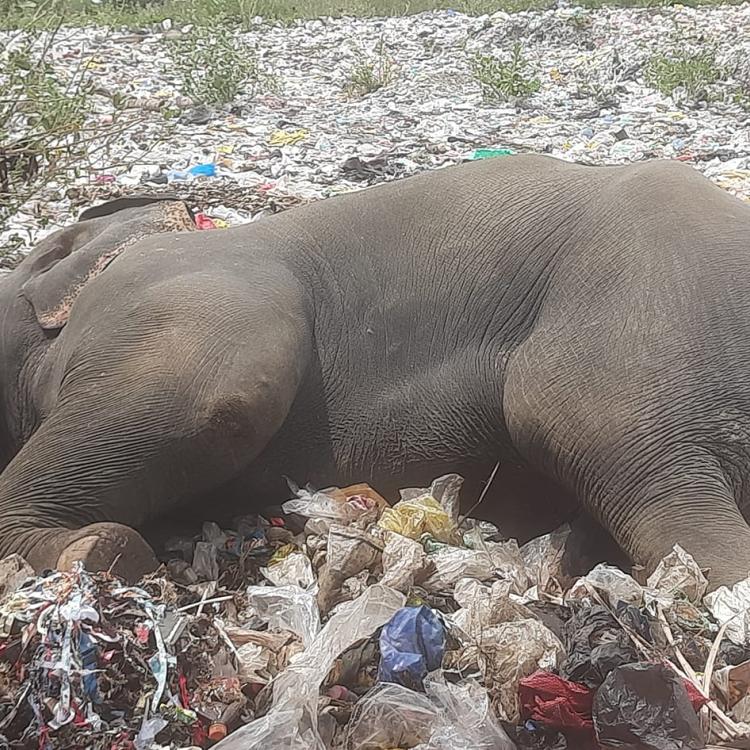
More than 20 wild elephants have died over the past eight years in Amparai alone after feeding at the Pallakkadu open landfill, where plastic waste is dumped without recycling or regulation. Environmentalists warn that the site now poses the most serious threat to elephant populations in the district, as it is routinely used by multiple coastal-area local authorities for unregulated waste disposal.
Concerns have intensified following the deaths of three elephants over a four-day period in late January, two of which were confirmed to have died after consuming garbage mixed with polythene.
Dr. D.B.N. Pushpa Kumara, the Wildlife Veterinary Officer for the Eastern Region, confirmed that two elephants found dead on the same day succumbed to digestive system infections caused by habitual consumption of non-degradable waste.
“When animals repeatedly consume non-biodegradable materials, their digestive processes are altered,” he said. “Over time, this leads to feeding difficulties, infections and eventually death.”
Echoing these concerns, Gihan de Silva, the Amparai Zone Wildlife Ranger from the Department of Wildlife Conservation, identified Pallakkadu as the most dangerous dumping site in the district.
“No recycling is carried out at this site. Polythene and other non-degradable materials are disposed of indiscriminately,” he said. “Even hospital waste, including expired medicines, is dumped there, sometimes mixed with household garbage.”
De Silva added that while waste management reforms introduced at the Buddhangala and Maha Oya dumping sites have resulted in a noticeable decline in elephant deaths in those areas, authorities have failed to take similar action elsewhere.
“No waste recycling takes place at the Nintavur, Pallakkadu and Pottuvil dumping sites,” he warned. “Until this is properly managed, the threat to wild elephants will continue.”
The crisis is not new. In October 2024, yet another elephant was found dead in Amparai after consuming plastic waste at an open landfill that conservationists had been warning about for years. At the time, it was reported that around 20 elephants had died over the previous decade in the region alone after ingesting plastic waste from the same site. Post-mortem examinations of elephants that had previously died recovered polythene and plastic materials from their stomachs.
Conservationists noted that more than ten elephants regularly visit the landfill, which receives rubbish from neighbouring towns including Sammanthurai, Kalmunai, Karaitheevu and Alayadivembu. The elephants have reportedly become so accustomed to foraging through the garbage mound that they now wait for trucks to unload waste at the site.
Similar warnings were raised as early as October 2020, when photographs taken by Jaffna-based photographer Tharmapalan Tilaxan showed wild elephant herds rummaging through garbage mounds in the Amparai district. At the time, it was reported that waste was being dumped near Ashraf Nagar, bordering the Oluvil Pallakkadu area, which lies within the elephants’ roaming range. That practice had already led to the deaths of six elephants, with post-mortem reports again recovering polythene and plastics from their stomachs.
Despite attempts by authorities to deter elephants by erecting fences around open dumping sites, these measures have proven ineffective, with elephants damaging the barriers in search of food. Environmentalists have repeatedly warned that without proper waste disposal infrastructure, rubbish is increasingly dumped in forested areas. Reports indicate that waste is dumped in more than 54 forests, with over 300 elephants passing through these areas daily.