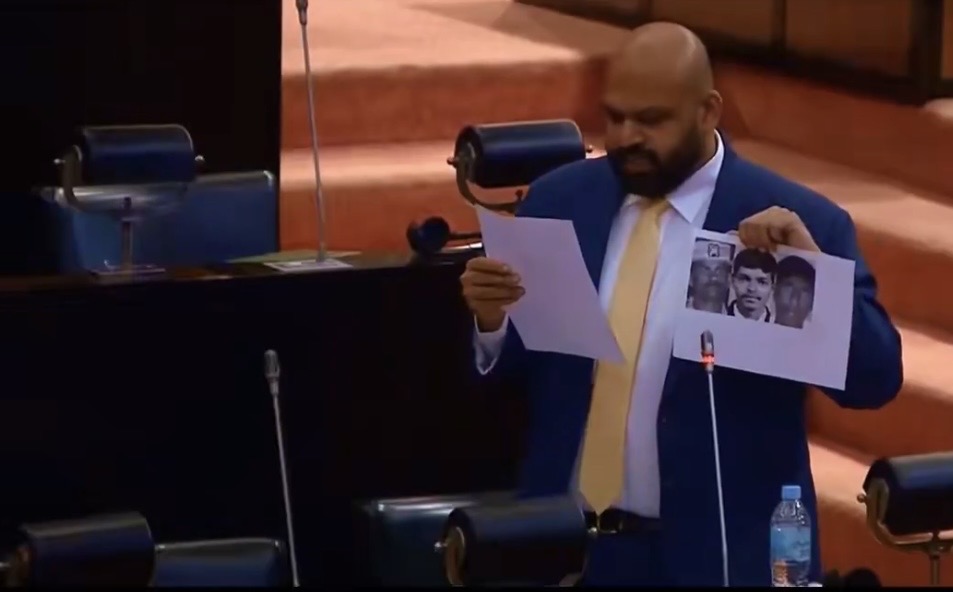
Ilankai Thamil Arasu Katchi (ITAK) parliamentarian Shanakiyan Rasamanickam questioned the Sri Lankan government in parliament yesterday over alleged links between military intelligence and armed groups, raising concerns about the lack of accountability for a series of violent incidents.
Speaking under Standing Order 27(2), Rasamanickam directed his questions to the Minister of Public Security and Parliamentary Affairs, seeking clarification on the status of investigations into alleged connections between Sri Lanka’s military intelligence service and armed groups that have operated in the past.
His intervention follows the recent arrest of former State Intelligence Service chief Major General Suresh Sallay over his alleged involvement in the 2019 Easter Sunday bombings. The arrest came after disclosures made in a Channel 4 Dispatches documentary aired in 2023, which linked several senior Sri Lankan officials to the attacks.
In testimony presented in the documentary, whistleblower Hanzeer Azad Maulana named Sallay as a key figure allegedly involved in planning the bombings.
Addressing parliament, Rasamanickam said that Sri Lanka’s past conflicts and their aftermath continue to leave unanswered questions.
Under Standing Order 27(2), I questioned the Minister of Public Security on the 2014 killings of Gopi, Thevigan and Appan in Nedunkeni, Vavuniya. While we learn the Channel 4 documentary Dispatches is being examined, why are the other Channel 4 documentaries—Sri Lanka’s Killing… pic.twitter.com/mPkMumD1Xf
— Shanakiyan Rajaputhiran Rasamanickam (@ShanakiyanR) March 5, 2026
“Sri Lanka’s war and its aftermath left behind many unresolved questions around the fate of individuals who were killed or detained. Activists, civilians and alleged combatants alike were affected and, in many cases, the circumstances surrounding those events remain unclear and un-investigated”.
He noted that while authorities had indicated that the Channel 4 Dispatches programme on the Easter Sunday bombings was being examined, earlier investigative documentaries by Channel 4 had also raised serious allegations regarding the conduct of the Sri Lankan state.
Rasamanickam referred to earlier films including “Sri Lanka’s Killing Fields” and “No Fire Zone”, which documented allegations of war crimes committed during the final stages of the armed conflict.
The MP also called for renewed scrutiny of the 2014 killings of Ponniah Selvanayagam alias Gopi, Sundaralingham Kajeepan alias Thevihan, and Navarathnam Navaneethan alias Appan, who were killed in Nedunkeni in Vavuniya during a military intelligence operation.
He told parliament that the killings should be re-investigated, arguing that they “do not stand alone” but form part of a “broader pattern” of violence linked to state-backed groups.
“These incidents share a single thread: the alleged involvement of state-security apparatus and the persistent absence of accountability”, Rasamanickam said.
During his remarks, Rasamanickam also referred to armed groups such as the Islamic Centre and the Tripoli Platoon, which he said had been created and supported by the Sri Lankan state with assistance from military intelligence between 2004 and 2014.
He questioned the government’s role in supplying weapons to these groups and requested that all official records relating to such provisions be submitted to parliament.
The MP also referred to Sallay’s earlier service in the Eastern Province intelligence unit and held up photographs of weapons that had been recovered in Batticaloa, raising concerns about how the arms had entered the district.
Rasamanickam suggested that the former intelligence chief may have had a role in the supply of weapons in the region and called for further investigations into the matter.
Responding to the questions, Minister of Public Security and Parliamentary Affairs Ananda Wijepala said that several of the issues raised fell under the purview of the Ministry of Defence and stated that a detailed response would be provided on Friday.
The intervention comes amid renewed scrutiny of Sri Lanka’s intelligence services following the arrest of Sallay and continuing international calls for accountability over allegations of state involvement in violence and human rights abuses during and after the armed conflict in the Tamil homeland.