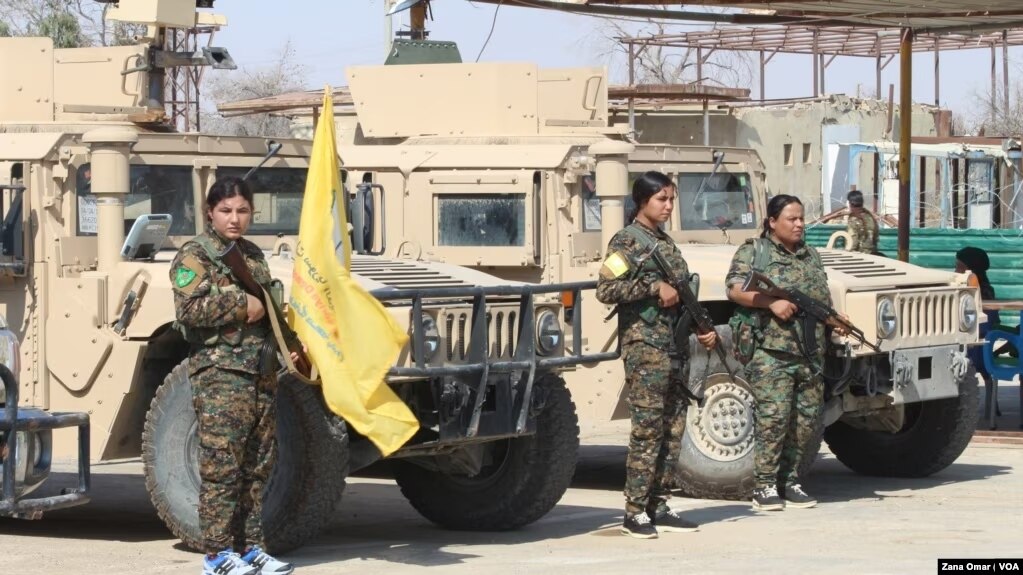
As pressure mounts for the Kurdish-led Syrian Democratic Forces (SDF) to integrate into the Syrian military, representatives have rejected demands to disarm and surrender key regions in the northeast, calling it a “red line”.
The developments come amidst growing regional and international involvement, as the United States, France, and Syria announced new talks to be hosted in Paris aimed at integrating Kurdish governance structures into the Syrian state.
On Friday, the French, Syrian and American governments issued a joint statement confirming their commitment to “host as soon as possible the next round of consultations in Paris between the Syrian government and the Syrian Democratic Forces regarding the full implementation of the March 10 agreement.” That agreement, signed earlier this year by SDF Commander Mazloum Abdi and Syria’s interim President Ahmad al-Sharaa, outlines the steps towards incorporating the SDF and its civil institutions into a unified Syrian state.
The SDF, originally formed in 2015 with US backing to combat ISIS, currently maintains de facto control over significant territory in northeast Syria, including major cities like Raqqa, Deir Ezzor, Hasakah, and Tabqa. The region also houses the Autonomous Administration of North and East Syria (AANES), a civilian governance structure with significant Kurdish leadership. The US-supported group has played a central role in the defeat of ISIS and continues to operate in areas containing much of Syria’s oil and gas reserves.
Despite American and Turkish pressure, the SDF leadership has remained firm in its refusal to lay down arms. Speaking to Kurdistan24, SDF representative Sihanouk Dibo stated, "laying down arms by the SDF is an issue that is not up for any discussion," Dibo added that while the SDF is open to political integration, it should take place “step by step” and that the group must become a recognised bloc within a new Syrian military framework, and not be dissolved.
This stance was echoed by SDF spokesperson Farhad Shami, who declared that disarmament is a “red line,” and insisted the group “seeks to engage Damascus as an equal partner, not as a subordinate.” The SDF also reiterated that any integration must guarantee constitutional protections for Syria’s diverse populations and ensure genuine political representation.
However, Damascus remains opposed to decentralisation. Syria’s interim government, which took power after Bashar al-Assad’s ousting in December, has repeatedly rejected any federal or autonomous model. “Talking about refusing to hand over weapons or maintaining an autonomous military force is completely unacceptable,” a Syrian government official told state broadcaster Al-Ikhbariya.
The situation has been further complicated by comments from US Special Envoy for Syria, Tom Barrack.
At a press briefing earlier this month, Barrack stated, “We don’t owe them [the SDF] the ability to have their own independent government within a government.”
He emphasised Washington’s support for a unified Syrian state with “one army, one flag,” while also insisting on a “reasonable” path for Kurdish integration. “We want to make sure that they’re treated fairly and that they have an opportunity to onboard if that’s what they want to do,” he said.
“But with the SDF, it’s difficult,” he added. “They’ve been on opposite sides of the equation. They feel the United States is obligated to them. The United States is saying yes, we’re obligated to you to be reasonable, but if you’re not reasonable, there’s going to be another alternative.”
“The United States honors nation-states that are acknowledged, viable, and legal – full stop. All of the other constituencies who are vying for posture or position within another nation-state, we may have empathy for, we may have sympathy for, we may have favorites that we would like to support at various times, and it’s never worked for us – ever.
“So as relates to SDF, there’s no question – especially Congress has a very soft spot in their heart for SDF, and it’s been very clear that we want to pave and provide an onramp for them to join what? The Syrian Government. There’s not an indication that there’s going to be a free Kurdistan. There’s not an indication that there’s going to be a separate SDF state. There’s not an indication on our part that there’s going to be a separate Alawite state or a separate Druze state. There’s Syria. You have a structure in Syria that is unfolding. They’ll have a Syrian constitution that’ll have a Syria – a parliament. Everybody has to be able to have discussions as to how that happens.
We don’t have a dog in that hunt other than to say we want to make sure those discussions take place, that they’re fairly portrayed, and that of course we have a favorite in the race and that SDF has been very good to us along this way. We want to make sure that they’re treated fairly and that they have an opportunity – an opportunity to onboard if that’s what they want to do. If that’s not what they want to do, they have their own decisions. It’s not our decision.
Meanwhile Turkish Foreign Minister Hakan Fidan recently warned that any attempts to pursue Kurdish autonomy would be seen as a “direct threat” to Turkey’s national security and could provoke intervention.
Recent violence across Syria continues to escalate. In the southern city of Sweida, recent sectarian violence has left nearly 1,400 dead, according to human rights monitors. The Syrian government has used the unrest to argue for greater centralised control and the disbanding of autonomous armed groups.
The SDF has also suffered ongoing attacks from ISIS, with over 35 of its fighters killed this year alone. The group’s persistent efforts to counter ISIS in the region have become central to its case for retaining military capacity and leadership autonomy.
While Paris prepares to host the next round of talks, Kurdish officials say progress will depend on clear agreements. A scheduled meeting between SDF leaders and a Syrian delegation last week was postponed without explanation. On Friday, French Foreign Minister Jean-Noël Barrot held a phone call with SDF commander Mazloum Abdi to confirm preparations for the upcoming session.
SDF representatives say they remain committed to a political solution that preserves the rights of Syria’s Kurdish and other populations. However, with the Syrian army now composed largely of former Islamist factions accused of persecuting minorities, including Kurds, Alawites, Shias, and Druze, Kurdish leaders remain wary of full military integration.
