
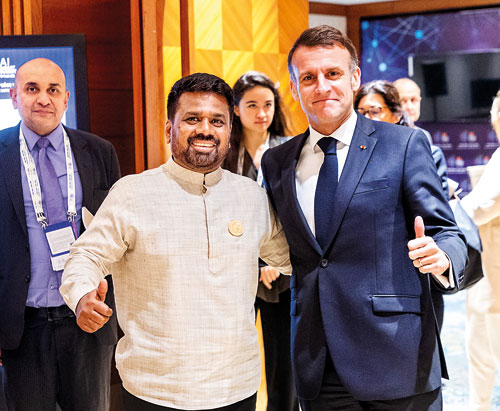
Sri Lankan president Anura Kumara Dissanayake has sought the support of French president Emmanuel Macron to retain the European Union’s Generalised Scheme of Preferences Plus trade concession, as the facility approaches expiry at the end of the year.
The request was made during talks between the two leaders on the sidelines of an international summit in New Delhi. According to officials, Macron assured that France would extend its fullest support for Sri Lanka to retain the GSP+ facility and pledged further concessions through existing trade agreements.
The GSP+ scheme provides preferential access to EU markets but is tied to compliance with international conventions on human rights, labour standards, governance and the rule of law. Sri Lanka’s eligibility has long been linked to its human rights record, including accountability for war crimes, the treatment of the Tamil people in the North-East and the continued use of repressive legislation.
Foreign Affairs Minister Vijitha Herath said the government plans to reapply for GSP+ ahead of its expiry in December and has already outlined its position during the 27th session of the EU-Sri Lanka Joint Commission held in Colombo earlier this month.
Discussions at the Joint Commission focused on Sri Lanka’s record on democracy, governance, the rule of law and human rights related matters. These included the proposed repeal of the Prevention of Terrorism Act, amendments to the Online Safety Act, minority rights, labour rights, anti corruption measures and freedom of expression and association.
The PTA has been widely condemned by Eelam Tamils as a tool of state repression used for decades to detain Tamils without charge, extract confessions under torture and suppress dissent across the Tamil homeland. Tamil civil society groups have warned that proposed replacement legislation risks entrenching similar powers under a different name.
Herath claimed the government is on track to repeal the PTA and other laws and replace them with legislation that conforms to international standards. He also stated that Sri Lanka has informed the EU of steps taken towards what he described as reconciliation and the strengthened role of state institutions such as the Office on Missing Persons, the Office for Reparations and the Office for National Unity and Reconciliation.
However, these state mechanisms have long been rejected by Tamil families of the disappeared and rights organisations, who point to a lack of credible accountability and continuing impunity for enforced disappearances, war crimes and abuses.
Dissanayake also discussed trade with Britain’s Deputy Prime Minister David Lammy, thanking the United Kingdom for including Sri Lanka under the Developing Countries Trading Scheme, which provides preferential market access to developing countries. He expressed the government’s interest in retaining that facility in the future.