
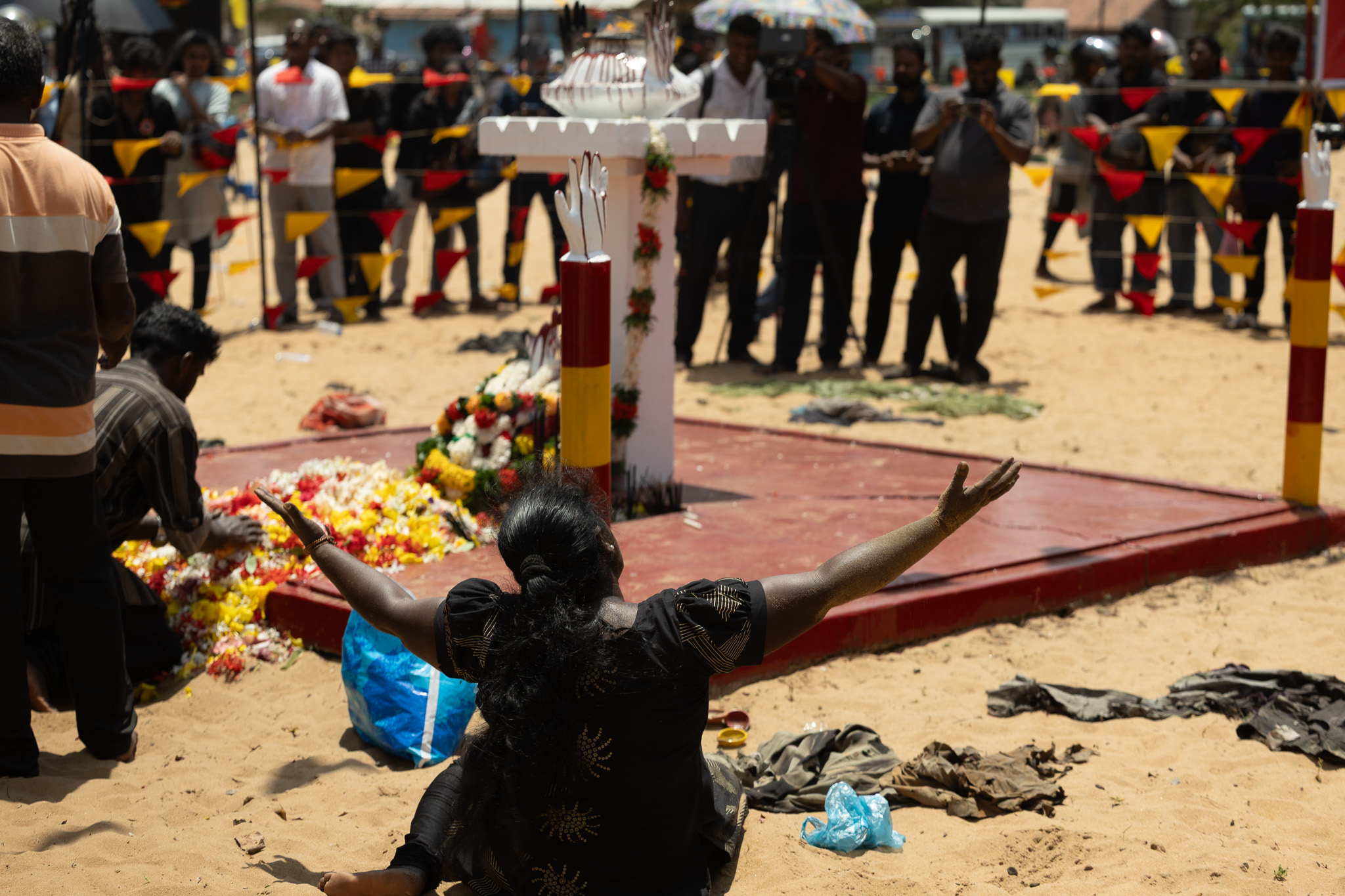
A Tamil woman mourns in Mullivaikkal on Tamil Genocide Remembance Day, May 18.
A deepening divide has emerged within Sri Lanka’s Catholic Church after more than 100 priests and religious figures from the North-East issued a forceful statement defending Rev. Fr Jeevantha Peiris and accusing sections of the Church hierarchy of echoing the Sri Lankan state’s denial of the Tamil genocide.
The intervention follows remarks made by Fr Peiris during a conference titled ‘Did Mullivaikkal End History?’ held at SEDEC Caritas Hall on 16 May, where the Sinhala Catholic priest openly described the destruction of Eelam Tamils as genocide and called for a re-examination of Tamil nationhood and the island’s post-independence history.
His comments drew swift condemnation from senior Church figures in Colombo, who insisted his remarks reflected only his personal opinions and not the position of the Catholic Church in Sri Lanka.
But in a direct public rebuke, the North-East clergy accused Church leadership of reproducing the “discourse of the state more than the Gospel” and reaffirmed that the Tamil nation had endured a historic and ongoing genocidal process.
The statement, issued by Priests and Religious for Justice and Peace, North-East on 25 May, declared:
“With this statement, we emphatically reaffirm our position on Eelam Tamils’ political aspirations, which are non-negotiable, and express our solidarity with Fr. Jeewantha Peiris (a Sinhala Catholic priest), who has been condemned by Sinhala-Buddhist extremists and the Catholic religious leadership in the island.”
The group further stated:
“Fr Pieris has spoken truth to power by stating that what happened to the Tamils is a genocide and Tamils have been subjected to historic oppression by the Sinhala majoritarian state.”
Church distances itself
The controversy erupted after Fr Peiris’ speech gained widespread attention online during Tamil Genocide Remembrance events marking the 17th anniversary of Mullivaikkal.
Responding to the backlash, Bishop Jude Nishantha Silva, Chairman of the Episcopal Commission for Social Communications of the Catholic Bishops’ Conference, publicly distanced the Church from the priest’s remarks.
“Fr. Jeewatha Peiris did not express the ideology of the Catholic Church. He has expressed his own ideology and not the ideology of the Church,” Bishop Silva said.
“The Catholic Church in Sri Lanka always stood for and continue to stand for reconciliation, social dialogue and respecting all communities of Sri Lanka,” he added.
National Director of Social Communications Fr Jude Krishantha Fernando also rejected claims of genocide and defended the Sri Lankan state’s military campaign.
“The war which raged in Sri Lanka was a war against terrorism and not against any ethnic group,” he said. “One had to eradicate terrorism which carried out attacks on the Dalada Maligawa, monks in Arantalawa, the Central Bank, the Pettah bus stand and a train in Dehiwala.”
The North-East clergy directly challenged that framing.
‘The Church experiences polarisation along ethnic lines’
The priests and religious figures argued that the Church in Sri Lanka itself remains deeply divided along ethnic lines, with Tamil clergy often taking sharply different positions to the Sinhala hierarchy on questions of justice, accountability and Tamil nationhood.
“Abundant evidence, both historical and contemporary, corroborates the view that the Catholic Church in Sri Lanka experiences polarisation along ethnic lines,” the statement said. “This is not a secret, nor is it unique to Sri Lanka that the Church community can be united by shared faith, but divided by ethnic, cultural, economic or political differences.”
The statement continued:
“The Tamil Catholic community has taken the side of the oppressed, as mandated by Scripture and the Church’s own Magisterium.”
“We regret that the Sri Lanka Bishops’ Conference has not been consistent in adopting a similar Gospel-based stance for truth and justice. At times, its pronouncements have reflected the discourse of the state more than the Gospel.”
The group also rejected attempts to detach the armed conflict from the wider history of Sinhala state oppression against the Tamil nation.
“The Eelam Tamils’ struggle for liberation resulted from the Sinhala state’s oppressive measures against the Eelam Tamils,” they said. “Refusing to acknowledge the root causes of the conflict and blaming Tamil victims and survivors for the genocidal war that culminated in Mullivaikkal reflects a denial strategy on the part of Church leadership.”
“Tamil armed resistance was the product of a long history of oppression and marginalisation that stretches back to colonial times.”
“We vehemently reject and condemn any attempt to deny historical facts and bury the truth. Recovery of truth is necessary for justice. There is no peace without justice.”
‘It is a genocidal war’
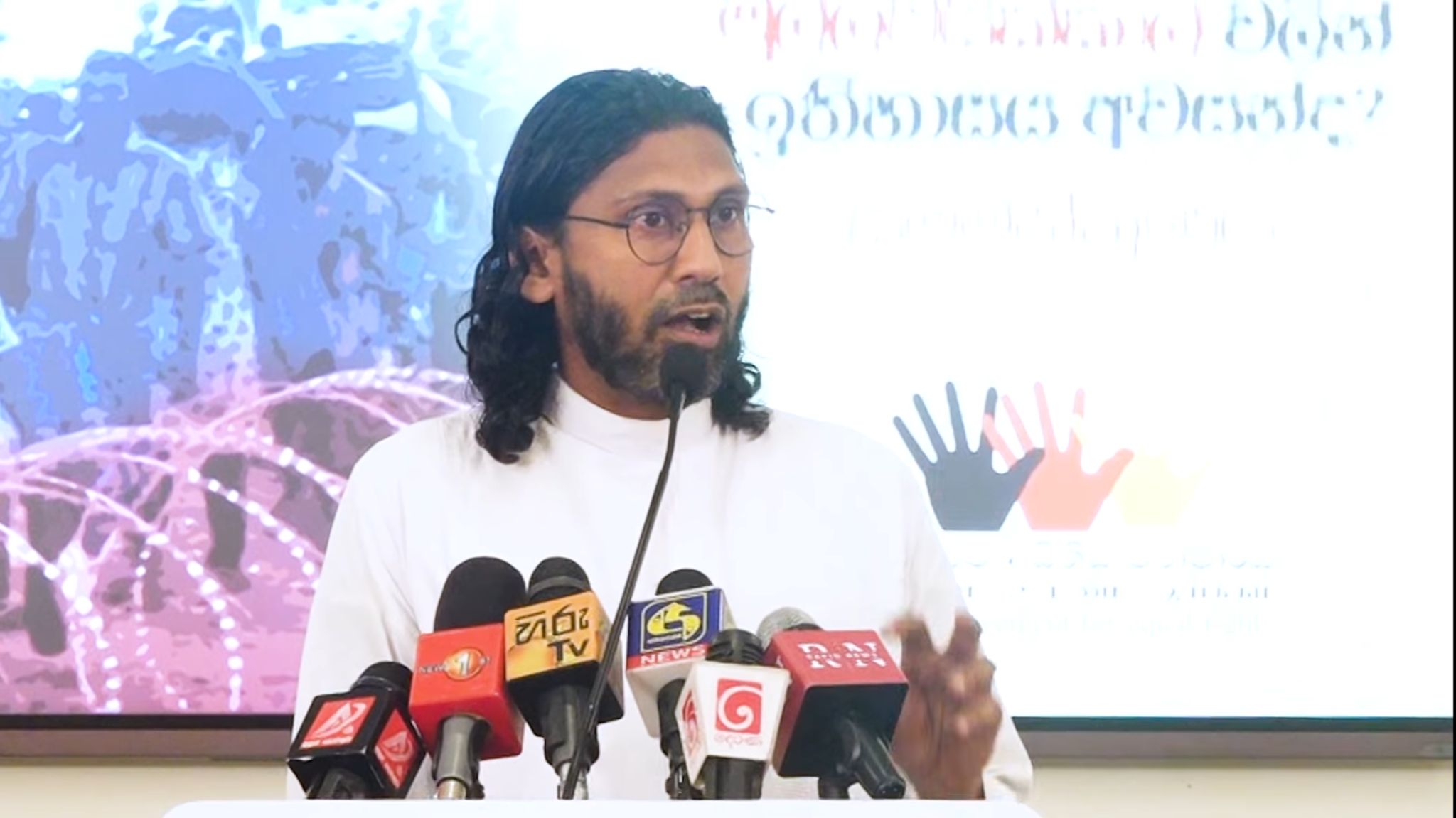
Fr Peiris speaking earlier this month.
At the centre of the dispute are the remarks delivered by Fr Peiris himself during his address earlier this month.
Opening his speech, the priest criticised the dominance of Sinhala nationalist narratives in Sri Lankan historiography.
“I think it is very important that in this evening’s discussion we ask the question of whether Mullivaikkal marks the end of history, because what we are still reading is history written by someone,” he said.
“Most of the time, we are compelled to read the history shaped by elite Sinhala nationalist narratives.”
“But I believe it is necessary to question what the real history is, as read through a subaltern, non-elite, genuine political analysis.”
Fr Peiris then focused extensively on the final letter written by Fr Francis Joseph, the Tamil Catholic priest who remained with civilians trapped inside Mullivaikkal during the final months of the genocide before forcibly disappearing after surrendering to the Sri Lankan military in May 2009.
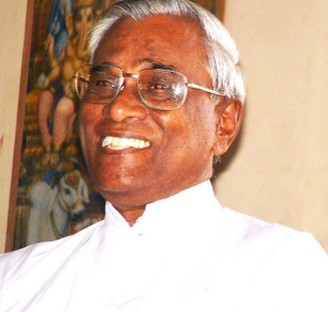
Fr Joseph
“On May 10, 2009, he wrote a letter addressed to the Pope in the Vatican,” Fr Peiris said.
“The reason was that he realized the Sri Lankan government, the United Nations, and all other organizations had failed to intervene in the crisis faced by the Tamil people.”
Quoting directly from Fr Joseph’s letter, Fr Peiris told the audience:
“Let it be known that under the guise of eradicating terrorism the Sri Lankan government is waging the war to annihilate the Tamil nation. It is a genocidal war.”
He further explained:
“He emphasized that everyone must understand that under the pretext of eliminating terrorism, the Sri Lankan government was conducting a war aimed at destroying the Tamil nation — a genocidal war.”
Fr Peiris also highlighted how Fr Joseph had accused both the Sri Lankan state and sections of the Church of abandoning Tamil civilians.
“He said that the present Sri Lankan government, as well as all previous governments, had always taken the side of Sinhala nationalism, not the side of the Tamil or Muslim people.”
“He writes in that article that the Catholic Church — even the central Catholic Church in Colombo — has by now abandoned the Tamil brothers in Jaffna, Mannar, Batticaloa, and Trincomalee, and instead has entered into an impure alliance with this nationalist state.”
Genocide, not ‘mass killing’
A major section of Fr Peiris’ speech centred on distinguishing genocide from mass killing.
“When this topic is discussed in the South, many people say: ‘Yes, there was a mass killing. Yes, Tamil people were killed.’ But many hesitate to accept it as genocide,” he said.
He then outlined the legal definition of genocide under international law, arguing that the intent to destroy a people as a group distinguished genocide from other forms of violence.
“Genocide is not just mass killing; it is a distinct category,” he said. “But for genocide, international law requires not only the physical act (the killing of people) but also two mental elements.”
“First, the deliberate intent to kill a person as a human being. Second, the killings must be carried out with the specific aim of destroying the group to which that person belongs.”
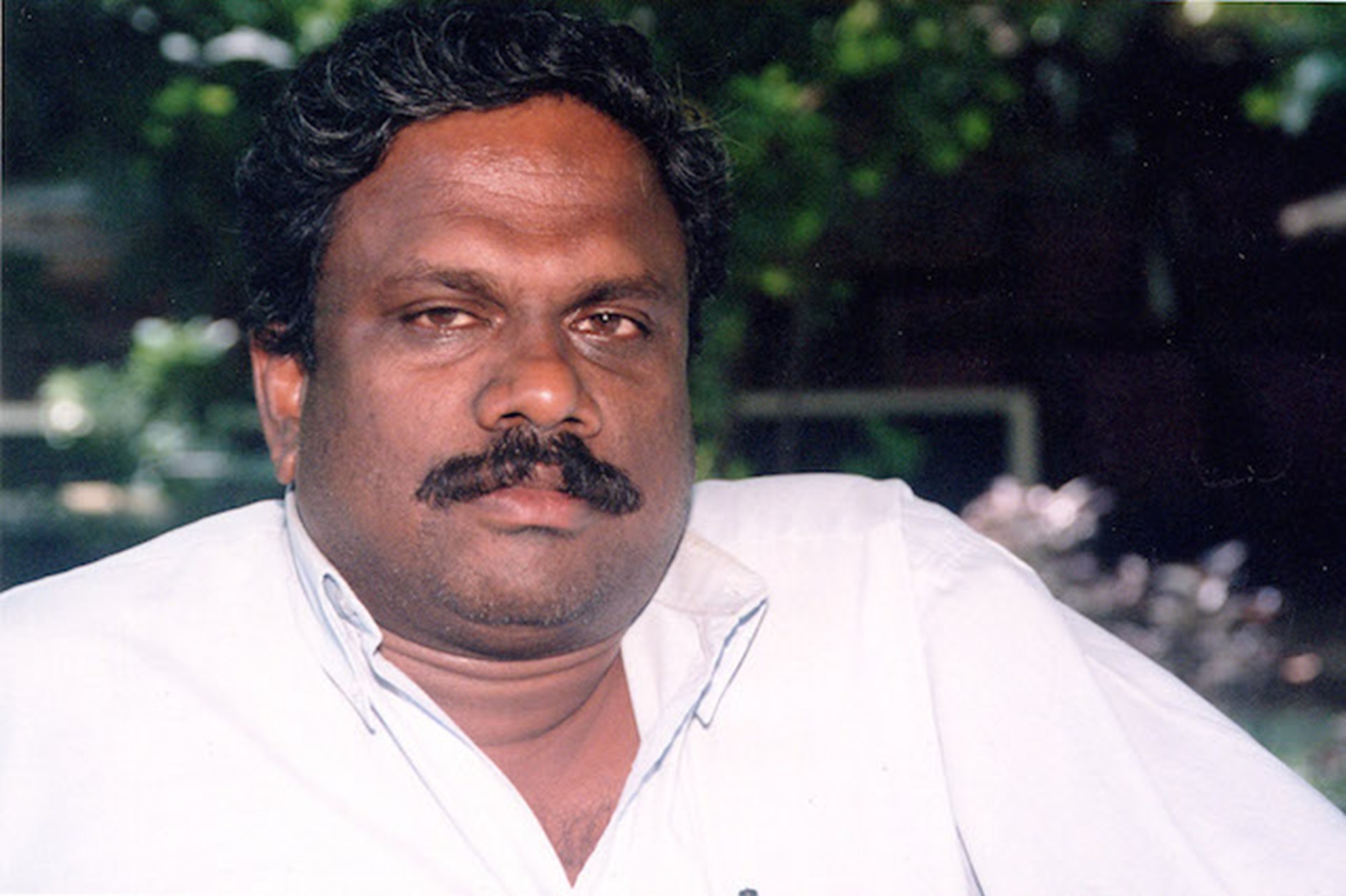
Sivaram, who was murdered in April 2005.
Fr Peiris pointed to the assassination of Tamil journalist Dharmeratnam Sivaram, known as Taraki, as an example of this broader genocidal process.
“Now, can we look at Sivaram’s assassination as just a murder? Or is it part of a larger act of genocide?” he asked.
“The question we must ask is: if Sivaram had not been Tamil, would he have been killed?”
“We know that Sivaram was continuously writing in favor of a political solution. That is why Dharmaratnam Sivaram was deliberately killed. Therefore, Sivaram’s assassination is part of the genocide.”
“So, what existed in Sri Lanka was not merely mass killings, but genocide. There was a desire to completely eradicate the Tamil community.”
‘There is evidence. History has proven it.’
Fr Peiris also criticised what he described as the continuation of Sinhala nationalist state ideology under successive governments, including the current National People’s Power administration.
“Terrorism was created by the Sinhala nationalist state,” he said. “Right now, the NPP government is serving that ideology.”
He further condemned attacks and intimidation targeting Tamil remembrance events across the island.
“When we tried to remember at Galle Face, and later in Borella, Wellawatte, and everywhere else, what happened?” he asked. “These nationalist governments sent their thugs, their henchmen, to attack those gatherings.”
“Justice must truly be delivered to the people who suffered genocide.”
Concluding his speech, Fr Peiris insisted that the question of genocide could no longer be avoided.
“So, the first question we cannot avoid is: did a genocide take place or not?” he said.
“If it did, we must accept that. There is evidence. History has proven it.”
The North-East clergy echoed that conclusion in their own statement.
“With our present statement, we declare that an historical genocidal process against the Eelam Tamils reached its zenith in Mullivaikkal in 2009, and a systematic genocide continues to unfold in the Tamil homeland.”
“Targeting advocates of truth merely mirrors the measures that the Roman Empire adopted against Jesus, who is our TRUTH, WAY and LIFE.”
Read the full text of Fr Peiris speech here.
Read the full statement from the North-East clergy here.