
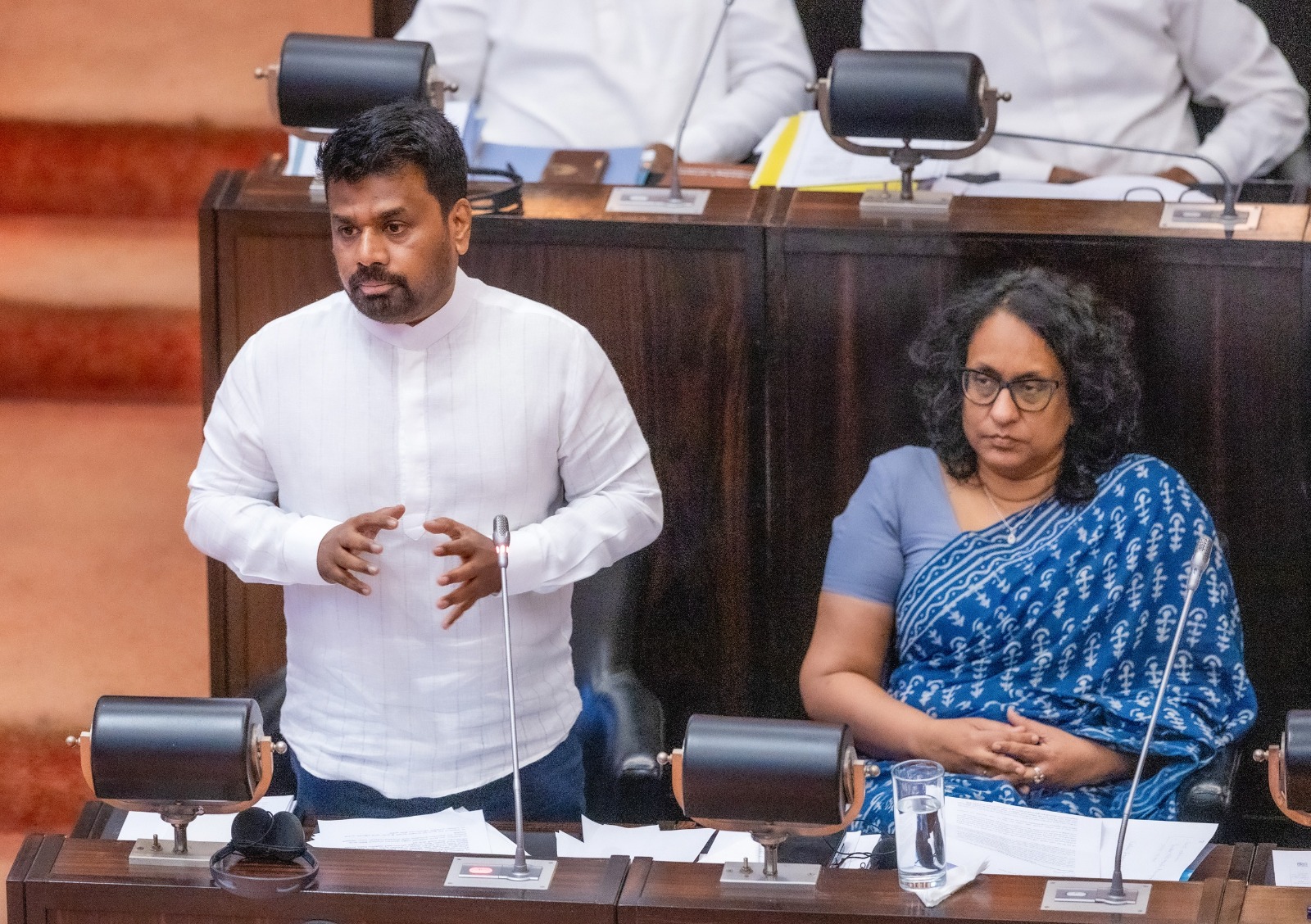
Sri Lanka's president speaking in Parliament on Friday.
Sri Lanka’s refusal to allow two United States warplanes to land this month has been presented as a firm assertion of neutrality. Yet, placed alongside a parallel refusal of an Iranian naval request, and continued engagement with both states, the episode instead exposes something far less stable: a fragile balancing act that is increasingly difficult to sustain.
Sri Lanka’s president Anura Kumara Dissanayake told parliament on Friday that two US aircraft, travelling from Djibouti and armed with anti-ship missiles, had sought permission to land at Mattala Rajapaksa International Airport between March 4 and 8. The request was denied, he said, in order to “maintain neutrality”. On the very same day, Iran had also sought clearance for a naval visit. That request, too, was rejected.
The symmetry of those decisions has been framed as evidence of even-handedness. In reality, it underscores the extent to which Sri Lanka is being compelled to respond to competing military demands in real time.
The decision was not taken in isolation. In the days surrounding it, Sri Lanka found itself responding to a rapidly escalating regional crisis. A United States submarine torpedoed an Iranian warship just off Sri Lanka’s southern coast, killing dozens of sailors, while a second Iranian vessel issued a distress call and was taken into Sri Lankan custody under international maritime law.
Even as Colombo denied formal access to both Washington and Tehran, it simultaneously engaged with each. Sri Lankan authorities assisted Iranian sailors and facilitated repatriation efforts, while maintaining diplomatic, military and economic ties with the United States, its largest export market. At the political level, senior Sri Lankan figures moved quickly to express condolences following the killing of Iran’s Supreme Leader, with officials noting that bilateral ties had “broadened significantly” and emphasising continued appreciation for Iran’s friendship. At the same time, senior US military and government officials had completed tours of the island.
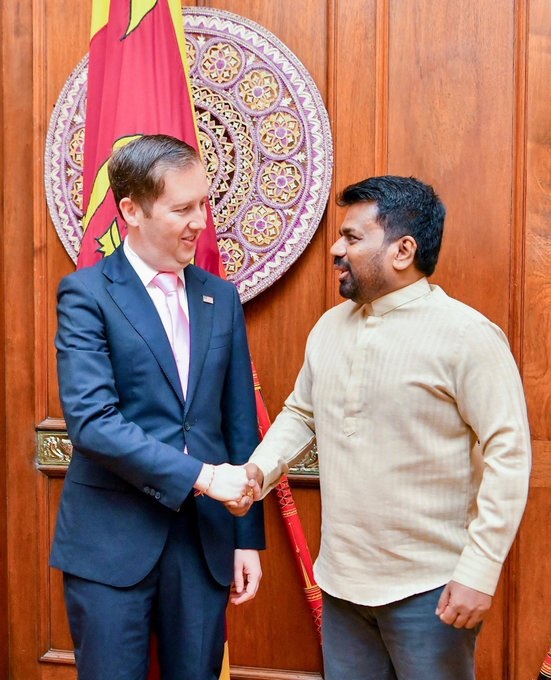
Dissanayake with Sergio Gor last week.
This is the context in which the rejection of the US request must be understood. It is a pattern of reactive calibration, part of a broader attempt to avoid entanglement while maintaining the façade of relationships on all sides.
Yet the very fact that such requests are made points to deeper structural realities. At the centre of this lies the Acquisition and Cross-Servicing Agreement (ACSA) between Sri Lanka and the United States.
First signed in 2007 and significantly expanded in 2017, ACSA provides the framework through which US military aircraft and vessels can access Sri Lankan facilities for fuel, supplies and logistical support. Officially, it is presented as a reciprocal arrangement, a routine agreement that enables cooperation between armed forces. In practice, however, its evolution has raised persistent concerns.
Reporting at the time of its renewal pointed to a marked expansion in scope, transforming what had been a relatively limited agreement into a far more detailed and wide-ranging framework. The revised version reportedly ran to dozens of pages with extensive annexes, covering a broad spectrum of logistical contingencies. Concerns were further heightened by the manner in which it was approved, with limited public debate and minimal parliamentary scrutiny, prompting warnings that decisions of long-term strategic consequence were being taken with little transparency.
It is within this framework that the recent request to land armed aircraft becomes intelligible. ACSA does not compel Sri Lanka to grant access, nor does it establish a permanent US military presence. What it does do is create the expectation and mechanism for such access to be sought. It embeds Sri Lanka within a network of logistical cooperation that can, under the right conditions, support military operations.
To this day, neither US or Sri Lankan authorities have revealed how often this agreement has been utilised in practice. We do not know if this was the first – or indeed last - time that US fighter jets have requested to refuel in Sri Lanka.
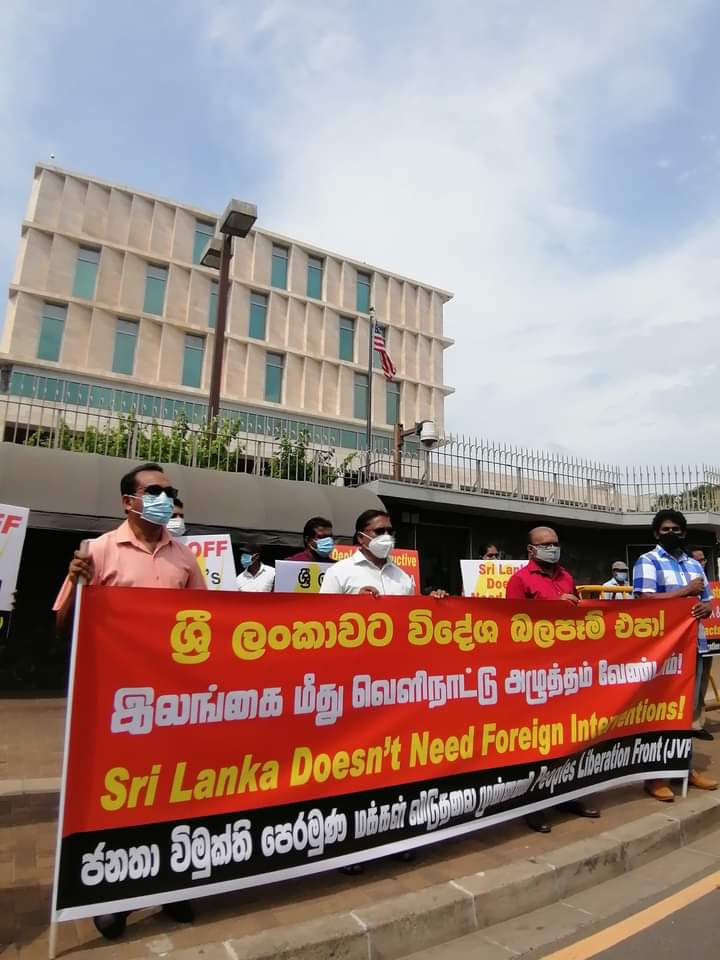
A JVP-led protest against US “imperial ambitions” in 2020.
The Janatha Vimukthi Peramuna (JVP), now at the core of the ruling National People’s Power (NPP) coalition, was among the most vocal opponents of ACSA at the time. It organised protests and issued repeated warnings that such agreements risked eroding sovereignty and drawing Sri Lanka into external military agendas. The current situation, in which a JVP-led administration is managing requests enabled by that very framework, highlights the contradiction between its past rhetoric and present reality.
The decision to disclose the matter publicly by Dissanayake is also telling. By raising it in parliament, the government sought to demonstrate control and assert a narrative of neutrality. Yet the need to do so reflects the political sensitivity of foreign military engagement, particularly in an island that is already suffering the economic blowbacks from the conflict in the Middle East. Dissanayake’s decision to announce the refusal immediately after meeting a senior US envoy only reinforces this tension. Just days before the Iranian ship was torpedoed, the commander of the United States Pacific Fleet, Admiral Steve ‘Web’ Koehler visited the island. Rather than demonstrating independence, it highlights the extent to which Sri Lanka is attempting to manage optics while remaining embedded within the very frameworks it claims to resist.
Sri Lanka’s approach, then, is not one of principled neutrality but of continual adjustment under pressure. It maintains military and economic ties with the United States, reinforced through agreements and high-level visits, while seeking to preserve its relationships with Iran and other states. Each decision is framed as balanced, yet each is made within a narrowing space for manoeuvre.
The problem for Colombo is that this strategy rests on a contradiction it cannot resolve. Agreements such as ACSA ensure that Sri Lanka remains accessible within external military planning, even as the government insists it is not aligned. Public refusals may signal caution, but they do not alter the underlying structures that make such requests routine.
This approach is unlikely to hold. With global attention now on Sri Lanka, each refusal will carry greater consequence, each request greater pressure. The structures of access will remain in place, while the political cost of denying them will rise. Sri Lanka is attempting to stand between competing forces without committing to either. But in doing so, it risks satisfying none, while exposing itself to increasing demands from all sides.
As conflicts spill closer to Sri Lanka’s shores and external powers increase their engagement, the space for manoeuvre becomes narrower. The balancing act, already strained, rests on contradictions that are becoming harder to sustain.