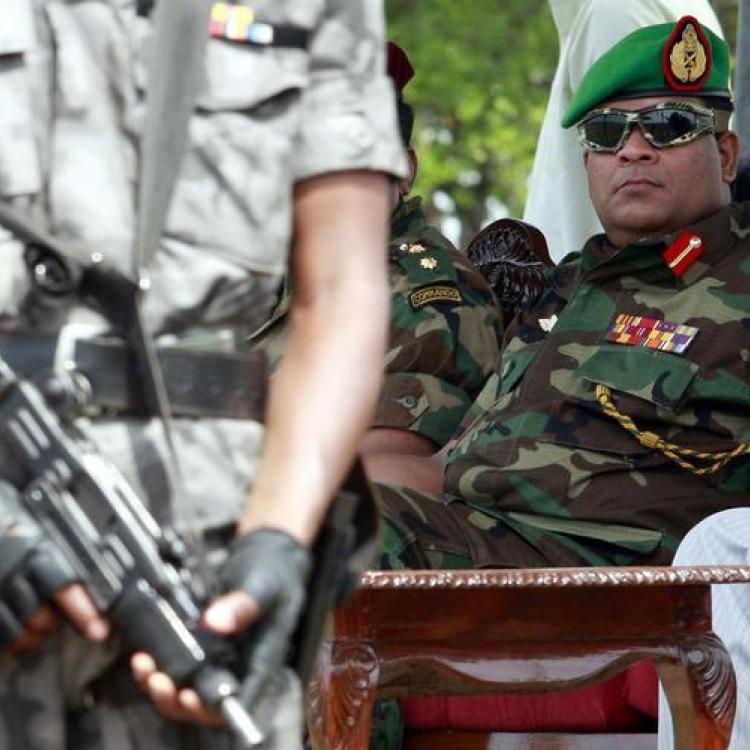
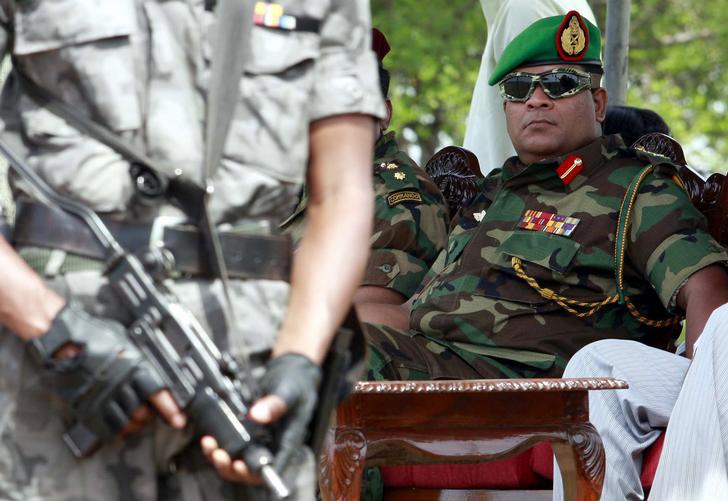
Accused war criminal Shavendra Silva has publicly lamented the impact of international sanctions imposed on him and his family, claiming that restrictions placed by the United States and United Kingdom have disrupted banking access, education opportunities and travel for his relatives.
Speaking during a panel discussion on a talk show titled “Rebuild Sri Lanka”, Silva complained that sanctions imposed over his role during the final stages of the armed conflict had affected not only him, but also his wife and daughters.
Silva, who commanded the Sri Lankan Army’s 58th Division during the Mullivaikkal genocide, oversaw grave violations of international law, including indiscriminate shelling of civilian areas, attacks on hospitals, enforced disappearances, torture, extrajudicial killings and widespread abuses committed against Tamil civilians and surrendering LTTE cadres.
Under Silva’s command, the 58th Division repeatedly carried out attacks on government-declared “No Fire Zones”, where tens of thousands of Tamil civilians were trapped during the final months of the armed conflict in 2009. Human rights organisations, UN investigations and survivors have also linked troops under his command to executions.
One of the most disturbing crimes that Silva is accused of directing is the mass murder of surrendering Tamil civilians and LTTE cadres, since dubbed the “White Flag” incident. The officer quoted Silva as telling troops on the frontline;
“This is a very decisive day for us because last night I got a call from the defence secretary. He told me that we only have a small chunk of land left to capture. Do whatever it takes, however it is done… finish it off the way it has to be done.”
An officer from Silva's 58 Division told Channel 4 News in 2011,
“I can confidently state that those who ordered the killing of people who surrendered were defence secretary Gotabhaya Rajapaksa and Brigadier Shavendra Silva”.
Despite those allegations, Silva described himself and other Sri Lankan military officers as “peacekeepers”.
“At the time, a vetting process was in place under which those who served as peacekeepers in these regiments were rejected,” Silva said, referring to visa refusals imposed by the United States after he completed his tenure as Sri Lanka’s ambassador to the United Nations in New York between 2010 and 2014.
“Their actions were not relevant to the process but declaring that they served in those units were enough to result in a visa refusal. Their names were removed from consideration, and this remains in effect today.”
Silva further complained that sanctions imposed against him had extended to his immediate family.
“My daughter is a scientist and dreamed of going to the US,” he said. “She has received invitations to pursue further study there, but she has been unable to do so. Universities have informed me that my children have been offered many opportunities, yet they cannot obtain visas due to my service in the Sri Lankan armed forces.”
The United States imposed sanctions on Silva and his immediate family members in February 2020, citing his alleged involvement in “gross violations of human rights” during the armed conflict.
Announcing the measures at the time, then US Secretary of State Mike Pompeo stated, “We urge the Sri Lankan government to promote human rights, hold accountable individuals responsible for war crimes and human rights violations, advance security sector reform, and uphold its other commitments to pursue justice and reconciliation.”
Silva also described difficulties accessing financial services as a result of sanctions.
“The forces provide me with healthcare support but in order not to solely depend on them, my wife and I have private insurance,” he stated. “Earlier this year, I attempted to send money to the bank for this insurance scheme. However, the bank later informed me that the transfer, made in my name, had triggered a freeze on the account due to sanctions.”
“It took the bank 11 months return the money,” he continued. “This included me arguing with the bank, asking how I could have anticipated this outcome, as I had simply requested a transfer, but the bank never informed me that other banks might freeze the funds because of the sanctions.”
Silva went on to claim that even extended family members had faced difficulties because of the restrictions imposed against him.
“There was an international bank operating in Sri Lanka, but as soon as I became Chief Commander, my wife’s older sister and younger brother—who had held accounts with the bank for 30 to 40 years—were told they could no longer continue banking there,” he said.
“As a result, they blamed me for the situation, as my position directly affected them.”
“In other countries, even a farmer doesn’t handle cash by hand as everything is online although our country is not at that standard, it will be soon,” Silva added. “I have no way for paying for anything even with my credit card. This is my reality.”
Silva also criticised sanctions imposed by the United Kingdom in March 2025 against himself and several other Sri Lankan military figures.
“A year ago, the UK imposed sanctions on me, the Admiral of the fleet, and Jagath Jayasuriya,” he said. “This was not applied to everyone who served in the same regiments so it must be investigated as to why we were the only ones targeted.”
“The only thing we have in common is that we served in the civil war; beyond that, there is no clear reason for these sanctions.”
“It is not as though I committed any wrongdoing after the war that led to this. I gave instructions in pursuit of victory, and beyond that, I see no justification.”
The UK sanctions announced on 24 March 2025 targeted Silva, former Navy Commander Wasantha Karannagoda, former Army Commander Jagath Jayasuriya and Vinayagamoorthy Muralitharan, the head of the Karuna Group paramilitary faction that operated alongside the Sri Lankan military.
The sanctions included travel bans and asset freezes.
Announcing the measures, British Foreign Secretary David Lammy said, “The UK government is committed to human rights in Sri Lanka, including seeking accountability for human rights violations and abuses which took place during the civil war, and which continue to have an impact on communities today.”
“This decision ensures that those responsible for past human rights violations and abuses are held accountable.”
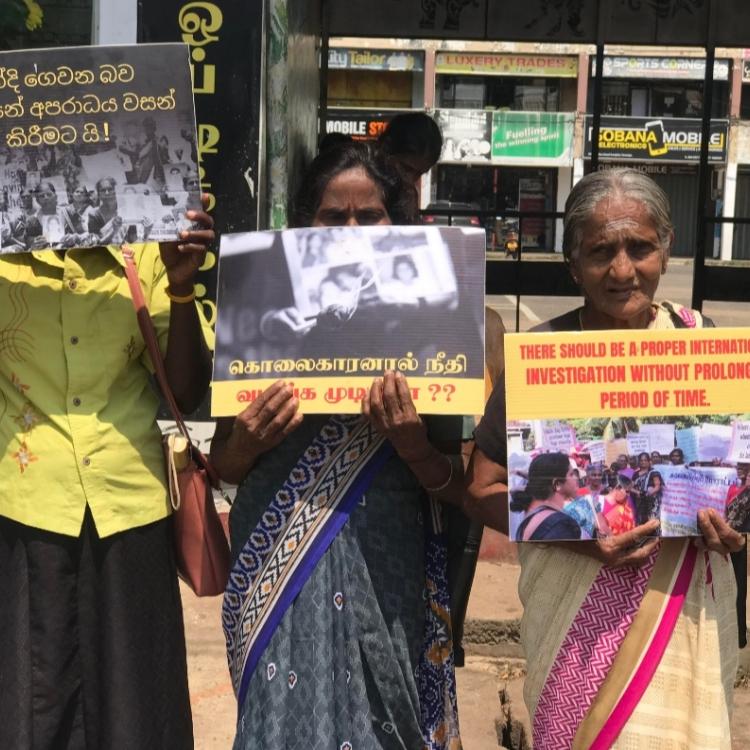
Silva’s remarks come amidst continuing international calls for accountability over mass atrocities committed during the final stages of the armed conflict, as Tamil families of the disappeared, survivors and rights organisations continue to demand international criminal investigations into the massacres at Mullivaikkal.