
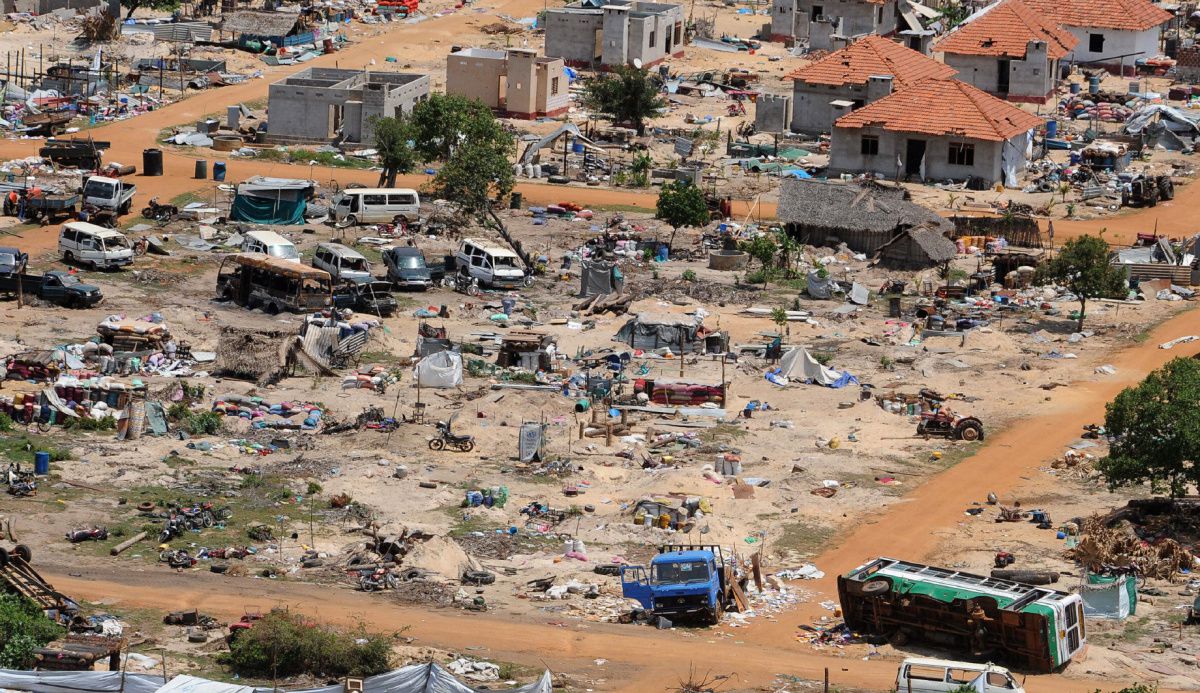
The aftermath of the Mullivaikkal genocide photographed days after it concluded.
The genocide unfolding in Gaza today has shocked the world, but it should not come as a surprise. It follows a now-familiar playbook: the shelling of hospitals, the deliberate denial of humanitarian aid, and the displacement of a civilian population into so-called “safe zones” only to bomb them indiscriminately. It is a campaign rooted in impunity and one that has clear precedent. Sixteen years ago, Sri Lanka enacted a strikingly similar offensive against Tamils in Mullivaikkal, leaving tens of thousands dead. The world failed to act then, and, in that silence, it sent a signal. Israel was listening.
A massacre in Mullivaikkal
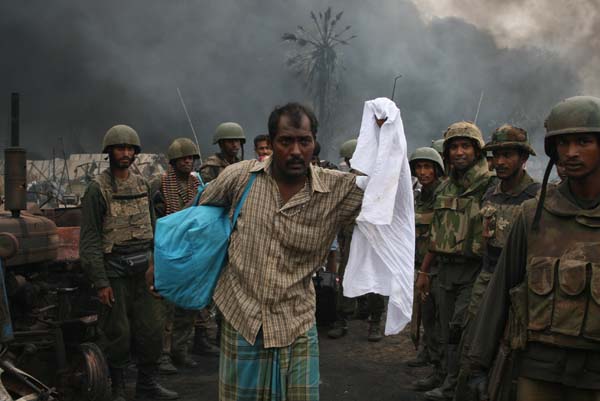
In this image released by the military, a Tamil man waves a white cloth in the air as he is surrounded by Sri Lankan soldiers in Mullivaikkal on May 17th 2009.
In May 2009, Sri Lanka’s military defeated the Liberation Tigers of Tamil Eelam (LTTE) killing tens of thousands of Tamils in the process. The government had declared a coastal enclave in Mullivaikkal where hundreds of thousands were hemmed in a “No-Fire Zone”, ostensibly a safe area for civilians. Yet it relentlessly shelled these zones and hospitals sheltering the wounded. The carnage was staggering. A United Nations panel estimated that between January and May 2009 alone, 40,000 to 75,000 civilians were killed, most due to deliberate fire by government forces. Many of these victims died in indiscriminate artillery barrages and air strikes in the very areas that were supposed to offer refuge. According to data compiled by the International Truth and Justice Project Sri Lanka (ITJP), as many as 169,796 Tamils remain unaccounted for.
Beyond the bombardment, the Sri Lankan military imposed a tight siege that cut off essential humanitarian aid. In late 2008, Sri Lanka ordered all UN and NGO aid workers out of the war zone. As the noose tightened around the trapped population, food, medicine and international monitors were largely kept at bay. The International Committee of the Red Cross struggled to evacuate the wounded by sea, and described the situation in Mullivaikkal as an “unimaginable humanitarian catastrophe”. When the guns fell silent, the aftermath revealed the full scale of atrocities. The surrendered or captured Tamil fighters and civilians were summarily executed or “disappeared” by security forces.
More than 16 years and successive Sri Lankan governments later, those in power in Colombo remain in outright denial of the atrocities committed by its forces. Officials who orchestrated the offensive have insisted that “zero civilians” were harmed, flatly contradicting evidence of mass slaughter. To this day, the state has rejected war crimes allegations and stonewalled calls for accountability. This stubborn refusal to acknowledge, let alone punish, grave violations has left survivors without justice and made a mockery of international humanitarian law. The result is impunity: no Sri Lankan military commander or official has been held criminally accountable for the Mullivaikkal massacres. Instead, the state has faced few tangible consequences from the world. This international failure to ensure justice in Sri Lanka set a dangerous precedent, one that echoes today in the besieged streets of Gaza.
Gaza 2023–24: A campaign of siege and devastation
.png)
An Israeli airstrike pounds the Gaza strip.
Over a decade after Mullivaikkal, a strikingly similar tragedy has unfolded in Gaza. In response to Hamas’s 7 October 2023 attacks, Israel launched an overwhelming military offensive against the blockaded Gaza Strip. What followed was months of intense bombardment in one of the most densely populated areas in the world. The Israeli campaign quickly demonstrated the same hallmarks of total war that had been seen in Sri Lanka. Heavy explosive weapons were unleashed on crowded populations, with the predictable result of mass civilian casualties. By early 2024, Israeli air and artillery strikes had killed thousands of Palestinian civilians, including large numbers of women and children. Scores of such attacks have devastated entire families and razed city blocks.
The Gaza offensive also replicated Sri Lanka’s strategy of besiegement and denied aid, albeit on a larger scale. From day one of the war, Israel imposed a “complete siege” on Gaza: cutting off electricity, water, food, fuel and all supplies for the enclave’s 2.3 million residents. “No electricity, no food, no water, no gas – it’s all closed,” declared Israeli Defence Minister Yoav Gallant. This strangling blockade exacted a severe humanitarian toll. Hospitals ran out of power and medicine, tap water became undrinkable, and the United Nations repeatedly sounded the alarm that collective punishment was unfolding – an act explicitly prohibited as a war crime. For weeks, Israel allowed only a trickle of aid convoys through the Rafah crossing, far below what was needed to avert catastrophe. Such deliberate obstruction of humanitarian relief mirrors the tactics used at Mullivaikkal, where Sri Lankan forces had cornered civilians and cut off life-saving aid. In Gaza, as in Tamil Eelam, civilian suffering was a tactic of war.
Israeli authorities, much like their Sri Lankan counterparts, have responded to reports of civilian devastation with blanket denials. The Israeli military insists it abides by international law and minimizes civilian harm, despite the mounting evidence to the contrary. Investigations by groups like Human Rights Watch have found no credible military justification for many deadly strikes, yet Israeli officials have provided little transparency or accountability. Indeed, Israel has a long record of failing to credibly investigate its own forces for alleged war crimes, fostering a culture of impunity. During the Gaza operation, Israeli leaders dismissed civilian death tolls reported by Gazan authorities and bristled at outside scrutiny.
This echoes Sri Lanka’s approach: absolute denial in the face of abundant evidence, and a refusal to accept independent investigations. In both instances, state officials invoked the rhetoric of the “War on Terror” to justify any excesses. Sri Lanka branded its campaign a “humanitarian operation” to save Tamils from “terrorism”; Israel claims its Gaza war is an existential fight against Hamas “terrorists”. These narratives have served to absolve the militaries of responsibility in their own eyes, even as the world witnesses large-scale atrocities. The clear through-line is a denial of war crimes and a conviction that the laws of war do not apply when combating an “enemy” cast as uniquely evil. Such attitudes thrive when there is little fear of consequences - a lesson painfully illustrated by the Sri Lankan case and seemingly taken to heart by Israel.
These shared tactics amount to a playbook of atrocity. They indicate that what happened in Mullivaikkal was not an isolated aberration, but part of a broader pattern whereby states pursuing ethnonationalist agendas are willing to inflict extraordinary violence on civilian populations and expect to get away with it. Indeed, the parallels between Sri Lanka’s and Israel’s methods are so stark that they invite an uncomfortable question: did the world’s muted response to Mullivaikkal embolden Israel to believe it could prosecute a similar campaign in Gaza with impunity?
Ethnonationalist ideologies and majoritarian domination
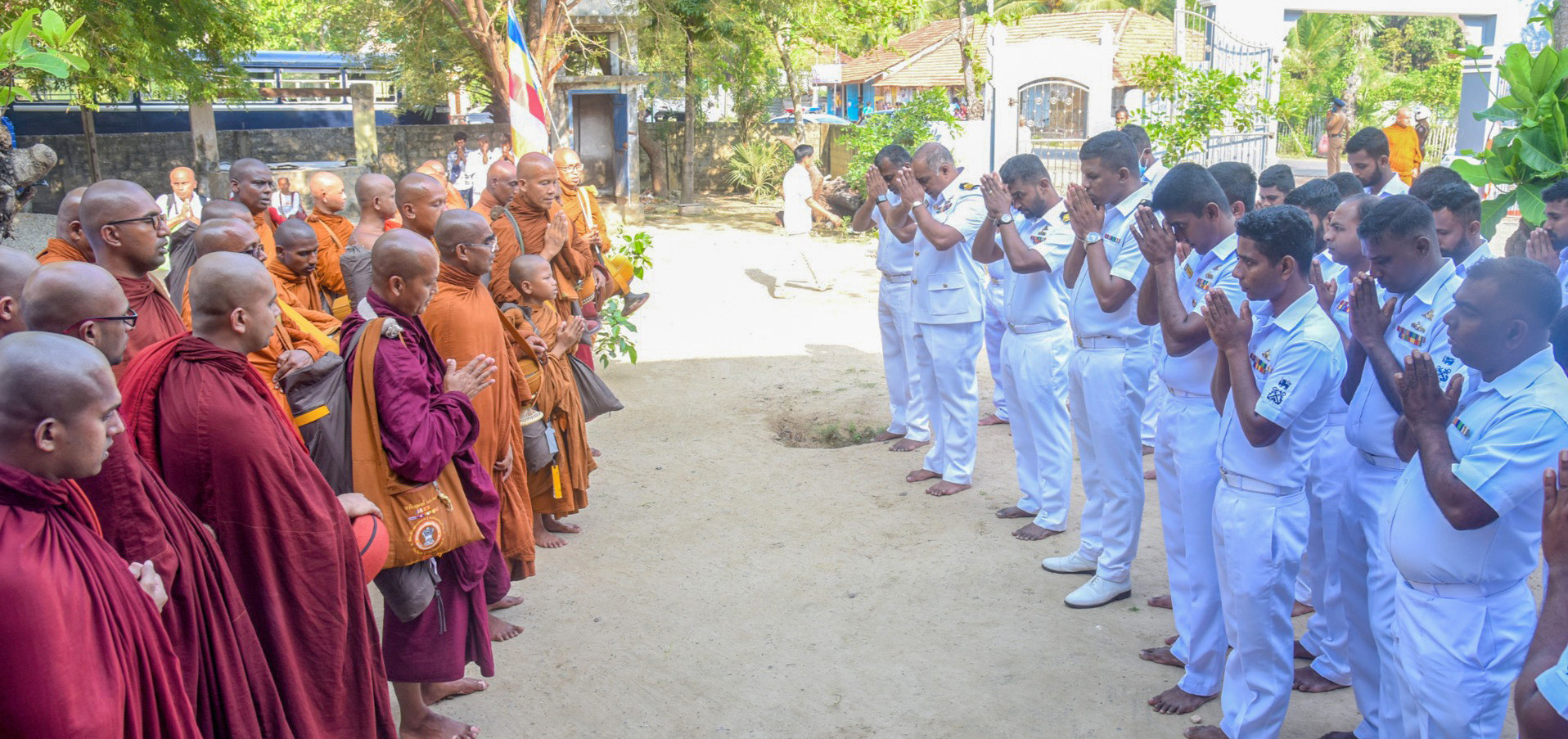
Buddhist monks and the Sri Lanka navy in Jaffna, 2025.
At the root of both conflicts is an ethnonationalist ideology that views another indigenous population as an existential threat to the state’s identity. In Sri Lanka, this ideology is Sinhalese Buddhist nationalism, a hegemonic vision that considers the island of Sri Lanka to belong exclusively to the Sinhala Buddhist majority. This doctrine, cultivated over decades, relegates Eelam Tamils (as well as Muslims and others) to second-class status or worse. As Tasha Manoranjan observes, “Sinhalese Buddhist nationalism is a racist ideology that considers the island only for the Sinhalese, where other communities — notably Tamils and Muslims — do not belong.” It is an ideology buttressed by a powerful “military-monastic complex”, an alliance of the army and Buddhist clergy, which has at times permitted “genocidal campaigns in the name of Buddha.”
In practical terms, Sinhala nationalist leaders have long sought to erase legitimate Tamil political claims. They have promoted policies of forced assimilation, demographic engineering, and linguistic/religious supremacy. It was this mindset that animated the all-out war in 2009. As the Rajapaksa government geared up for the final offensive, it made clear there would be no compromise with Tamil independence. The campaign from 2008–09 was explicitly designed to inflict mass casualties and break the backbone of Tamil resistance, reflecting a belief that the Tamil national question could be resolved by force. In essence, Sri Lanka’s state ideology cast the Tamil civilian population itself as the enemy, a collective to be subdued and subordinated to Sinhala dominance.
Israel’s ruling ideology shares analogous features, despite the different ethnoreligious context. Modern political Zionism, especially in its right-wing iteration, posits Israel as a state that by definition exists for the Jewish people, often to the exclusion of the Palestinians who also inhabit the land. In recent years, Israeli politics have been dominated by an ascendant Jewish ethnonationalism that openly champions Jewish supremacy between the Jordan River and the Mediterranean. This was codified in the 2018 Nation-State Law, which asserts that only the Jewish people have the right to national self-determination in Israel. The implication is that Palestinians are merely resident aliens in what is historically their own homeland. Hardline Israeli leaders frequently describe the Palestinian presence as a “demographic threat” to the Jewish and democratic character of the state. Senior officials have gone further into outright racism, revealing a toxic worldview in which Palestinians (and other non-Jews) are permanent outsiders at best, or a hostile fifth column at worst. During the Gaza war, this ideology manifested in chilling rhetoric: Palestinian neighborhoods were described as nests of terror to be “wiped out,” and civilians in Gaza were implicitly equated with the militant enemy through terms like “human animals”. The upshot is an ideological permission structure for extreme violence: if Palestinians are seen as an alien population standing in the way of a purely Jewish state, then methods that would otherwise be unconscionable, such as siege, collective punishment, even mass killings, become permissible as measures of self-preservation. This mirrors the Sinhalese nationalist view that Tamils who voice for self-determination had to be decisively crushed to preserve Sri Lanka as a unitary Sinhala Buddhist nation.
Crucially, both Sri Lanka and Israel justify their actions with the language of counter-terrorism while pursuing aims of demographic dominance. It reflects an intent not just to defeat a militant group, but to break the will and identity of a people. That intent pushes these crimes into the definition of genocide, which entails efforts to destroy a national, ethnic, racial or religious group “in whole or in part.”
Indeed, many have recognised the Mullivaikkal massacre as a genocide, and a growing number of international observers including genocide scholars have warned that Israel’s assault on Gaza constitutes a genocide too. In both cases, the combination of ethnonationalist fervour and military might unleashed on a trapped population created a scenario of one-sided slaughter with the goal of permanently altering the status quo in favour of the dominant group.
Colonisation and demographic engineering: Tamil Eelam and the West Bank
.JPG)
A protest against Sinhala colonisation in Mullaitivu in 2018.
Military offensives like those in Mullivaikkal and Gaza also do not occur in isolation. They are linked to long-term projects of territorial and demographic control. After the guns fall silent, the struggle continues in the form of settler-colonial policies that aim to cement the dominant group’s hold over contested lands. Here again, the parallels between Sri Lanka and Israel are striking.
Even decades before the war raged, the Sri Lankan government pursued a programme of state-sponsored Sinhalese settlements in traditional Tamil areas. The objective was clear: to change the demography of the Tamil homeland in the North-East and undermine Tamil aspirations for autonomy or nationhood. This Sinhalisation of the Tamil homeland accelerated dramatically after the 2009 genocide. With the LTTE defeated, Colombo moved swiftly to plant Sinhala Buddhist markers across the region and settle Sinhalese families in formerly Tamil districts.
One emblematic example is the Trincomalee District in the Eastern Province, a strategic and resource-rich area. Fifteen years on from Mullivaikkal, “the colonization of Tamil and Muslim lands has accelerated in Trincomalee,” notes a 2024 report, to the point that Sinhalese now constitute 27% of Trincomalee’s population and occupy 36% of its land area. In a single divisional zone (Kuchchaveli) that links the Northern and Eastern Provinces, over 50% of the land was expropriated in the past decade, ostensibly for “development” but largely used to build Buddhist viharas (temples) and new Sinhala settlements. At least 26 new Buddhist shrines have been erected on nearly 3,900 acres of seized land in that one area.
This pattern repeats elsewhere. Tamil locals frequently report “land grabs” where the army or government agencies claim land for archaeological reserves or farms, only to hand it to Sinhalese settlers. The net effect is that Tamil population is being diluted across its historic homeland. As Krisna Saravanamuttu put it in 2013, these land seizures and settlements “are fragmenting the Tamil people’s national and social coherence” in the North-East, undermining any possibility of creating a contiguous national homeland for Tamils. In other words, by changing the facts on the ground, Sri Lanka seeks to make the Tamil quest for self-determination geographically and demographically unviable.
This logic is virtually identical to Israel’s longstanding settlement enterprise in the occupied Palestinian territories. Since 1967, Israel has actively sponsored Jewish settlements in the West Bank (and until 2005, in Gaza as well) to establish irreversible control over land envisioned for a Palestinian state. Today, that project has advanced so far that about 700,000 Israeli settlers live on occupied land in East Jerusalem and the West Bank. These settlements, which remain illegal under international law, are strategically placed to carve up Palestinian enclaves and secure key resources like water and fertile land. They are often accompanied by exclusive roads, military outposts, and the expropriation of Palestinian property. The cumulative impact has been to make a coherent Palestinian state increasingly difficult. Indeed, Israeli officials of the current ruling coalition openly oppose Palestinian statehood and instead speak of a singular Jewish sovereignty over the whole land. The West Bank, in effect, is being “Judaized”, much as Tamil North-East is being Buddhisized and Sinhalised. The goal in both cases is similar: create new demographic realities that erase the targeted group’s claim to nationhood and permanently thwart their aspirations for independence or nation-status.
Notably, there is a direct historical link between these two settler projects. In the 1980s, during the Tamil liberation struggle, Israeli advisers provided guidance to Colombo on how to establish and secure Sinhala settlements in Tamil-majority areas. Saravanamuttu notes Israel shared its West Bank strategy with Sri Lankan authorities, advising them to create “Sinhala-only armed settlements in the eastern province” as buffer zones around Tamil populations. The idea, borrowed from the Israeli playbook, was “to destroy the local population’s claim to national existence and render invalid any political solution based on popular sovereignty.” In practice, this meant inserting pockets of Sinhala communities under military protection in order to break up contiguous Tamil regions – directly paralleling how Israeli settlements break up Palestinian contiguity. We see the fruits of that policy today in places like Trincomalee and Amparai, where Tamil villagers now find themselves adjacent to growing Sinhala settlements. Similarly, Palestinian villages in the West Bank wake up to find new hilltop outposts often populated by armed Israeli settlers overlooking their homes, seizing their farmland, and cutting them off from neighbours. Settler-colonialism is the common framework here: a state transmigrating its people into other regions to dispossess the local population and claim the land’s identity.
Sri Lanka’s ongoing Sinhala Buddhist colonisation of the Tamil regions and Israel’s expansion of Jewish settlements are two manifestations of the same impulse: to consolidate ethnonational domination through the facts of habitation and geography. The human cost of these projects is borne by Tamils and Palestinians, who face displacement, marginalisation, and the erasure of their heritage. These are not isolated local issues but parts of a global pattern of settler-colonial oppression. Crucially, both states have carried out these schemes under the gaze of an international community that, aside from occasional words of concern, has largely failed to halt or reverse the land grabs.
The Israel–Sri Lanka military nexus
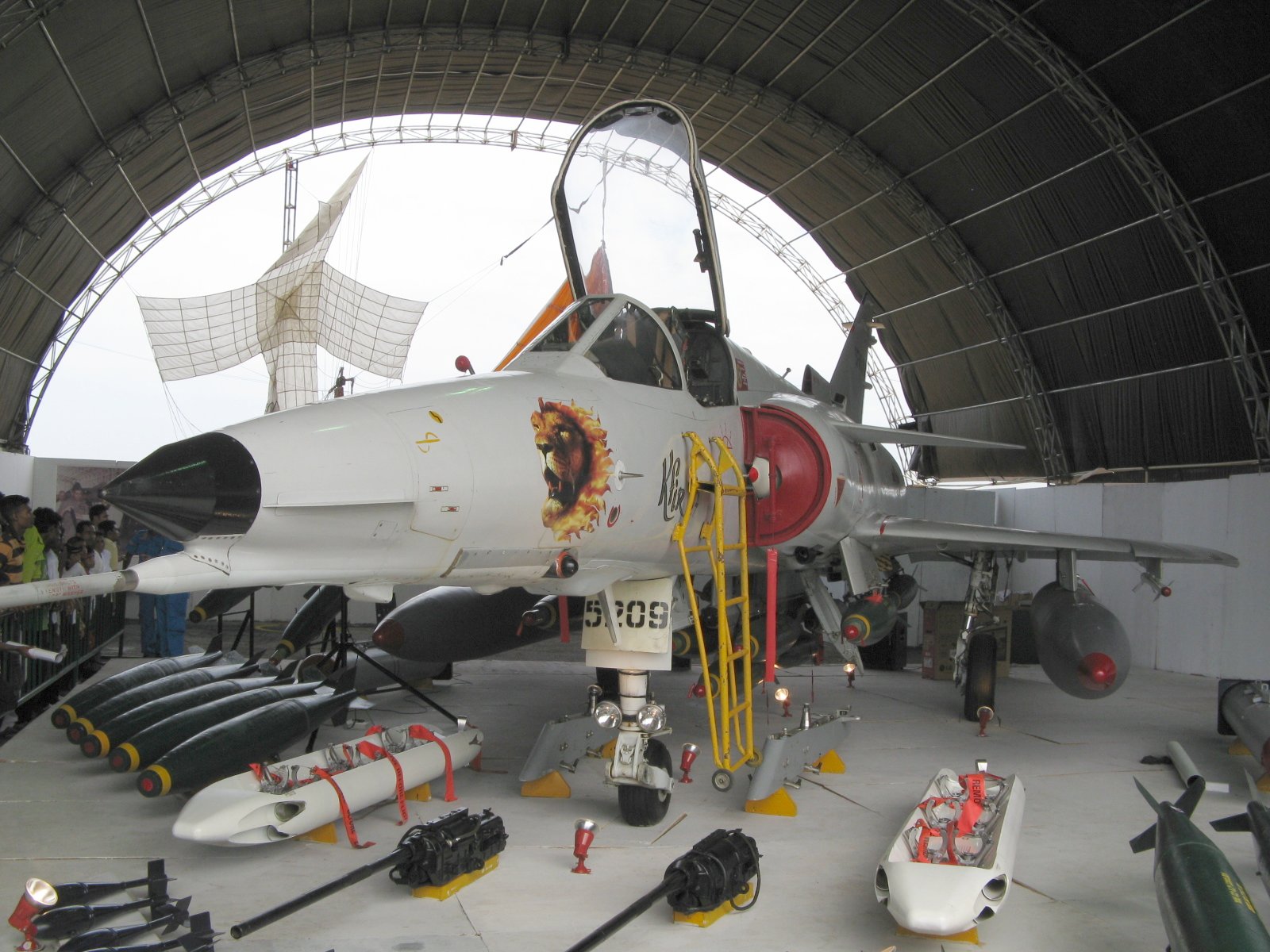
A Kfir jet emblazoned with a lion sits in a Sri Lankan hangar. (Courtesy: Chamal Pathirana)
The parallels between Israel and Sri Lanka are more than coincidental; there has been direct collaboration and exchange of methods between the two states. During Sri Lanka’s war on Tamils, Israel was a key arms supplier and adviser to the Sri Lankan state. Throughout the 2000s, Israel stepped in as one of Colombo’s most important military partners. Sri Lanka procured significant Israeli military technology, including the IAI Kfir fighter jets that became the workhorses of its bombing campaign. Between the 1990s and 2000s, Sri Lanka bought at least 16 Kfir combat aircraft from Israel, which were used for ground attack missions. Notably, it was Israeli-made Kfirs that bombed the Sencholai orphanage in 2006, killing dozens of Tamil schoolgirls - an incident emblematic of Colombo’s disregard for Tamil lives. Israel also supplied Super Dvora and Shaldag class patrol boats to the Sri Lankan Navy. These fast attack craft helped Sri Lanka destroy the LTTE’s seaborne supply lines and were used in coastal bombardments. Additionally, Israel provided surveillance drones (UAVs) that gave Sri Lankan forces crucial intelligence and targeting capabilities. The Sri Lankan Army itself acknowledged that Israeli UAVs “played a critical role in the war”, as they fed realtime video for directing artillery and air strikes. This meant that Israeli technology was complicit in pinpointing civilian concentrations that were nonetheless bombarded.
Beyond hardware, Israel reportedly provided training and strategic advice to Sri Lanka. Israeli military trainers worked with Sri Lankan special forces and the police Special Task Force, a commando unit notorious for brutal counter-insurgency operations. It is also documented that in the 1980s, Israeli intelligence (often euphemistically referred to as “advisers”) assisted Sri Lanka in devising tactics to combat Tamil guerrillas and to carry out the aforementioned settlement plans in the Eastern Province. This deep cooperation suggests that Sri Lanka’s war benefited from Israeli know-how gleaned in conflicts against the Palestinians and others. In essence, Sri Lanka’s offensive became an imported model of counter-insurgency that combined modern weaponry and surveillance with ruthless disregard for civilian life. Some of the very weapons and techniques Israel honed in its occupation of Palestinian territories were deployed in Sri Lanka’s onslaught against the Tamils.
This military nexus has a morally bitter flip side: the lack of accountability for one conflict’s atrocities potentially feeds into the next conflict. Israel’s arms sales to Sri Lanka continued even as credible reports emerged of Sri Lankan forces shelling hospitals and no-fire zones. There was no discernible hesitation on Israel’s part to arm Sri Lanka. Business and geopolitical interests took priority. For its part, Sri Lanka’s triumph in 2009, achieved with foreign assistance and followed by impunity, may have served as a grim inspiration or case study for how to defeat a resistant population through overwhelming force. It is chilling that throughout Israel’s offensive, some commentators observed Israel seemingly adopting a “Sri Lanka option” in Gaza. This is not to say Israel needed Sri Lanka as a mentor in brutality; Israel has its own long history of harsh measures in Gaza and Lebanon. However, the two countries reinforced each other’s worst tendencies. Sri Lanka showed that a state can massacre by the tens of thousands and suffer little more than mild censure and half-hearted UN resolutions. Israel, with far greater international clout, has evidently calculated that it too can prosecute a maximalist war in Gaza for over 18 months without facing serious consequences from its allies. It is telling that even as Israel faced global protests over Gaza, Sri Lanka staunchly defended co-operation with Israel, effectively returning the favour of support. This underlines a dangerous alliance.
The consequences of impunity
The tragic through-line from Mullivaikkal to Gaza is a stark lesson in the global consequences of impunity. When the international community fails to hold a state accountable for egregious crimes, it sends a clear signal to others that such crimes are permissible. Sri Lanka’s genocide of Tamils went unpunished. No international tribunal, no targeted sanctions for the architects of the violence, not even UN Security Council action. This lack of accountability did not go unnoticed by other governments around the world. It especially did not escape the attention of Israel, which was not only a partner to Sri Lanka but also a nation long accused of violating Palestinian rights.
Sixteen years ago, Sri Lanka’s genocide led to the total military occupation of the Tamil homeland and an expanding programme of Sinhala settlements. Today, Israel’s leaders are enacting a similar playbook in Gaza and the West Bank. Massive military force followed by territorial absorption, apparently confident that they too will face little more than rhetorical rebuke. As Saravanamuttu wrote in 2024, “we remember the Tamil genocide as we bear witness to the genocide unfolding in Gaza.” The failure to deliver justice for one atrocity has helped pave the way for another.
What is at stake here is not only the fate of the Tamil and Palestinian peoples, but the integrity of the international legal order and the credibility of institutions meant to safeguard human rights. The United Nations, global powers, and civil society must recognise that impunity anywhere is a threat to humanity everywhere. If we tolerate the deliberate bombing of hospitals or the starvation of civilians in one conflict, we embolden other regimes to emulate the same methods. This cycle must be broken.
First and foremost, there needs to be a renewed push for accountability in both Sri Lanka and Israel. In Sri Lanka’s case, that means no longer deferring justice for the 2009 massacre. The world should support efforts at an international accountability mechanism, whether via the International Criminal Court (ICC) or a special tribunal, since Sri Lanka has proven unwilling to prosecute its war criminals domestically. Sri Lankan military commanders and officials credibly accused of war crimes should face travel bans and asset freezes, signalling that they are not beyond the law’s reach.
Likewise for Israel and Gaza. Despite political sensitivities, nations genuinely committed to human rights should back the ICC’s ongoing probe into the situation in Palestine. There should be no double standards. The perpetrators of mass atrocities, however powerful, should be held to account.
Additionally, the international community should use the levers of diplomacy and economics to restrain these kinds of military campaigns. That means, for example, suspending arms sales to any state currently engaged in grave breaches of humanitarian law. Had major powers cut off military assistance to Sri Lanka in early 2009 or threatened real repercussions, perhaps the worst of Mullivaikkal might have been averted. Similarly, continuing to supply Israel unconditionally while it pummels Gaza only fuels the fire. Countries should condition aid and arms on adherence to the laws of war. No longer can mass atrocities be shrugged off as “internal matters” or obscured by the rhetoric of counter-terrorism.
Finally, there must be a proactive effort to halt and reverse settler-colonial projects that threaten a people’s right to self-determination. The world tended to ignore or excuse Sri Lanka’s demographic engineering in Tamil areas, viewing it as a domestic policy issue. But that “colonisation by bits and pieces” laid the groundwork for permanent instability and injustice, just as Israeli settlements foreclose peace and entrench apartheid-like conditions. The international community should demand that Sri Lanka stop its land grabs in the North-East, return lands to their rightful Tamil owners, and respect the cultural and political rights of the Tamil people. In parallel, Israel must be pressed to freeze all settlement construction and dismantle outposts in occupied territory as part of any credible path to peace. These are not extreme demands – they are requirements grounded in UN resolutions and international law. Supporting the self-determination and equal rights of Tamils and Palestinians is not only a moral duty but also the only viable route to a sustainable peace.
What we witness in the mirroring of Sri Lanka’s Mullivaikkal offensive and Israel’s Gaza war is a sobering indictment of global governance. It is a tale of two campaigns of state violence, distant in geography but united by method and mentality, and by the world’s failure, so far, to adequately respond.
It is time to reverse that course.