
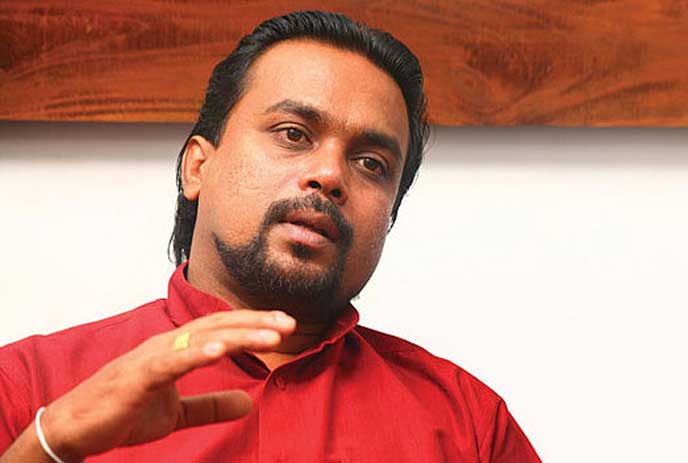
Sinhala extremist and National Freedom Front (NFF) leader Wimal Weerawansa has voiced strong opposition to the Sri Lankan government’s decision to award the development of its electronic National Identity Card (e-NIC) system to an Indian non-profit organisation, claiming it raises serious concerns over “national security”.
Speaking at a media briefing last week, Weerawansa criticised the government, accusing it of compromising Sri Lanka’s “national interest” by enabling an Indian entity to access the sensitive personal data of Sri Lankan citizens, including biometric information such as fingerprints and retina scans.
According to Weerawansa, an MoU was originally signed in 2021 between Sri Lanka and India under the previous government to cooperate on the e-NIC system. Though that project was not implemented at the time, he stated that the current administration under President Anura Kumara Dissanayake had revived the initiative in 2023, allocating Rs. 3 million for its continuation.
Weerawansa claimed that Sri Lanka’s Department of Persons Registration had already completed 99% of the technical system for the e-NIC domestically, using Rs. 5 billion of local investment. “All necessary equipment, including fingerprint and retina scanners and personal identification systems, have already been procured,” he said.
Despite this progress, he alleged that the government sidelined the local system and instead pressured the department to hand over the project to India’s National Institute for Smart Government (NISG), citing flaws in the domestic system as justification. He also raised objections to the nature of the tendering process, claiming it was conducted solely in India and open only to Indian companies, thereby excluding Sri Lankan firms entirely.
“According to the tender, the Indian company will have access to crucial data, including the movement of people, accommodation details, and even the country’s medical requirements,” Weerawansa warned. He also expressed concerns about data privacy, stating that under the tender agreement, the Indian company would bear only 10% responsibility in the event of a data breach.
Weerawansa added that India’s Ministry of Digital Economy has already approved the tender and called on Sri Lankan authorities to reconsider the move, citing significant risks to national sovereignty and individual privacy.
Weerawansa further linked the e-NIC development to broader concerns regarding the growing military and economic relationship between Sri Lanka and India. He pointed to seven Memorandums of Understanding (MoUs) signed during Indian Prime Minister Narendra Modi’s visit to the island in April, none of which have been made public by the Sri Lankan government.
Among these, Weerawansa drew particular attention to the MoU on defence cooperation. “Not even the most extreme right-wing government in power in Sri Lanka had ever moved to sign a defence MoU with India before this,” he said. He likened the current secrecy to the Indo-Sri Lanka Accord signed by then-President J.R. Jayewardene in 1987, which Weerawansa accused of being hidden from the public.
As evidence of the implications of this MoU, he referenced this week’s acquisition of a 51% controlling stake in Colombo Dockyard PLC by India’s state-owned Mazagon Dock Shipbuilders Ltd (MDL) for $52.96 million, previously owned by Japan-based Onomichi Dockyard. While Onomichi is a commercial shipbuilding firm, MDL is a key supplier of naval vessels and submarines to the Indian military.
“If Colombo Harbour is used to construct military vessels and submarines in the future, Sri Lanka could be dragged into global conflicts,” warned Weerawansa. He pointed to the recent Iranian ballistic missile attacks on US bases in Qatar as evidence of how strategic installations can become targets.
Weerawansa also raised concerns over the employment prospects of Sri Lankan workers at the dockyard, questioning whether they would retain their jobs if military production replaces commercial operations. “This question did not arise when the Colombo Dockyard was building commercial vessels,” he noted, “but if this changes, the jobs of Sri Lankan workers could be in jeopardy.”
The NFF leader’s remarks come amid growing Sinhala nationalist scrutiny of Sri Lanka’s economic and defence ties with India.