
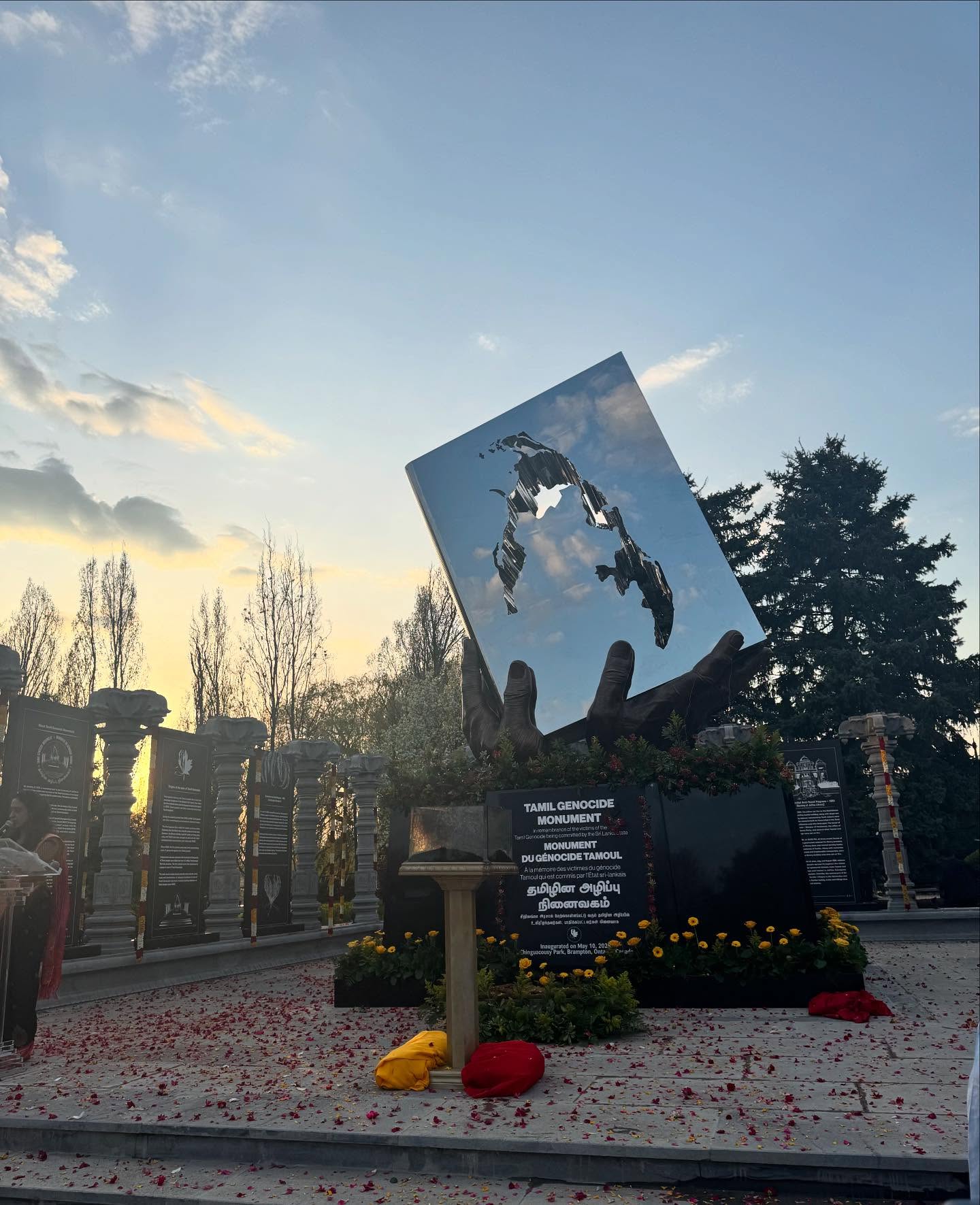
Last month in Brampton, Canada, hundreds gathered as a new Tamil genocide monument was officially unveiled. It was an act of remembrance that resonated not only with the Tamil diaspora but with justice seekers across the world. As flowers were laid and flames lit before it on May 18, Tamil Genocide Remembrance Day, it stood as a solemn memorial to the tens of thousands of Tamil civilians slaughtered at Mullivaikkal in 2009, and as a bold counter to decades of denial and erasure by the Sri Lankan state.
In the shadow of Colombo’s sustained campaign to whitewash its crimes, the construction of such monuments is more than just symbolic. It is a vital assertion of truth and justice. For decades, Tamil survivors and human rights organisations have documented the systemic campaign of violence carried out by the Sri Lankan state: the relentless shelling of civilian zones, the bombing of hospitals, the denial of food and medicine, and the execution of surrendering civilians. The final months of the armed conflict were not simple war. They were a slaughter. And yet, 16 years later, there has been no justice. No accountability. No acknowledgement.
Instead, the Sri Lankan state has gone to great lengths to not only shield perpetrators, but to destroy the memory of the genocide and the Tamil nation itself. From bulldozing the remains of Tamil cemeteries to erecting Buddhist shrines atop Tamil villages, Colombo has weaponised state institutions in a campaign of erasure. As PEARL’s 2016 report, Erasing the Past, meticulously outlines, the state’s efforts to eliminate Tamil memory are ongoing and systematic.
In the North-East, where the soil is soaked with the blood of the massacred, mourning has become an act of resistance. This is why the Brampton monument matters.
By building spaces of remembrance in countries where freedom of expression is protected, the Tamil diaspora is not just honouring the dead. It is safeguarding the truth. The Brampton memorial is a site where grief can be expressed, history can be recorded, and younger generations can learn the truth that was silenced in the Tamil homeland. It is a direct challenge to Sri Lanka’s genocide denial and a refusal to let the past be buried with the victims.
Unsurprisingly, the Sri Lankan government’s response has been one of outrage. Officials lodged diplomatic protests, attacked the monument as promoting a “false narrative,” and even threatened legal action against those using the term “genocide.” This furious reaction only confirms the importance of such efforts. When the truth risks being erased, it becomes even more essential to safeguard.
But one monument is not enough.
We need more across the diaspora and in the Tamil homeland. We need them in London, in Paris, in Oslo, in Sydney. And most urgently, we need them in Kilinochchi, in Mullaitivu, in Amparai and Jaffna. Every place where a child’s life was ended by shellfire, or a mother lost her family to the army’s guns, must be etched into our collective memory.
Building monuments is not just about stone and steel. It is about justice. Each Tamil genocide monument reaffirms the call for accountability. Each one reminds the world that the bloodshed of 2009 was not a tragic accident of war, but a calculated campaign of extermination. And each one stands as a promise that the Tamil people will never forget, never forgive, and never stop fighting for liberation.
In a world where impunity still reigns and the same crimes are being repeated elsewhere, these monuments are moral landmarks. They compel action. They demand justice. So let Brampton be the beginning. Let it inspire Tamil communities, lawmakers, and human rights defenders everywhere. Let it push the international community to move beyond rhetoric and towards accountability.
For the Tamil nation, remembrance is resistance. And monuments like this one are not just to remember the past. They are to shape a future towards freedom.
_____
Theepan is a staff writer at the Tamil Guardian.