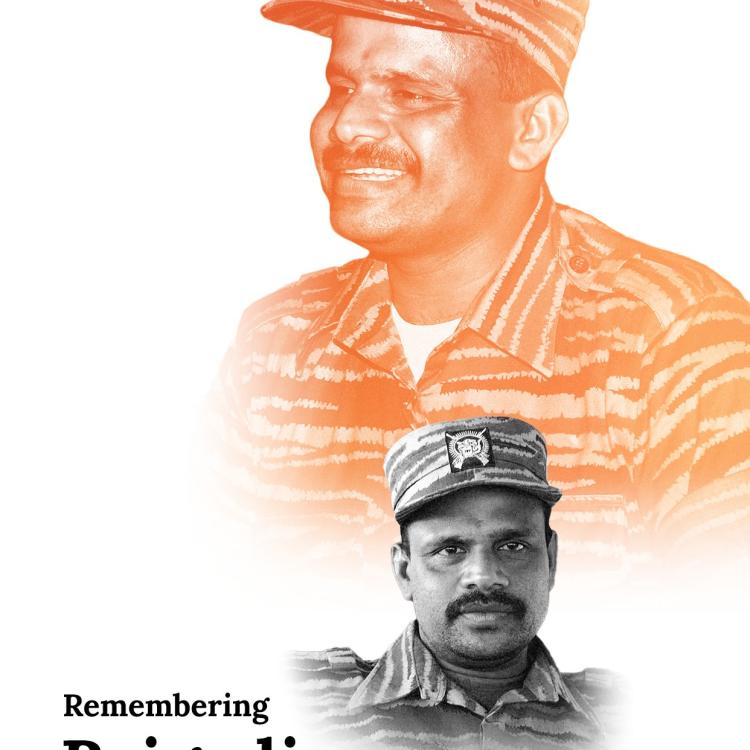
ITAK parliamentarian Thurairasa Ravikaran paid tribute to former LTTE military commander Brigadier Balraj in Parliament on Thursday whilst also raising concerns over alleged state-backed deforestation in Vanni and government policies affecting local paddy farmers.
Speaking during parliamentary proceedings, Ravikaran marked the 18th anniversary of the death of Brigadier Balraj, describing him as a “battlefield hero” (சமர்கள நாயகன்) of the Tamil Eelam liberation struggle.
“Eighteen years have passed since the battlefield hero of our Eelam liberation struggle, Brigadier Balraj, left us,” he said. “I express my respects in this House to Brigadier Balraj, who hailed from Kokkuthoduvai in Mullaitivu district and was admired even by international military experts.”
The Vanni MP then drew attention to large-scale deforestation near the University of Vavuniya, alleging that more than 40 acres of forest land had been cleared.
He said residents had raised suspicions that the destruction was taking place with the support of forestry authorities, noting that an office of the forest department of Sri Lanka was located only one-and-a-half to two kilometres from the affected site.
“It's said that trees are being removed immediately after they are cut down, and concrete fence posts are already prepared,” Ravikaran said. “We have evidence regarding this. Therefore, I request the authorities to take action.”
Ravikaran also addressed several regulations and proposals presented under the Sri Lankan Ministry of Finance, Planning and Economic Development, focusing particularly on the government's rice import policy and its impact on local producers in the Vanni region.
Questioning the rationale behind continued rice imports, he noted that large quantities of locally produced paddy from the recent cultivation seasons remained unsold in storage facilities.
He referred to the Extraordinary Gazette No. 2482/12 issued in April 2026, which relaxed import restrictions on Ponni Samba and Paal Ponni rice varieties to address an alleged shortage of Samba and Keeri Samba rice. Under the regulations, importers are permitted to bring in up to 1,040 metric tonnes of rice before 31 May, provided the consignments are cleared through customs within the stipulated period.
According to Ravikaran, Sri Lankan government figures indicate that approximately 185,000 metric tonnes of paddy remain in storage under the Paddy Marketing Board, whilst locally produced rice from the recent harvest has yet to be effectively marketed.
“While claiming there is a shortage of Samba rice for consumers, the government is rapidly easing imports of Paal Ponni and Ponni Samba rice,” he said. “We do not understand what kind of economic policy this is.”
The MP stated that in the Kumulamunai Agrarian Service Centre area of Mullaitivu district alone, over 3,490 acres of paddy cultivation had recently been harvested, including approximately 1,325.6 acres cultivated with Keeri Samba.
He questioned whether the government intended to prioritise local producers over imports and called on authorities to ensure that farmers receive fair prices for their harvests.
Ravikaran further argued that the government's decision in March to permit rice imports before existing stocks had been cleared from storage facilities resulted in reduced procurement of locally produced paddy from the Vanni region.
“The urgency shown by the government in facilitating rice imports was not demonstrated when purchasing, storing and marketing local rice,” he said.
Whilst acknowledging concerns over possible shortages of Samba and Keeri Samba rice and the need to stabilise consumer prices, Ravikaran urged the government to simultaneously utilise domestic production more effectively through the Paddy Marketing Board and ensure fair returns for local farmers.