.jpg)
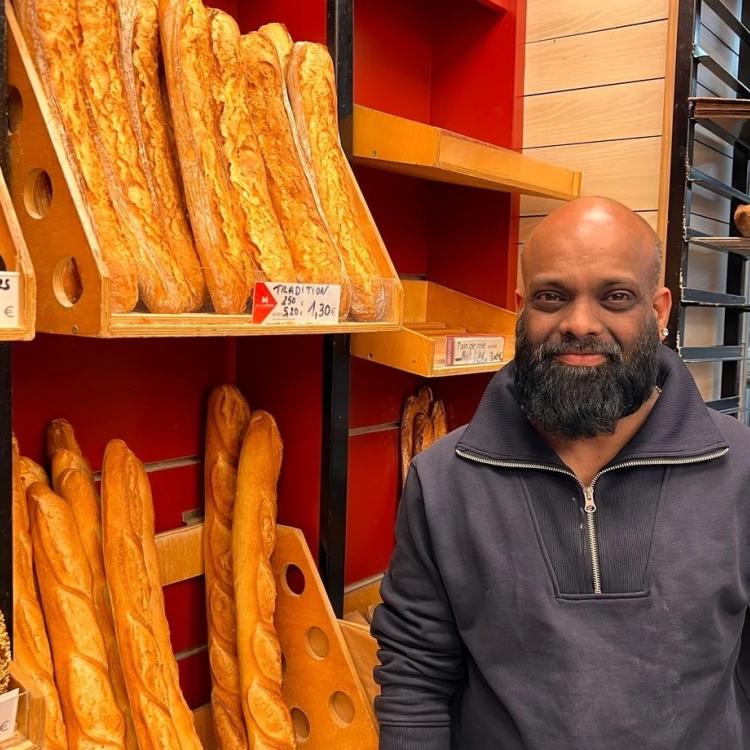
Jegatheepan outside Le Fournil Didot, the bakery he took over in 2022
Sithamparappillai Jegatheepan fled the Tamil homeland not knowing the language, where to go, or what lay ahead. Last month, he was crowned the best baguette baker in Paris and will soon deliver bread to the Élysée Palace. Tamil Guardian spoke to him about his journey.
On the morning of 26 February, a baker in Paris's 14th arrondissement received a phone call that would change his life. The voice on the other end told him he had won the the Grand Prix de la Baguette de Traditio Française - the most coveted prize in French bread-making, awarded annually by the City of Paris since 1994. His first reaction was not triumph. It was disbelief.
"They called me to tell me the results. My first reaction was honestly, 'No… it can't be me.' I really didn't believe it."
It was only when representatives from the bakers' union came to the shop in person that reality began to take hold. Then he called his wife.
"Soon after, people from the bakery union came to my shop to congratulate me. That's when it started to feel real. Then I called my wife and told her the news. She was very happy."
Sithamparappillai Jegatheepan, 43, had entered the competition for the first time. He beat 142 other bakers. His prize includes €4,000 and a year-long contract to supply fresh baguettes daily to the Élysée Palace, the official residence of Emmanuel Macron. It was, by any measure, an extraordinary result, one made more so by where his story began.
.jpg)
Jegatheepan with the prize-winning baguette at Fournil Didot
Jegatheepan grew up in Vadamaradchi, in the north of the Tamil homeland. He left in 2000, spending two years in Colombo before making his way to France. The reason was straightforward: survival.
"I left Tamil Eelam because of the situation there at the time. Life was very difficult, and it was not easy to live or move freely. My brother had already been living in France for nearly 20 years, so I joined him here. Like many others, I left hoping for a better life."
He was, at that point, one of tens of thousands of Eelam Tamils who fled the North-East during the war, scattering across Europe and beyond. France became home to one of the largest Tamil diaspora communities on the continent.
Arriving in Paris, the adjustment was steep.
"It was very difficult at first. I didn't know anything - where to go, what to do, or how things worked. Everything was different: the food, the lifestyle, the culture. I also didn't speak the language, so finding a job was very hard. For about a year I struggled and searched for work. Finally, I found a job in a restaurant. That was my first step here."
He spent years in that restaurant world, adapting slowly to a country that had felt entirely foreign. Asked today whether he has finally gotten used to life in France, he laughs.
"Yes… I think so."
.jpg)
Fresh from the oven at Fournil Didot, Paris's 14th arrondissement
The move into baking came through a chance connection.
"While I was working in the restaurant, I had a friend who worked in a bakery. He told me they needed help and encouraged me to try. So, I gave it a chance. I discovered that I really liked the work. Little by little, I started learning the different tasks in the bakery."
That liking deepened into something more deliberate. Watching other bakeries around him, he felt a pull he could not ignore.
"When I looked at other bakeries, I began to feel something inside me - a desire to grow in this field. I slowly tried to learn everything: desserts, viennoiseries, and bread. I wanted to truly understand this craft. Baking is something very traditional in France, and I felt proud to learn it properly."
In 2008, he bought his first bakery in the 15th arrondissement. There he met a French baker named Monsieur Jean-Pierre, who would shape everything that followed. The notion of Jegatheepan as entirely self-taught, he is quick to clarify, is not quite right.
"Not completely. At that time, a French baker named Monsieur Jean-Pierre worked there. He stayed with me for many years until his retirement. He taught me everything about bread-making. Before that, I mainly made macarons and desserts. When he retired in 2022, I had to take over the bread-making myself. Now I also try to pass what I learned on to my staff."
Also in 2022, Jegatheepan took over Fournil Didot, the bakery at 103 Rue Didot in the 14th arrondissement where he now works. It is from this shop that he and his team bake around 650 baguettes each day, each loaf baked at 270 degrees Celsius for 20 minutes, with the dough resting for at least 24 hours beforehand.
The Grand Prix de la baguette, now in its 33rd year, is a celebration of the traditional. Flour, water, salt and yeast, made exactly as they have been made for generations. Baguettes are judged on appearance, taste, baking, crumb, aeration, size and salt content. A 1993 law regulates what can and cannot go into a baguette de tradition. The competition is, in a sense, a test of how faithfully a baker can execute something that has no room for shortcuts.
Jegatheepan is modest about what set his apart.
"Honestly, there was nothing very special about it. I made it the way I always do. I tried to respect the tradition: the shape, the look, and the correct measurements for the ingredients. They expect a baguette that is 'croustillante,' so crunchy on the outside, so I focused on that. I simply tried to make it the traditional French way."
.jpg)
Baguette dough resting before baking — each loaf proofs for at least 24 hours
When pressed on why his baguette won out of 142 others, he is equally measured.
"Maybe because of the balance - the crunchy crust and the soft inside. Also, the baking process, the temperature, the timing, and the appearance of the baguette. In the end, everything must come together."
He had tried to enter the competition the year before but missed the paperwork deadline. This year, he was determined not to let the opportunity pass again.
"Every year the city council sends a letter inviting bakers to participate. I actually tried to apply last year, but I missed the paperwork deadline. So, this year I told myself, 'Let me try again.'"
His daughter, he adds, had made clear what was at stake.
"My daughter yesterday told me I wouldn't be allowed home if I didn't win the prize. She was so happy when I called her yesterday afternoon. She loved it."
The prize carries consequences that go well beyond a certificate. As winner, Jegatheepan will travel to the Élysée Palace to arrange the daily delivery of fresh baguettes to the French President's official residence for the coming year. He has not yet met Macron.
"Not yet. I will go to the Élysée soon to discuss the delivery arrangements for the baguettes. The President won't be there that day. I will meet him another time."
The prospect still strikes him as faintly improbable.
"It still feels a bit unbelievable. Again, it makes me feel like I have somehow become an insider. Even some French people don't have the opportunity to go to the Élysée. My colleagues sometimes joke and say, 'Take us with you when you go!'"
Reflecting on the full arc of his journey, from the Tamil homeland to supplying bread to the President of France, he pauses on what it means.
"I feel very happy and a little amazed. Sometimes I think about my journey - I was born in Sri Lanka, I lived in Eelam, and I came here not knowing anything. And now I will be supplying bread to the President of France. I feel as if I have become a bit of an insider. That doesn't happen every day."
Asked what winning means to him specifically as an Eelam Tamil, his answer is considered.
"For me, it feels like I achieved something meaningful. It was not something I expected at all. I just wanted to try the competition. I never imagined I would win. Making a baguette is a craft that has been passed down in France for generations, so receiving this recognition means a lot to me."
.jpg)
Jegatheepan inspects the morning's bake at Fournil Didot
Jegatheepan is the second Eelam Tamil to win the prize in three years. In 2023, Tharshan Selvarajah, who had also come to France from the Tamil homeland, won the same competition after competing against 176 entrants. Selvarajah later carried the Olympic torch at the Paris 2024 Games. The pattern is striking: two Eelam Tamils, both having arrived in France as refugees, both rising to the pinnacle of one of France's most fiercely contested culinary traditions.
To Tamils across the world who have followed his story with pride, his message is direct.
"I would just say that if you work hard and keep trying, you can achieve great things."
On what the achievement says about Tamil talent more broadly, he is generous but self-deprecating.
"Tamils are very talented. There are many people who are even more skilled than me. Sometimes they just don't put their talents forward. I hope more Tamils will step forward and share their abilities with the world."
He is equally careful not to let his French working life dilute who he is.
"Even though I live here and my work is French, I will always be Tamil. That is something I cannot forget. I also remind my children, who were born here, that they are Tamil too. I tell them not to forget the language and to keep it alive."
For the Eelam Tamil diaspora scattered across Europe, North America, and beyond after a war that killed tens of thousands and displaced many more, achievements like Jegatheepan's are evidence that a people forced to leave their homeland and rebuild from nothing have not only survived, but excelled.
As for what comes next, he is already looking ahead.
"For now, I want to continue developing this bakery. It is my second shop, which I bought in 2022. Maybe next year I will also try the viennoiserie competition, or even the sandwich competition."
When asked what advice he would give to Tamil people around the world, he deflects at first.
"I don't think I am someone important enough to give advice," he laughs. But he gives an answer anyway.
"I would say this: work hard and stay patient. Good things will come with time. And for the younger generation - please do not forget Tamil. Learn the language, the culture and pass it on to the next generations."
Asked finally what he would say to the version of himself who arrived in France knowing no one and speaking no French, he takes a moment.
"I would tell him not to worry too much. When I came to France, I had no idea what my life would become. But somehow, step by step, things worked out. Looking back now, I feel grateful. In the end… I made it."
"நான் வந்ததுக்கு சாதிச்சிட்டேன்," he says in Tamil. "I came, and I achieved."